Event submissions
Published
This submission belongs to the session S6. Galaxies, Clusters and Compact Objects of the event The 3rd International Online Conference on Universe
Published date
27 Feb, 2026
Academic Editor
'%3e%3cpath%20d='M12.6657%2010.9104C12.4185%2010.325%2012.0599%209.79327%2011.6097%209.34482C11.1609%208.89508%2010.6293%208.5365%2010.0442%208.28888C10.0389%208.28626%2010.0337%208.28495%2010.0285%208.28233C10.8446%207.69279%2011.3752%206.73249%2011.3752%205.64904C11.3752%203.8542%209.92103%202.39999%208.1262%202.39999C6.33136%202.39999%204.87715%203.8542%204.87715%205.64904C4.87715%206.73249%205.40774%207.69279%206.22393%208.28364C6.21869%208.28626%206.21345%208.28757%206.20821%208.29019C5.62129%208.5378%205.09463%208.89284%204.64265%209.34613C4.1929%209.79493%203.83432%2010.3266%203.58671%2010.9117C3.34345%2011.4845%203.21226%2012.0987%203.20023%2012.7209C3.19988%2012.7349%203.20233%2012.7488%203.20744%2012.7619C3.21255%2012.7749%203.22022%2012.7867%203.22998%2012.7968C3.23975%2012.8068%203.25142%2012.8147%203.26431%2012.8202C3.2772%2012.8256%203.29105%2012.8284%203.30504%2012.8284H4.09109C4.14874%2012.8284%204.19459%2012.7825%204.1959%2012.7262C4.2221%2011.7148%204.62823%2010.7676%205.34617%2010.0497C6.08899%209.30683%207.0755%208.89808%208.1262%208.89808C9.17689%208.89808%2010.1634%209.30683%2010.9062%2010.0497C11.6242%2010.7676%2012.0303%2011.7148%2012.0565%2012.7262C12.0578%2012.7838%2012.1037%2012.8284%2012.1613%2012.8284H12.9474C12.9613%2012.8284%2012.9752%2012.8256%2012.9881%2012.8202C13.001%2012.8147%2013.0126%2012.8068%2013.0224%2012.7968C13.0322%2012.7867%2013.0398%2012.7749%2013.0449%2012.7619C13.0501%2012.7488%2013.0525%2012.7349%2013.0522%2012.7209C13.0391%2012.0947%2012.9094%2011.4855%2012.6657%2010.9104ZM8.1262%207.9024C7.52486%207.9024%206.9589%207.6679%206.53312%207.24211C6.10733%206.81633%205.87283%206.25037%205.87283%205.64904C5.87283%205.0477%206.10733%204.48174%206.53312%204.05596C6.9589%203.63018%207.52486%203.39567%208.1262%203.39567C8.72753%203.39567%209.29349%203.63018%209.71927%204.05596C10.1451%204.48174%2010.3796%205.0477%2010.3796%205.64904C10.3796%206.25037%2010.1451%206.81633%209.71927%207.24211C9.29349%207.6679%208.72753%207.9024%208.1262%207.9024Z'%20fill='%235D1EE1'/%3e%3c/g%3e%3c/svg%3e) Paola Marziani
Paola MarzianiCitation
Kostas Kourmpetis, Shafqat Riaz, Honghui Liu, Temurbek Mirzaev, Cosimo Bambi, Debtroy Das, Jiachen Jiang, Kostas Kokkotas, Andrea Santangelo, Reflecting the Reflection: Impact of Returning Radiation in Black Hole X-ray Binary Spectra, in Proceedings of The 3rd International Online Conference on Universe, 4 March–6 March 2026, MDPI: Basel, Switzerland
Share
Email
Facebook
Twitter
LinkedIn
Reflecting the Reflection: Impact of Returning Radiation in Black Hole X-ray Binary Spectra
'%3e%3cpath%20d='M12.6647%2010.9104C12.4176%2010.325%2012.0589%209.7933%2011.6088%209.34485C11.16%208.89511%2010.6283%208.53653%2010.0432%208.28891C10.038%208.28629%2010.0327%208.28498%2010.0275%208.28236C10.8437%207.69282%2011.3743%206.73252%2011.3743%205.64907C11.3743%203.85423%209.92005%202.40002%208.12522%202.40002C6.33038%202.40002%204.87618%203.85423%204.87618%205.64907C4.87618%206.73252%205.40677%207.69282%206.22296%208.28367C6.21772%208.28629%206.21248%208.2876%206.20724%208.29022C5.62031%208.53783%205.09365%208.89287%204.64167%209.34616C4.19192%209.79496%203.83334%2010.3266%203.58573%2010.9117C3.34247%2011.4846%203.21128%2012.0987%203.19925%2012.721C3.1989%2012.735%203.20135%2012.7489%203.20646%2012.7619C3.21157%2012.7749%203.21924%2012.7868%203.22901%2012.7968C3.23877%2012.8068%203.25045%2012.8148%203.26334%2012.8202C3.27623%2012.8256%203.29007%2012.8284%203.30406%2012.8284H4.09012C4.14776%2012.8284%204.19362%2012.7825%204.19493%2012.7262C4.22113%2011.7148%204.62726%2010.7676%205.34519%2010.0497C6.08802%209.30686%207.07452%208.89811%208.12522%208.89811C9.17592%208.89811%2010.1624%209.30686%2010.9052%2010.0497C11.6232%2010.7676%2012.0293%2011.7148%2012.0555%2012.7262C12.0568%2012.7839%2012.1027%2012.8284%2012.1603%2012.8284H12.9464C12.9604%2012.8284%2012.9742%2012.8256%2012.9871%2012.8202C13%2012.8148%2013.0117%2012.8068%2013.0214%2012.7968C13.0312%2012.7868%2013.0389%2012.7749%2013.044%2012.7619C13.0491%2012.7489%2013.0515%2012.735%2013.0512%2012.721C13.0381%2012.0947%2012.9084%2011.4856%2012.6647%2010.9104ZM8.12522%207.90243C7.52388%207.90243%206.95792%207.66793%206.53214%207.24215C6.10636%206.81636%205.87185%206.2504%205.87185%205.64907C5.87185%205.04773%206.10636%204.48177%206.53214%204.05599C6.95792%203.63021%207.52388%203.3957%208.12522%203.3957C8.72655%203.3957%209.29252%203.63021%209.7183%204.05599C10.1441%204.48177%2010.3786%205.04773%2010.3786%205.64907C10.3786%206.2504%2010.1441%206.81636%209.7183%207.24215C9.29252%207.66793%208.72655%207.90243%208.12522%207.90243Z'%20fill='%235D1EE1'/%3e%3c/g%3e%3c/svg%3e)
Kostas Kourmpetis 1,2
Shafqat Riaz 2
Honghui Liu 1
Temurbek Mirzaev 3

Cosimo Bambi 3,4
Debtroy Das 3
Jiachen Jiang 5
Kostas Kokkotas 2
Andrea Santangelo 1
1. Institute for Astronomy and Astrophysics, Eberhard Karls University of Tübingen, Sand 1, 72076 Tübingen, Germany
2. Theoretical Astrophysics, IAAT, Eberhard-Karls Universität Tübingen, D-72076 Tübingen, Germany
3. Center for Astronomy and Astrophysics, Center for Field Theory and Particle Physics and Department of Physics, Fudan University,
200438 Shanghai, China
4. School of Natural Sciences and Humanities, New Uzbekistan University, Tashkent 100007,
Uzbekistan
5. Department of Physics, University of Warwick, Coventry CV4 7AL, UK
Abstract
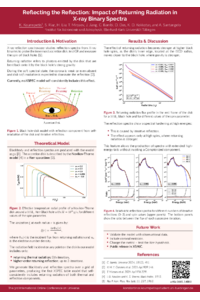
X-ray reflection spectroscopy is a powerful tool for exploring the innermost regions of accreting black hole systems. The X-ray spectra of black hole X-ray binaries (XRBs) typically consist of three components: thermal emission from the accretion disk, Comptonized emission from a hot corona, and a reflection component resulting from the illumination of the disk by the corona. Modeling the reflection features provides key information about the black hole’s spin and disk's parameters.
A phenomenon known as returning radiation (i.e., disk emission that is bent back onto itself by the black hole’s strong gravity) can significantly affect the reflection spectra, particularly for sources in the high-soft state. However, current XSPEC reflection models do not fully account for this effect.
We present a new reflection model that self-consistently includes returning radiation. To isolate its effects, we adopt a standard disk–corona configuration but disable the corona, allowing the reflection spectrum to arise solely from returning radiation, including higher-order reflections. Compared to widely used models such as relxillNS, our model naturally produces a harder high-energy reflection spectrum without requiring a Comptonized component. Our results demonstrate that returning radiation alone can account for the observed reflection features of XRBs in the soft state
and should therefore be considered an important component. Including returning radiation in spectra modeling also enables us to explore its impact on black hole spin measurements and test General Relativity in the strong-field regime.
Keywords
X-ray binaries
Black hole physics
Accretion
Returning Radiation
Poster
Poster_universe.pdf
Feature-Rich Representations of GRB Light Curves for Microlensing Classification
Jet–environment interaction after delayed collapse in binary neutron star mergers