Event submissions
Published
This submission belongs to the session S2. Environmental Impact and Risk Assessment of the event The 1st International Online Conference on Environments
Published date
27 Feb, 2026
Academic Editor
'%3e%3cpath%20d='M12.6657%2010.9104C12.4185%2010.325%2012.0599%209.79327%2011.6097%209.34482C11.1609%208.89508%2010.6293%208.5365%2010.0442%208.28888C10.0389%208.28626%2010.0337%208.28495%2010.0285%208.28233C10.8446%207.69279%2011.3752%206.73249%2011.3752%205.64904C11.3752%203.8542%209.92103%202.39999%208.1262%202.39999C6.33136%202.39999%204.87715%203.8542%204.87715%205.64904C4.87715%206.73249%205.40774%207.69279%206.22393%208.28364C6.21869%208.28626%206.21345%208.28757%206.20821%208.29019C5.62129%208.5378%205.09463%208.89284%204.64265%209.34613C4.1929%209.79493%203.83432%2010.3266%203.58671%2010.9117C3.34345%2011.4845%203.21226%2012.0987%203.20023%2012.7209C3.19988%2012.7349%203.20233%2012.7488%203.20744%2012.7619C3.21255%2012.7749%203.22022%2012.7867%203.22998%2012.7968C3.23975%2012.8068%203.25142%2012.8147%203.26431%2012.8202C3.2772%2012.8256%203.29105%2012.8284%203.30504%2012.8284H4.09109C4.14874%2012.8284%204.19459%2012.7825%204.1959%2012.7262C4.2221%2011.7148%204.62823%2010.7676%205.34617%2010.0497C6.08899%209.30683%207.0755%208.89808%208.1262%208.89808C9.17689%208.89808%2010.1634%209.30683%2010.9062%2010.0497C11.6242%2010.7676%2012.0303%2011.7148%2012.0565%2012.7262C12.0578%2012.7838%2012.1037%2012.8284%2012.1613%2012.8284H12.9474C12.9613%2012.8284%2012.9752%2012.8256%2012.9881%2012.8202C13.001%2012.8147%2013.0126%2012.8068%2013.0224%2012.7968C13.0322%2012.7867%2013.0398%2012.7749%2013.0449%2012.7619C13.0501%2012.7488%2013.0525%2012.7349%2013.0522%2012.7209C13.0391%2012.0947%2012.9094%2011.4855%2012.6657%2010.9104ZM8.1262%207.9024C7.52486%207.9024%206.9589%207.6679%206.53312%207.24211C6.10733%206.81633%205.87283%206.25037%205.87283%205.64904C5.87283%205.0477%206.10733%204.48174%206.53312%204.05596C6.9589%203.63018%207.52486%203.39567%208.1262%203.39567C8.72753%203.39567%209.29349%203.63018%209.71927%204.05596C10.1451%204.48174%2010.3796%205.0477%2010.3796%205.64904C10.3796%206.25037%2010.1451%206.81633%209.71927%207.24211C9.29349%207.6679%208.72753%207.9024%208.1262%207.9024Z'%20fill='%235D1EE1'/%3e%3c/g%3e%3c/svg%3e) Gianniantonio Petruzzelli
Gianniantonio PetruzzelliCitation
Nadeem Ali, Ahmed Saleh Summan, Muhammad Salman Zeb, Mansour A. Alghamdi, Environmental Impact and Risk Assessment of Phthalate Contamination in Indoor Dust and PM₁₀ from Car Repair Workshops, in Proceedings of The 1st International Online Conference on Environments, 2 March–4 March 2026, MDPI: Basel, Switzerland
Share
Email
Facebook
Twitter
LinkedIn
Environmental Impact and Risk Assessment of Phthalate Contamination in Indoor Dust and PM₁₀ from Car Repair Workshops
'%3e%3cpath%20d='M12.6647%2010.9104C12.4176%2010.325%2012.0589%209.7933%2011.6088%209.34485C11.16%208.89511%2010.6283%208.53653%2010.0432%208.28891C10.038%208.28629%2010.0327%208.28498%2010.0275%208.28236C10.8437%207.69282%2011.3743%206.73252%2011.3743%205.64907C11.3743%203.85423%209.92005%202.40002%208.12522%202.40002C6.33038%202.40002%204.87618%203.85423%204.87618%205.64907C4.87618%206.73252%205.40677%207.69282%206.22296%208.28367C6.21772%208.28629%206.21248%208.2876%206.20724%208.29022C5.62031%208.53783%205.09365%208.89287%204.64167%209.34616C4.19192%209.79496%203.83334%2010.3266%203.58573%2010.9117C3.34247%2011.4846%203.21128%2012.0987%203.19925%2012.721C3.1989%2012.735%203.20135%2012.7489%203.20646%2012.7619C3.21157%2012.7749%203.21924%2012.7868%203.22901%2012.7968C3.23877%2012.8068%203.25045%2012.8148%203.26334%2012.8202C3.27623%2012.8256%203.29007%2012.8284%203.30406%2012.8284H4.09012C4.14776%2012.8284%204.19362%2012.7825%204.19493%2012.7262C4.22113%2011.7148%204.62726%2010.7676%205.34519%2010.0497C6.08802%209.30686%207.07452%208.89811%208.12522%208.89811C9.17592%208.89811%2010.1624%209.30686%2010.9052%2010.0497C11.6232%2010.7676%2012.0293%2011.7148%2012.0555%2012.7262C12.0568%2012.7839%2012.1027%2012.8284%2012.1603%2012.8284H12.9464C12.9604%2012.8284%2012.9742%2012.8256%2012.9871%2012.8202C13%2012.8148%2013.0117%2012.8068%2013.0214%2012.7968C13.0312%2012.7868%2013.0389%2012.7749%2013.044%2012.7619C13.0491%2012.7489%2013.0515%2012.735%2013.0512%2012.721C13.0381%2012.0947%2012.9084%2011.4856%2012.6647%2010.9104ZM8.12522%207.90243C7.52388%207.90243%206.95792%207.66793%206.53214%207.24215C6.10636%206.81636%205.87185%206.2504%205.87185%205.64907C5.87185%205.04773%206.10636%204.48177%206.53214%204.05599C6.95792%203.63021%207.52388%203.3957%208.12522%203.3957C8.72655%203.3957%209.29252%203.63021%209.7183%204.05599C10.1441%204.48177%2010.3786%205.04773%2010.3786%205.64907C10.3786%206.2504%2010.1441%206.81636%209.7183%207.24215C9.29252%207.66793%208.72655%207.90243%208.12522%207.90243Z'%20fill='%235D1EE1'/%3e%3c/g%3e%3c/svg%3e)
Nadeem Ali 1
Ahmed Saleh Summan 2

Muhammad Salman Zeb 3
Mansour A. Alghamdi 3
1. Center of Excellence in Environmental Studies, King Abdulaziz University, Jeddah, Saudia Arabia
2. Department of Environment, Faculty of Environmental Sciences, King Abdulaziz University, Jeddah, Saudi Arabia
3. Department of Environmental Sciences, King Abdulaziz University, Jeddah, Saudi Arabia
Abstract
Phthalates are widely used plasticizers that readily migrate from indoor materials into dust and airborne particles, potentially posing health risks for workers in small enterprises such as car repair shops. This study assessed the concentrations of 13 phthalate esters in indoor dust and PM₁₀ from car repair workshops in Jeddah, Saudi Arabia, and estimated occupational exposure for adult workers. Floor dust samples were collected from multiple car repair workshops using a standard vacuum-based sampling method. Indoor PM₁₀ wassimultaneously sampled on quartz fiber filters using a Micro-Environmental Monitor 400, and all samples were analyzed by gas chromatography–mass spectrometry (GC–MS). All target phthalates were frequently detected in both matrices, with substantially higher levels in dust than in PM₁₀. In dust, di(2-ethylhexyl) phthalate (DEHP) was the predominant compound, with mean and maximum concentrations of 4.1×10⁵ and 8.0×10⁵ ng/g, respectively, followed by benzyl butyl phthalate (BzBP) and diethyl phthalate (DEP). In PM₁₀, DEHP also dominated (mean 2.8×10³ ng/g), with notable contributions from Di-isobutyl phthalate (DiBP), DEP, and dimethyl phthalate (DMP). Combined exposure through dust ingestion and inhalation was primarily driven by DEHP (median 538 ng/kg bw/day; 90th percentile 1055 ng/kg bw/day), while other phthalates, including BzBP, DEP, DiBP, DMP, and di-n-octyl phthalate (DnOP), contributed appreciably to the cumulative phthalate burden. The exceptionally high DEHP levels in dust, coupled with measurable airborne concentrations, indicate an intense use or continuous presence of DEHP-containing materials, lubricants, and plastic components in car repair environments. The estimated occupational exposures approach, and in some cases exceed, those reported for other high-contact indoor micro-environments, highlighting car repair shops as an overlooked yet significant source of phthalate exposure for adults. These findings highlight the need for better material selection, improved ventilation, personal protective equipment, and stronger hygiene practices to reduce phthalate exposure among auto-repair workers in similar settings.
Keywords
Phthalates
Indoor dust
PM₁₀
Car repair workshops
Occupational exposure
DEHP
Saudi Arabia.
Poster
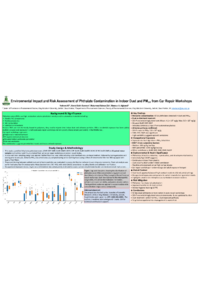
Poster- Phthalates in car repair shops.pdf
Advancing Environmental Policy Studies With Pluralist Epistemology
Adsorptive Removal of Synthetic Textile Dyes Using Raw Almond Shells: A Sustainable Approach to Wastewater Treatment