Event submissions
Published
This submission belongs to the session S1. Environmental Assessment Methods and Management Technologies of the event The 1st International Online Conference on Environments
Published date
27 Feb, 2026
Academic Editor
'%3e%3cpath%20d='M12.6657%2010.9104C12.4185%2010.325%2012.0599%209.79327%2011.6097%209.34482C11.1609%208.89508%2010.6293%208.5365%2010.0442%208.28888C10.0389%208.28626%2010.0337%208.28495%2010.0285%208.28233C10.8446%207.69279%2011.3752%206.73249%2011.3752%205.64904C11.3752%203.8542%209.92103%202.39999%208.1262%202.39999C6.33136%202.39999%204.87715%203.8542%204.87715%205.64904C4.87715%206.73249%205.40774%207.69279%206.22393%208.28364C6.21869%208.28626%206.21345%208.28757%206.20821%208.29019C5.62129%208.5378%205.09463%208.89284%204.64265%209.34613C4.1929%209.79493%203.83432%2010.3266%203.58671%2010.9117C3.34345%2011.4845%203.21226%2012.0987%203.20023%2012.7209C3.19988%2012.7349%203.20233%2012.7488%203.20744%2012.7619C3.21255%2012.7749%203.22022%2012.7867%203.22998%2012.7968C3.23975%2012.8068%203.25142%2012.8147%203.26431%2012.8202C3.2772%2012.8256%203.29105%2012.8284%203.30504%2012.8284H4.09109C4.14874%2012.8284%204.19459%2012.7825%204.1959%2012.7262C4.2221%2011.7148%204.62823%2010.7676%205.34617%2010.0497C6.08899%209.30683%207.0755%208.89808%208.1262%208.89808C9.17689%208.89808%2010.1634%209.30683%2010.9062%2010.0497C11.6242%2010.7676%2012.0303%2011.7148%2012.0565%2012.7262C12.0578%2012.7838%2012.1037%2012.8284%2012.1613%2012.8284H12.9474C12.9613%2012.8284%2012.9752%2012.8256%2012.9881%2012.8202C13.001%2012.8147%2013.0126%2012.8068%2013.0224%2012.7968C13.0322%2012.7867%2013.0398%2012.7749%2013.0449%2012.7619C13.0501%2012.7488%2013.0525%2012.7349%2013.0522%2012.7209C13.0391%2012.0947%2012.9094%2011.4855%2012.6657%2010.9104ZM8.1262%207.9024C7.52486%207.9024%206.9589%207.6679%206.53312%207.24211C6.10733%206.81633%205.87283%206.25037%205.87283%205.64904C5.87283%205.0477%206.10733%204.48174%206.53312%204.05596C6.9589%203.63018%207.52486%203.39567%208.1262%203.39567C8.72753%203.39567%209.29349%203.63018%209.71927%204.05596C10.1451%204.48174%2010.3796%205.0477%2010.3796%205.64904C10.3796%206.25037%2010.1451%206.81633%209.71927%207.24211C9.29349%207.6679%208.72753%207.9024%208.1262%207.9024Z'%20fill='%235D1EE1'/%3e%3c/g%3e%3c/svg%3e) Milena Horvat
Milena HorvatCitation
Hadj Boumedien Rahmoun, Maamar Boumediene, Eduardo Ferreira Da Silva, Adsorptive Removal of Synthetic Textile Dyes Using Raw Almond Shells: A Sustainable Approach to Wastewater Treatment, in Proceedings of The 1st International Online Conference on Environments, 2 March–4 March 2026, MDPI: Basel, Switzerland
Share
Email
Facebook
Twitter
LinkedIn
Adsorptive Removal of Synthetic Textile Dyes Using Raw Almond Shells: A Sustainable Approach to Wastewater Treatment
'%3e%3cpath%20d='M12.6647%2010.9104C12.4176%2010.325%2012.0589%209.7933%2011.6088%209.34485C11.16%208.89511%2010.6283%208.53653%2010.0432%208.28891C10.038%208.28629%2010.0327%208.28498%2010.0275%208.28236C10.8437%207.69282%2011.3743%206.73252%2011.3743%205.64907C11.3743%203.85423%209.92005%202.40002%208.12522%202.40002C6.33038%202.40002%204.87618%203.85423%204.87618%205.64907C4.87618%206.73252%205.40677%207.69282%206.22296%208.28367C6.21772%208.28629%206.21248%208.2876%206.20724%208.29022C5.62031%208.53783%205.09365%208.89287%204.64167%209.34616C4.19192%209.79496%203.83334%2010.3266%203.58573%2010.9117C3.34247%2011.4846%203.21128%2012.0987%203.19925%2012.721C3.1989%2012.735%203.20135%2012.7489%203.20646%2012.7619C3.21157%2012.7749%203.21924%2012.7868%203.22901%2012.7968C3.23877%2012.8068%203.25045%2012.8148%203.26334%2012.8202C3.27623%2012.8256%203.29007%2012.8284%203.30406%2012.8284H4.09012C4.14776%2012.8284%204.19362%2012.7825%204.19493%2012.7262C4.22113%2011.7148%204.62726%2010.7676%205.34519%2010.0497C6.08802%209.30686%207.07452%208.89811%208.12522%208.89811C9.17592%208.89811%2010.1624%209.30686%2010.9052%2010.0497C11.6232%2010.7676%2012.0293%2011.7148%2012.0555%2012.7262C12.0568%2012.7839%2012.1027%2012.8284%2012.1603%2012.8284H12.9464C12.9604%2012.8284%2012.9742%2012.8256%2012.9871%2012.8202C13%2012.8148%2013.0117%2012.8068%2013.0214%2012.7968C13.0312%2012.7868%2013.0389%2012.7749%2013.044%2012.7619C13.0491%2012.7489%2013.0515%2012.735%2013.0512%2012.721C13.0381%2012.0947%2012.9084%2011.4856%2012.6647%2010.9104ZM8.12522%207.90243C7.52388%207.90243%206.95792%207.66793%206.53214%207.24215C6.10636%206.81636%205.87185%206.2504%205.87185%205.64907C5.87185%205.04773%206.10636%204.48177%206.53214%204.05599C6.95792%203.63021%207.52388%203.3957%208.12522%203.3957C8.72655%203.3957%209.29252%203.63021%209.7183%204.05599C10.1441%204.48177%2010.3786%205.04773%2010.3786%205.64907C10.3786%206.2504%2010.1441%206.81636%209.7183%207.24215C9.29252%207.66793%208.72655%207.90243%208.12522%207.90243Z'%20fill='%235D1EE1'/%3e%3c/g%3e%3c/svg%3e)
Hadj Boumedien Rahmoun 1
Maamar Boumediene 2

Eduardo Ferreira Da Silva 3
1. Water and Structures in Their Environment (EOLE) Laboratory, Department of Hydraulics, Faculty of Technology, University of Tlemcen, Tlemcen 13000, Algeria
2. Promotion of Water, Mineral and Soil Resources: Environmental Legislation and Technological Choices Laboratory, Department of Hydraulics, Faculty of Technology, University of Tlemcen, Tlemcen 13000, Algeria
3. GeoBioTec Research Unit, Department of Geosciences, Campus de Santiago, University of Aveiro, 3810-193 Aveiro, Portugal
Abstract
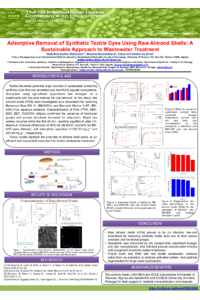
The adsorption capacity of raw almond shells (RASs) was evaluated for the removal of two synthetic textile dyes, Bemacron Blue RS 01 (BB-RS01) and Bemacid Marine N-5R (BM-N5R), from aqueous solutions. Prior to adsorption tests, RAS was characterized using Fourier-transform infrared spectroscopy (FTIR), scanning electron microscopy (SEM-EDX), Brunauer–Emmett–Teller (BET) surface analysis, thermogravimetric/differential thermal analysis (TGA/DTA), and point of zero charge (pHpzc) determination to assess its physicochemical properties relevant to adsorption. Batch adsorption experiments were then conducted under varying operational parameters, including contact time, dye concentration, biosorbent dosage, particle size, pH, and temperature. Rapid dye uptake occurred within the first 30 minutes, reaching equilibrium after two hours. Maximum dye removal efficiencies of 90% for BB-RS01 and 80% for BM-N5R were achieved at acidic pH (2–4) and low initial concentrations (15 mg.L-1). Increasing biosorbent dosage and decreasing particle size enhanced adsorption efficiency. The adsorption process exhibited endothermic behavior, with optimal performance at 35 °C.
Kinetic data were best fit by a pseudo-second-order model, suggesting chemisorption as the controlling mechanism. Equilibrium data followed the Langmuir model for BB-RS01 (R2 = 0.995) and the Freundlich model for BM-N5R (R2 = 0.850), indicating monolayer and heterogeneous multilayer adsorption, respectively. The maximum adsorption capacities were 208.33 mg.g-1 for BB-RS01 and 243.90 mg.g-1 for BM-N5R. Regeneration studies showed stable adsorption performance for up to four reuse cycles.
These findings confirm that RAS is a promising, sustainable, and low-cost biosorbent for the treatment of dye-contaminated wastewater, supporting circular economy and green chemistry principles.
Keywords
almond shells
adsorption
biosorbent
characterization
textile dyes
wastewater treatment
circular economy
green chemistry.
Poster
Présentation Rahmoun_Hadj_Boumedien.pdf
Environmental Impact and Risk Assessment of Phthalate Contamination in Indoor Dust and PM₁₀ from Car Repair Workshops
Hydrogeochemical Characterization and Gold Mining Impacts on Groundwater Quality in the Ayanfuri Mining Enclave, Ghana: Implications for Sustainable Environmental Management