Event submissions
Published
This submission belongs to the session S1. Environmental Assessment Methods and Management Technologies of the event The 1st International Online Conference on Environments
Published date
27 Feb, 2026
Academic Editor
'%3e%3cpath%20d='M12.6657%2010.9104C12.4185%2010.325%2012.0599%209.79327%2011.6097%209.34482C11.1609%208.89508%2010.6293%208.5365%2010.0442%208.28888C10.0389%208.28626%2010.0337%208.28495%2010.0285%208.28233C10.8446%207.69279%2011.3752%206.73249%2011.3752%205.64904C11.3752%203.8542%209.92103%202.39999%208.1262%202.39999C6.33136%202.39999%204.87715%203.8542%204.87715%205.64904C4.87715%206.73249%205.40774%207.69279%206.22393%208.28364C6.21869%208.28626%206.21345%208.28757%206.20821%208.29019C5.62129%208.5378%205.09463%208.89284%204.64265%209.34613C4.1929%209.79493%203.83432%2010.3266%203.58671%2010.9117C3.34345%2011.4845%203.21226%2012.0987%203.20023%2012.7209C3.19988%2012.7349%203.20233%2012.7488%203.20744%2012.7619C3.21255%2012.7749%203.22022%2012.7867%203.22998%2012.7968C3.23975%2012.8068%203.25142%2012.8147%203.26431%2012.8202C3.2772%2012.8256%203.29105%2012.8284%203.30504%2012.8284H4.09109C4.14874%2012.8284%204.19459%2012.7825%204.1959%2012.7262C4.2221%2011.7148%204.62823%2010.7676%205.34617%2010.0497C6.08899%209.30683%207.0755%208.89808%208.1262%208.89808C9.17689%208.89808%2010.1634%209.30683%2010.9062%2010.0497C11.6242%2010.7676%2012.0303%2011.7148%2012.0565%2012.7262C12.0578%2012.7838%2012.1037%2012.8284%2012.1613%2012.8284H12.9474C12.9613%2012.8284%2012.9752%2012.8256%2012.9881%2012.8202C13.001%2012.8147%2013.0126%2012.8068%2013.0224%2012.7968C13.0322%2012.7867%2013.0398%2012.7749%2013.0449%2012.7619C13.0501%2012.7488%2013.0525%2012.7349%2013.0522%2012.7209C13.0391%2012.0947%2012.9094%2011.4855%2012.6657%2010.9104ZM8.1262%207.9024C7.52486%207.9024%206.9589%207.6679%206.53312%207.24211C6.10733%206.81633%205.87283%206.25037%205.87283%205.64904C5.87283%205.0477%206.10733%204.48174%206.53312%204.05596C6.9589%203.63018%207.52486%203.39567%208.1262%203.39567C8.72753%203.39567%209.29349%203.63018%209.71927%204.05596C10.1451%204.48174%2010.3796%205.0477%2010.3796%205.64904C10.3796%206.25037%2010.1451%206.81633%209.71927%207.24211C9.29349%207.6679%208.72753%207.9024%208.1262%207.9024Z'%20fill='%235D1EE1'/%3e%3c/g%3e%3c/svg%3e) Milena Horvat
Milena HorvatCitation
Dorcas Adeola Adejunmobi, Sabrina Sorlini, Alessandro Abba, Angela Daniela La Rosa, Life Cycle Assessment (LCA) of a Metal Scrap Shredder Facility, in Proceedings of The 1st International Online Conference on Environments, 2 March–4 March 2026, MDPI: Basel, Switzerland
Share
Email
Facebook
Twitter
LinkedIn
Life Cycle Assessment (LCA) of a Metal Scrap Shredder Facility
'%3e%3cpath%20d='M12.6647%2010.9104C12.4176%2010.325%2012.0589%209.7933%2011.6088%209.34485C11.16%208.89511%2010.6283%208.53653%2010.0432%208.28891C10.038%208.28629%2010.0327%208.28498%2010.0275%208.28236C10.8437%207.69282%2011.3743%206.73252%2011.3743%205.64907C11.3743%203.85423%209.92005%202.40002%208.12522%202.40002C6.33038%202.40002%204.87618%203.85423%204.87618%205.64907C4.87618%206.73252%205.40677%207.69282%206.22296%208.28367C6.21772%208.28629%206.21248%208.2876%206.20724%208.29022C5.62031%208.53783%205.09365%208.89287%204.64167%209.34616C4.19192%209.79496%203.83334%2010.3266%203.58573%2010.9117C3.34247%2011.4846%203.21128%2012.0987%203.19925%2012.721C3.1989%2012.735%203.20135%2012.7489%203.20646%2012.7619C3.21157%2012.7749%203.21924%2012.7868%203.22901%2012.7968C3.23877%2012.8068%203.25045%2012.8148%203.26334%2012.8202C3.27623%2012.8256%203.29007%2012.8284%203.30406%2012.8284H4.09012C4.14776%2012.8284%204.19362%2012.7825%204.19493%2012.7262C4.22113%2011.7148%204.62726%2010.7676%205.34519%2010.0497C6.08802%209.30686%207.07452%208.89811%208.12522%208.89811C9.17592%208.89811%2010.1624%209.30686%2010.9052%2010.0497C11.6232%2010.7676%2012.0293%2011.7148%2012.0555%2012.7262C12.0568%2012.7839%2012.1027%2012.8284%2012.1603%2012.8284H12.9464C12.9604%2012.8284%2012.9742%2012.8256%2012.9871%2012.8202C13%2012.8148%2013.0117%2012.8068%2013.0214%2012.7968C13.0312%2012.7868%2013.0389%2012.7749%2013.044%2012.7619C13.0491%2012.7489%2013.0515%2012.735%2013.0512%2012.721C13.0381%2012.0947%2012.9084%2011.4856%2012.6647%2010.9104ZM8.12522%207.90243C7.52388%207.90243%206.95792%207.66793%206.53214%207.24215C6.10636%206.81636%205.87185%206.2504%205.87185%205.64907C5.87185%205.04773%206.10636%204.48177%206.53214%204.05599C6.95792%203.63021%207.52388%203.3957%208.12522%203.3957C8.72655%203.3957%209.29252%203.63021%209.7183%204.05599C10.1441%204.48177%2010.3786%205.04773%2010.3786%205.64907C10.3786%206.2504%2010.1441%206.81636%209.7183%207.24215C9.29252%207.66793%208.72655%207.90243%208.12522%207.90243Z'%20fill='%235D1EE1'/%3e%3c/g%3e%3c/svg%3e)
Dorcas Adeola Adejunmobi 1
Sabrina Sorlini 1

Alessandro Abba 1

Angela Daniela La Rosa 2
1. Department of Civil, Environmental, Architectural Engineering and Mathematics (DICATAM), University of Brescia, Brescia, 25123, Italy
2. Department of Manufacturing and Civil Engineering, Norwegian University of Science and Technology (NTNU), Gjovik 2815, Norway
Abstract
Introduction
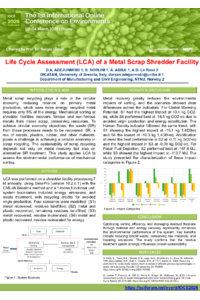
Metal scrap recycling plays a role in the circular economy, reducing reliance on primary metal production, which uses more energy; recycled metal requires only 5% of the energy. Mechanical sorting at shredder facilities recovers ferrous and non-ferrous metals from mixed scrap, conserving resources. To achieve circular economy objectives, the waste (SR) from these processes needs to be recovered. SR, a mix of metals, plastics, rubber, and other materials, poses a challenge in achieving a circular economy in scrap recycling. The sustainability of scrap recycling depends not only on metal recovery but also on alternative SR treatment. This study applies LCA to assess the environmental performance of mechanical sorting.
Method
LCA was performed on a shredder facility processing 7 kt annually. Using SimaPro with the CML-IA Baseline method and a 1-tonne functional unit, system boundaries included energy, emissions, and waste treatment, with recycling credits for avoided virgin production. Four scenarios were modelled: (S1) metal recovered, residues landfilled; (S2) metal and plastic recovered, remaining residues landfilled; (S3) metal recovered, residue incinerated; (S4) metal and plastic recovered, residue incinerated for energy.
Result
Metal recovery greatly reduces the environmental impacts of sorting, and the scenarios showed clear differences across the indicators. For Global Warming Potential, S1 had the highest impact at 8.77 kg CO2-eq, while S4 performed best at -17.34 kg CO2-eq due to avoided virgin production and energy substitution. The Human Toxicity indicator followed the same trend, with S1 showing the highest impact at -29.25 kg 1,4DBeq and S4 the lowest at -91.78 kg 1,4DB-eq. Acidification showed the best performance in S2 at -0.19 kg SO2-eq and the highest impact in S3 at -18.14 kg SO2-eq. For Fossil Fuel Depletion, S2 performed best at -147.28 MJ, while S3 showed the highest impact at -114.01 MJ.
Conclusions
The results demonstrate that combining material recovery with appropriate residue treatment significantly enhances environmental benefits compared to landfill-only.
Keywords
LCA
Metal Recovery
Shredder Residue (SR)
Landfill
Incineration
Poster
Dorcas-Poster.pdf
Hydrogeochemical Characterization and Gold Mining Impacts on Groundwater Quality in the Ayanfuri Mining Enclave, Ghana: Implications for Sustainable Environmental Management
Solar-Activated Chlorine Process for Efficient Degradation of Brominated Aromatic Pollutants