Event submissions
Published
This submission belongs to the session S1. Environmental Assessment Methods and Management Technologies of the event The 1st International Online Conference on Environments
Published date
27 Feb, 2026
Academic Editor
'%3e%3cpath%20d='M12.6657%2010.9104C12.4185%2010.325%2012.0599%209.79327%2011.6097%209.34482C11.1609%208.89508%2010.6293%208.5365%2010.0442%208.28888C10.0389%208.28626%2010.0337%208.28495%2010.0285%208.28233C10.8446%207.69279%2011.3752%206.73249%2011.3752%205.64904C11.3752%203.8542%209.92103%202.39999%208.1262%202.39999C6.33136%202.39999%204.87715%203.8542%204.87715%205.64904C4.87715%206.73249%205.40774%207.69279%206.22393%208.28364C6.21869%208.28626%206.21345%208.28757%206.20821%208.29019C5.62129%208.5378%205.09463%208.89284%204.64265%209.34613C4.1929%209.79493%203.83432%2010.3266%203.58671%2010.9117C3.34345%2011.4845%203.21226%2012.0987%203.20023%2012.7209C3.19988%2012.7349%203.20233%2012.7488%203.20744%2012.7619C3.21255%2012.7749%203.22022%2012.7867%203.22998%2012.7968C3.23975%2012.8068%203.25142%2012.8147%203.26431%2012.8202C3.2772%2012.8256%203.29105%2012.8284%203.30504%2012.8284H4.09109C4.14874%2012.8284%204.19459%2012.7825%204.1959%2012.7262C4.2221%2011.7148%204.62823%2010.7676%205.34617%2010.0497C6.08899%209.30683%207.0755%208.89808%208.1262%208.89808C9.17689%208.89808%2010.1634%209.30683%2010.9062%2010.0497C11.6242%2010.7676%2012.0303%2011.7148%2012.0565%2012.7262C12.0578%2012.7838%2012.1037%2012.8284%2012.1613%2012.8284H12.9474C12.9613%2012.8284%2012.9752%2012.8256%2012.9881%2012.8202C13.001%2012.8147%2013.0126%2012.8068%2013.0224%2012.7968C13.0322%2012.7867%2013.0398%2012.7749%2013.0449%2012.7619C13.0501%2012.7488%2013.0525%2012.7349%2013.0522%2012.7209C13.0391%2012.0947%2012.9094%2011.4855%2012.6657%2010.9104ZM8.1262%207.9024C7.52486%207.9024%206.9589%207.6679%206.53312%207.24211C6.10733%206.81633%205.87283%206.25037%205.87283%205.64904C5.87283%205.0477%206.10733%204.48174%206.53312%204.05596C6.9589%203.63018%207.52486%203.39567%208.1262%203.39567C8.72753%203.39567%209.29349%203.63018%209.71927%204.05596C10.1451%204.48174%2010.3796%205.0477%2010.3796%205.64904C10.3796%206.25037%2010.1451%206.81633%209.71927%207.24211C9.29349%207.6679%208.72753%207.9024%208.1262%207.9024Z'%20fill='%235D1EE1'/%3e%3c/g%3e%3c/svg%3e) WALTER ALBERTO PENGUE
WALTER ALBERTO PENGUECitation
Lidia Nuño, Virginia Perez, Raúl Muñoz, Recovery of ammonium crystals and water by condensation of the gases emitted during the solar drying of wastewater sludge, in Proceedings of The 1st International Online Conference on Environments, 2 March–4 March 2026, MDPI: Basel, Switzerland
Share
Email
Facebook
Twitter
LinkedIn
Recovery of ammonium crystals and water by condensation of the gases emitted during the solar drying of wastewater sludge
'%3e%3cpath%20d='M12.6647%2010.9104C12.4176%2010.325%2012.0589%209.7933%2011.6088%209.34485C11.16%208.89511%2010.6283%208.53653%2010.0432%208.28891C10.038%208.28629%2010.0327%208.28498%2010.0275%208.28236C10.8437%207.69282%2011.3743%206.73252%2011.3743%205.64907C11.3743%203.85423%209.92005%202.40002%208.12522%202.40002C6.33038%202.40002%204.87618%203.85423%204.87618%205.64907C4.87618%206.73252%205.40677%207.69282%206.22296%208.28367C6.21772%208.28629%206.21248%208.2876%206.20724%208.29022C5.62031%208.53783%205.09365%208.89287%204.64167%209.34616C4.19192%209.79496%203.83334%2010.3266%203.58573%2010.9117C3.34247%2011.4846%203.21128%2012.0987%203.19925%2012.721C3.1989%2012.735%203.20135%2012.7489%203.20646%2012.7619C3.21157%2012.7749%203.21924%2012.7868%203.22901%2012.7968C3.23877%2012.8068%203.25045%2012.8148%203.26334%2012.8202C3.27623%2012.8256%203.29007%2012.8284%203.30406%2012.8284H4.09012C4.14776%2012.8284%204.19362%2012.7825%204.19493%2012.7262C4.22113%2011.7148%204.62726%2010.7676%205.34519%2010.0497C6.08802%209.30686%207.07452%208.89811%208.12522%208.89811C9.17592%208.89811%2010.1624%209.30686%2010.9052%2010.0497C11.6232%2010.7676%2012.0293%2011.7148%2012.0555%2012.7262C12.0568%2012.7839%2012.1027%2012.8284%2012.1603%2012.8284H12.9464C12.9604%2012.8284%2012.9742%2012.8256%2012.9871%2012.8202C13%2012.8148%2013.0117%2012.8068%2013.0214%2012.7968C13.0312%2012.7868%2013.0389%2012.7749%2013.044%2012.7619C13.0491%2012.7489%2013.0515%2012.735%2013.0512%2012.721C13.0381%2012.0947%2012.9084%2011.4856%2012.6647%2010.9104ZM8.12522%207.90243C7.52388%207.90243%206.95792%207.66793%206.53214%207.24215C6.10636%206.81636%205.87185%206.2504%205.87185%205.64907C5.87185%205.04773%206.10636%204.48177%206.53214%204.05599C6.95792%203.63021%207.52388%203.3957%208.12522%203.3957C8.72655%203.3957%209.29252%203.63021%209.7183%204.05599C10.1441%204.48177%2010.3786%205.04773%2010.3786%205.64907C10.3786%206.2504%2010.1441%206.81636%209.7183%207.24215C9.29252%207.66793%208.72655%207.90243%208.12522%207.90243Z'%20fill='%235D1EE1'/%3e%3c/g%3e%3c/svg%3e)
Lidia Nuño 1,2
Virginia Perez 3
Raúl Muñoz 2,4
1. Biomass unit, Ceder-Ciemat, E-42290 Lubia, Soria, Spain
2. Department of Chemical Engineering and Environmental Technology, University of Valladolid, Dr. Mergelina s/n., Valladolid, 47011, Spain.
3. Thermal Conversion Process unit, Ceder-Ciemat, E-42290 Lubia, Soria, Spain
4. Institute of Sustainable Processes, University of Valladolid, Dr. Mergelina s/n., Valladolid, 47011, Spain.
Abstract
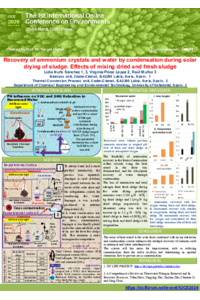
Ammonia recovery reduces contamination and provides a source of Nitrogen. Ammonia volatilization during solar drying of WWTP sludge ranged from 22% to 74%. A gas-permeable membrane has a short half-life, making it difficult to reuse. Here, we demonstrate the feasibility of ammonium recovery as ammonium sulfate crystals using the heat stored in the dryer, followed by water recovery through condensation. A laboratory-scale solar dryer was designed to use artificial solar light. In one set of experiments, water samples were recovered at their original pH throughout the condensation process. In another setup, an impinger containing sulfuric acid (impinger A) was placed inside the artificial solar dryer. Passing the gas produced during the drying of the sludge to impinger A and then to the condensation setup (a thermostatic bath to condense water vapor). The experiment was replicated, varying the oxygen rate, air recirculation, and artificial alkalization of sludge. Recovered water, ammonia crystals, and acidic residues were analysed for Total Nitrogen (ammonia and inorganic nitrogen), Total Carbon (organic and inorganic carbon), and short-chain carboxylic acids. The loss of ammonium and total nitrogen from fresh sludge during the solar drying prototype measurements was 2.103 g N - NH4/kg dried sludge and 11.64 g N/kg dried sludge, respectively. Our laboratory setup recovered up to 3.3 g N - NH4 / kg dried sludge in the form of (NH4)2SO4 by mixing fresh and dried sludge, and 5.5 g N - NH4 / kg dried sludge after sludge alkalization with ash sludge. The reuse of heat stored in the solar dryer, combined with an air-extraction and condensation system, enhances simultaneous recovery of elements such as ammonia and water. The system still has areas for improvement, such as reducing contamination from the acidic residues and determining an optimal extraction flow to prevent cross-contamination.
Keywords
Circular Economics/ Ammonia recovery/ water recovery/ Wastewater/ sludge/ solar dryer.
Poster
sciforum-158027.pdf
Phytoplankton Community Shifts in a Mediterranean Lagoon Under Combined Shellfish Farming and Climate Pressure
Investigating the Effects of Psychoactive Emerging Contaminants in Early Frog Life Stages