Event submissions
Published
This submission belongs to the session S2. Environmental Impact and Risk Assessment of the event The 1st International Online Conference on Environments
Published date
27 Feb, 2026
Academic Editor
'%3e%3cpath%20d='M12.6657%2010.9104C12.4185%2010.325%2012.0599%209.79327%2011.6097%209.34482C11.1609%208.89508%2010.6293%208.5365%2010.0442%208.28888C10.0389%208.28626%2010.0337%208.28495%2010.0285%208.28233C10.8446%207.69279%2011.3752%206.73249%2011.3752%205.64904C11.3752%203.8542%209.92103%202.39999%208.1262%202.39999C6.33136%202.39999%204.87715%203.8542%204.87715%205.64904C4.87715%206.73249%205.40774%207.69279%206.22393%208.28364C6.21869%208.28626%206.21345%208.28757%206.20821%208.29019C5.62129%208.5378%205.09463%208.89284%204.64265%209.34613C4.1929%209.79493%203.83432%2010.3266%203.58671%2010.9117C3.34345%2011.4845%203.21226%2012.0987%203.20023%2012.7209C3.19988%2012.7349%203.20233%2012.7488%203.20744%2012.7619C3.21255%2012.7749%203.22022%2012.7867%203.22998%2012.7968C3.23975%2012.8068%203.25142%2012.8147%203.26431%2012.8202C3.2772%2012.8256%203.29105%2012.8284%203.30504%2012.8284H4.09109C4.14874%2012.8284%204.19459%2012.7825%204.1959%2012.7262C4.2221%2011.7148%204.62823%2010.7676%205.34617%2010.0497C6.08899%209.30683%207.0755%208.89808%208.1262%208.89808C9.17689%208.89808%2010.1634%209.30683%2010.9062%2010.0497C11.6242%2010.7676%2012.0303%2011.7148%2012.0565%2012.7262C12.0578%2012.7838%2012.1037%2012.8284%2012.1613%2012.8284H12.9474C12.9613%2012.8284%2012.9752%2012.8256%2012.9881%2012.8202C13.001%2012.8147%2013.0126%2012.8068%2013.0224%2012.7968C13.0322%2012.7867%2013.0398%2012.7749%2013.0449%2012.7619C13.0501%2012.7488%2013.0525%2012.7349%2013.0522%2012.7209C13.0391%2012.0947%2012.9094%2011.4855%2012.6657%2010.9104ZM8.1262%207.9024C7.52486%207.9024%206.9589%207.6679%206.53312%207.24211C6.10733%206.81633%205.87283%206.25037%205.87283%205.64904C5.87283%205.0477%206.10733%204.48174%206.53312%204.05596C6.9589%203.63018%207.52486%203.39567%208.1262%203.39567C8.72753%203.39567%209.29349%203.63018%209.71927%204.05596C10.1451%204.48174%2010.3796%205.0477%2010.3796%205.64904C10.3796%206.25037%2010.1451%206.81633%209.71927%207.24211C9.29349%207.6679%208.72753%207.9024%208.1262%207.9024Z'%20fill='%235D1EE1'/%3e%3c/g%3e%3c/svg%3e) Gianniantonio Petruzzelli
Gianniantonio PetruzzelliCitation
Tatiana Pedron, Bruno Lemos Batista, Vera Slaveykova, Mercury Speciation and Functional Gene Markers in Amazonian River Biofilms, in Proceedings of The 1st International Online Conference on Environments, 2 March–4 March 2026, MDPI: Basel, Switzerland
Share
Email
Facebook
Twitter
LinkedIn
Mercury Speciation and Functional Gene Markers in Amazonian River Biofilms

Tatiana Pedron 1

Bruno Lemos Batista 1
'%3e%3cpath%20d='M12.6647%2010.9104C12.4176%2010.325%2012.0589%209.7933%2011.6088%209.34485C11.16%208.89511%2010.6283%208.53653%2010.0432%208.28891C10.038%208.28629%2010.0327%208.28498%2010.0275%208.28236C10.8437%207.69282%2011.3743%206.73252%2011.3743%205.64907C11.3743%203.85423%209.92005%202.40002%208.12522%202.40002C6.33038%202.40002%204.87618%203.85423%204.87618%205.64907C4.87618%206.73252%205.40677%207.69282%206.22296%208.28367C6.21772%208.28629%206.21248%208.2876%206.20724%208.29022C5.62031%208.53783%205.09365%208.89287%204.64167%209.34616C4.19192%209.79496%203.83334%2010.3266%203.58573%2010.9117C3.34247%2011.4846%203.21128%2012.0987%203.19925%2012.721C3.1989%2012.735%203.20135%2012.7489%203.20646%2012.7619C3.21157%2012.7749%203.21924%2012.7868%203.22901%2012.7968C3.23877%2012.8068%203.25045%2012.8148%203.26334%2012.8202C3.27623%2012.8256%203.29007%2012.8284%203.30406%2012.8284H4.09012C4.14776%2012.8284%204.19362%2012.7825%204.19493%2012.7262C4.22113%2011.7148%204.62726%2010.7676%205.34519%2010.0497C6.08802%209.30686%207.07452%208.89811%208.12522%208.89811C9.17592%208.89811%2010.1624%209.30686%2010.9052%2010.0497C11.6232%2010.7676%2012.0293%2011.7148%2012.0555%2012.7262C12.0568%2012.7839%2012.1027%2012.8284%2012.1603%2012.8284H12.9464C12.9604%2012.8284%2012.9742%2012.8256%2012.9871%2012.8202C13%2012.8148%2013.0117%2012.8068%2013.0214%2012.7968C13.0312%2012.7868%2013.0389%2012.7749%2013.044%2012.7619C13.0491%2012.7489%2013.0515%2012.735%2013.0512%2012.721C13.0381%2012.0947%2012.9084%2011.4856%2012.6647%2010.9104ZM8.12522%207.90243C7.52388%207.90243%206.95792%207.66793%206.53214%207.24215C6.10636%206.81636%205.87185%206.2504%205.87185%205.64907C5.87185%205.04773%206.10636%204.48177%206.53214%204.05599C6.95792%203.63021%207.52388%203.3957%208.12522%203.3957C8.72655%203.3957%209.29252%203.63021%209.7183%204.05599C10.1441%204.48177%2010.3786%205.04773%2010.3786%205.64907C10.3786%206.2504%2010.1441%206.81636%209.7183%207.24215C9.29252%207.66793%208.72655%207.90243%208.12522%207.90243Z'%20fill='%235D1EE1'/%3e%3c/g%3e%3c/svg%3e)
Vera Slaveykova 2
1. Center for Natural and Human Sciences, Federal University of ABC, Santo André 09210-580, SP, Brazil
2. Department F.A. Forel for Environmental and Aquatic Sciences and the Institute for Environmental Sciences, University of Geneva, 66 Boulevard Carl-Vogt, CH-1211 Geneva, Switzerland
Abstract
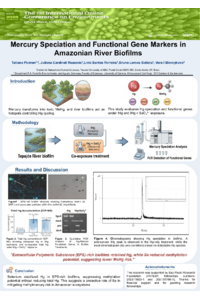
Mercury (Hg) is a global contaminant of significant concern, especially due to its transformation into methylmercury (MeHg), a potent neurotoxin. River biofilms, such as those found in the Tapajós River, are recognized as crucial hotspots for microbial methylation of Hg. This study investigated the interaction between Hg and selenium (Se), an element known to mitigate Hg toxicity, in freshwater biofilms. The objective was to evaluate Hg speciation and correlate it with the detection of key genes involved in Hg methylation and resistance (hgcA, merA, gcs, dsrA) under different exposure conditions to IHg and SeO32-. The results demonstrated that biofilms act as efficient sinks for Hg, with high bioaccumulation of the metal. Speciation analysis revealed that Hg remained predominantly in the inorganic form (IHg) in the dissolved phase, with MeHg was below the detection limits, suggesting a low methylation rate under experimental conditions. PCR analysis revealed a detection pattern suggesting strong selectivity and toxicity of IHg. The resistance gene merA was not detected in treatments with IHg alone and IHg+ SeO32, suggesting the elimination of the subpopulation carrying this gene due to toxicity. Crucially, the methylation gene hgcA, which was detected in single treatments with IHg, was not detected under the co-exposure to IHg + SeO32-, suggesting that SeO32- mitigated the methylation. From an environmental perspective, our results suggest that naturally occurring Se may play a protective role in Amazonian ecosystems impacted by Hg, reducing the bioavailable fraction of this potent neurotoxin and, consequently, eliminating susceptible microbial populations. This has important implications for risk assessment and potential bioremediation strategies in regions affected by artisanal gold mining and other sources of Hg contamination.
Keywords
Biofilm
hgcA
merA
Mercury
Selenium
Speciation
Poster
IOCE 2026 Poster Template_Tatiana_Pedron.pdf
Changes in the macrozoobenthic community across coastal lagoons in the Po River Delta (Northern Adriatic Sea, Italy) during the outbreak years of the blue crab Callinectes sapidus (Rathbun, 1896)
Coupled AOPs as a mitigation strategy for synergetic environmental remediation in small scale environments: the case of sono-galvano-Fenton technique against recalcitrant pollutant in water