Event submissions
Published
This submission belongs to the session S1. Environmental Assessment Methods and Management Technologies of the event The 1st International Online Conference on Environments
Published date
27 Feb, 2026
Academic Editor
'%3e%3cpath%20d='M12.6657%2010.9104C12.4185%2010.325%2012.0599%209.79327%2011.6097%209.34482C11.1609%208.89508%2010.6293%208.5365%2010.0442%208.28888C10.0389%208.28626%2010.0337%208.28495%2010.0285%208.28233C10.8446%207.69279%2011.3752%206.73249%2011.3752%205.64904C11.3752%203.8542%209.92103%202.39999%208.1262%202.39999C6.33136%202.39999%204.87715%203.8542%204.87715%205.64904C4.87715%206.73249%205.40774%207.69279%206.22393%208.28364C6.21869%208.28626%206.21345%208.28757%206.20821%208.29019C5.62129%208.5378%205.09463%208.89284%204.64265%209.34613C4.1929%209.79493%203.83432%2010.3266%203.58671%2010.9117C3.34345%2011.4845%203.21226%2012.0987%203.20023%2012.7209C3.19988%2012.7349%203.20233%2012.7488%203.20744%2012.7619C3.21255%2012.7749%203.22022%2012.7867%203.22998%2012.7968C3.23975%2012.8068%203.25142%2012.8147%203.26431%2012.8202C3.2772%2012.8256%203.29105%2012.8284%203.30504%2012.8284H4.09109C4.14874%2012.8284%204.19459%2012.7825%204.1959%2012.7262C4.2221%2011.7148%204.62823%2010.7676%205.34617%2010.0497C6.08899%209.30683%207.0755%208.89808%208.1262%208.89808C9.17689%208.89808%2010.1634%209.30683%2010.9062%2010.0497C11.6242%2010.7676%2012.0303%2011.7148%2012.0565%2012.7262C12.0578%2012.7838%2012.1037%2012.8284%2012.1613%2012.8284H12.9474C12.9613%2012.8284%2012.9752%2012.8256%2012.9881%2012.8202C13.001%2012.8147%2013.0126%2012.8068%2013.0224%2012.7968C13.0322%2012.7867%2013.0398%2012.7749%2013.0449%2012.7619C13.0501%2012.7488%2013.0525%2012.7349%2013.0522%2012.7209C13.0391%2012.0947%2012.9094%2011.4855%2012.6657%2010.9104ZM8.1262%207.9024C7.52486%207.9024%206.9589%207.6679%206.53312%207.24211C6.10733%206.81633%205.87283%206.25037%205.87283%205.64904C5.87283%205.0477%206.10733%204.48174%206.53312%204.05596C6.9589%203.63018%207.52486%203.39567%208.1262%203.39567C8.72753%203.39567%209.29349%203.63018%209.71927%204.05596C10.1451%204.48174%2010.3796%205.0477%2010.3796%205.64904C10.3796%206.25037%2010.1451%206.81633%209.71927%207.24211C9.29349%207.6679%208.72753%207.9024%208.1262%207.9024Z'%20fill='%235D1EE1'/%3e%3c/g%3e%3c/svg%3e) Milena Horvat
Milena HorvatCitation
Anna Bilida, Maria Antonopoulou, Mitigating Antibiotic Contamination in Aquaculture Effluents Using UVC/H₂O₂ Advanced Oxidation Process, in Proceedings of The 1st International Online Conference on Environments, 2 March–4 March 2026, MDPI: Basel, Switzerland
Share
Email
Facebook
Twitter
LinkedIn
Mitigating Antibiotic Contamination in Aquaculture Effluents Using UVC/H₂O₂ Advanced Oxidation Process
'%3e%3cpath%20d='M12.6647%2010.9104C12.4176%2010.325%2012.0589%209.7933%2011.6088%209.34485C11.16%208.89511%2010.6283%208.53653%2010.0432%208.28891C10.038%208.28629%2010.0327%208.28498%2010.0275%208.28236C10.8437%207.69282%2011.3743%206.73252%2011.3743%205.64907C11.3743%203.85423%209.92005%202.40002%208.12522%202.40002C6.33038%202.40002%204.87618%203.85423%204.87618%205.64907C4.87618%206.73252%205.40677%207.69282%206.22296%208.28367C6.21772%208.28629%206.21248%208.2876%206.20724%208.29022C5.62031%208.53783%205.09365%208.89287%204.64167%209.34616C4.19192%209.79496%203.83334%2010.3266%203.58573%2010.9117C3.34247%2011.4846%203.21128%2012.0987%203.19925%2012.721C3.1989%2012.735%203.20135%2012.7489%203.20646%2012.7619C3.21157%2012.7749%203.21924%2012.7868%203.22901%2012.7968C3.23877%2012.8068%203.25045%2012.8148%203.26334%2012.8202C3.27623%2012.8256%203.29007%2012.8284%203.30406%2012.8284H4.09012C4.14776%2012.8284%204.19362%2012.7825%204.19493%2012.7262C4.22113%2011.7148%204.62726%2010.7676%205.34519%2010.0497C6.08802%209.30686%207.07452%208.89811%208.12522%208.89811C9.17592%208.89811%2010.1624%209.30686%2010.9052%2010.0497C11.6232%2010.7676%2012.0293%2011.7148%2012.0555%2012.7262C12.0568%2012.7839%2012.1027%2012.8284%2012.1603%2012.8284H12.9464C12.9604%2012.8284%2012.9742%2012.8256%2012.9871%2012.8202C13%2012.8148%2013.0117%2012.8068%2013.0214%2012.7968C13.0312%2012.7868%2013.0389%2012.7749%2013.044%2012.7619C13.0491%2012.7489%2013.0515%2012.735%2013.0512%2012.721C13.0381%2012.0947%2012.9084%2011.4856%2012.6647%2010.9104ZM8.12522%207.90243C7.52388%207.90243%206.95792%207.66793%206.53214%207.24215C6.10636%206.81636%205.87185%206.2504%205.87185%205.64907C5.87185%205.04773%206.10636%204.48177%206.53214%204.05599C6.95792%203.63021%207.52388%203.3957%208.12522%203.3957C8.72655%203.3957%209.29252%203.63021%209.7183%204.05599C10.1441%204.48177%2010.3786%205.04773%2010.3786%205.64907C10.3786%206.2504%2010.1441%206.81636%209.7183%207.24215C9.29252%207.66793%208.72655%207.90243%208.12522%207.90243Z'%20fill='%235D1EE1'/%3e%3c/g%3e%3c/svg%3e)
Anna Bilida 1

Maria Antonopoulou 1
1. Department of Sustainable Agriculture, University of Patras, GR-30131 Agrinio, Greece
Abstract
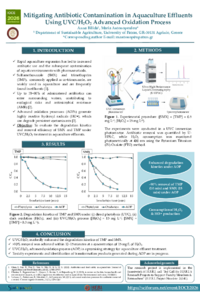
Aquaculture has proliferated globally, accompanied by the widespread use of antibiotics like sulfamethoxazole (SMX) and trimethoprim (TMP) to manage bacterial infections and improve productivity. These chemicals are often co-administered as a combination (co-trimoxazole), and their ongoing release into aquatic habitats has aroused considerable concern due to their persistence, bioaccumulation, and promotion of antimicrobial resistance. Residues may linger in sediments, affect non-target species, and pose threats to human health through food-chain transmission. Advanced Oxidative Processes (AOPs) provide a potential technique for degrading such persistent contaminants by generating highly reactive hydroxyl radicals.
This study used a UVC/H2O2 system to simultaneously remove SMX and TMP from various aquaculture influents and effluents. The influents and effluents were collected from different aquaculture facilities, spiked with environmentally relevant concentrations of both antibiotics, and treated with the UVC/H2O2 process under controlled laboratory conditions. The process efficiency was evaluated using a combination of chemical analytical techniques and toxicity assays. Preliminary results showed that the concentration of H2O2 significantly affected the process, with % removal up to about 90% for both antibiotics observed in aquaculture influents and effluents. In all cases, SMX was removed more rapidly. In conclusion, UVC/H₂O₂ process can effectively remove both antibiotics, underscoring the potential of AOPs as long-term nd efficient treatment options for reducing antibiotic contamination in aquaculture systems.
Acknowledgements: "The research project is implemented in the framework of H.F.R.I. call "3rd Call for H.F.R.I.'s Research Projects to Support Faculty Members & Researchers" (H.F.R.I. Project Number: 26141).
Keywords
Aquaculture
Advanced Oxidative Processes
Sulfamethoxazole
Trimethoprim
Co-trimoxazole
UVC
Hydrogen Peroxide
Ecotoxicity
Poster
158447.pdf
Valorization of Strawberry (Fragaria × ananassa Duch) cv. ‘Malwina’ by-products: A Source of Phenolics and Antioxidants for Sustainable Applications
Environmental Impact Assessment of Quarry Impact (Land Loss and Air Quality) in Akure, Nigeria