Event submissions
Published
This submission belongs to the session S1. Environmental Assessment Methods and Management Technologies of the event The 1st International Online Conference on Environments
Published date
27 Feb, 2026
Academic Editor
'%3e%3cpath%20d='M12.6657%2010.9104C12.4185%2010.325%2012.0599%209.79327%2011.6097%209.34482C11.1609%208.89508%2010.6293%208.5365%2010.0442%208.28888C10.0389%208.28626%2010.0337%208.28495%2010.0285%208.28233C10.8446%207.69279%2011.3752%206.73249%2011.3752%205.64904C11.3752%203.8542%209.92103%202.39999%208.1262%202.39999C6.33136%202.39999%204.87715%203.8542%204.87715%205.64904C4.87715%206.73249%205.40774%207.69279%206.22393%208.28364C6.21869%208.28626%206.21345%208.28757%206.20821%208.29019C5.62129%208.5378%205.09463%208.89284%204.64265%209.34613C4.1929%209.79493%203.83432%2010.3266%203.58671%2010.9117C3.34345%2011.4845%203.21226%2012.0987%203.20023%2012.7209C3.19988%2012.7349%203.20233%2012.7488%203.20744%2012.7619C3.21255%2012.7749%203.22022%2012.7867%203.22998%2012.7968C3.23975%2012.8068%203.25142%2012.8147%203.26431%2012.8202C3.2772%2012.8256%203.29105%2012.8284%203.30504%2012.8284H4.09109C4.14874%2012.8284%204.19459%2012.7825%204.1959%2012.7262C4.2221%2011.7148%204.62823%2010.7676%205.34617%2010.0497C6.08899%209.30683%207.0755%208.89808%208.1262%208.89808C9.17689%208.89808%2010.1634%209.30683%2010.9062%2010.0497C11.6242%2010.7676%2012.0303%2011.7148%2012.0565%2012.7262C12.0578%2012.7838%2012.1037%2012.8284%2012.1613%2012.8284H12.9474C12.9613%2012.8284%2012.9752%2012.8256%2012.9881%2012.8202C13.001%2012.8147%2013.0126%2012.8068%2013.0224%2012.7968C13.0322%2012.7867%2013.0398%2012.7749%2013.0449%2012.7619C13.0501%2012.7488%2013.0525%2012.7349%2013.0522%2012.7209C13.0391%2012.0947%2012.9094%2011.4855%2012.6657%2010.9104ZM8.1262%207.9024C7.52486%207.9024%206.9589%207.6679%206.53312%207.24211C6.10733%206.81633%205.87283%206.25037%205.87283%205.64904C5.87283%205.0477%206.10733%204.48174%206.53312%204.05596C6.9589%203.63018%207.52486%203.39567%208.1262%203.39567C8.72753%203.39567%209.29349%203.63018%209.71927%204.05596C10.1451%204.48174%2010.3796%205.0477%2010.3796%205.64904C10.3796%206.25037%2010.1451%206.81633%209.71927%207.24211C9.29349%207.6679%208.72753%207.9024%208.1262%207.9024Z'%20fill='%235D1EE1'/%3e%3c/g%3e%3c/svg%3e) Milena Horvat
Milena HorvatCitation
Jader Rodriguez Cortina, Andres Sarmiento, John Javier Espitia, Edwin Villagran, Life Cycle Assessment and Exergetic Performance of Solar Agricultural Dryers: Scientific Trends, Technological Niches, and Transitions Toward Sustainable Postharvest Systems, in Proceedings of The 1st International Online Conference on Environments, 2 March–4 March 2026, MDPI: Basel, Switzerland
Share
Email
Facebook
Twitter
LinkedIn
Life Cycle Assessment and Exergetic Performance of Solar Agricultural Dryers: Scientific Trends, Technological Niches, and Transitions Toward Sustainable Postharvest Systems

Jader Rodriguez Cortina 1
'%3e%3cpath%20d='M12.6647%2010.9104C12.4176%2010.325%2012.0589%209.7933%2011.6088%209.34485C11.16%208.89511%2010.6283%208.53653%2010.0432%208.28891C10.038%208.28629%2010.0327%208.28498%2010.0275%208.28236C10.8437%207.69282%2011.3743%206.73252%2011.3743%205.64907C11.3743%203.85423%209.92005%202.40002%208.12522%202.40002C6.33038%202.40002%204.87618%203.85423%204.87618%205.64907C4.87618%206.73252%205.40677%207.69282%206.22296%208.28367C6.21772%208.28629%206.21248%208.2876%206.20724%208.29022C5.62031%208.53783%205.09365%208.89287%204.64167%209.34616C4.19192%209.79496%203.83334%2010.3266%203.58573%2010.9117C3.34247%2011.4846%203.21128%2012.0987%203.19925%2012.721C3.1989%2012.735%203.20135%2012.7489%203.20646%2012.7619C3.21157%2012.7749%203.21924%2012.7868%203.22901%2012.7968C3.23877%2012.8068%203.25045%2012.8148%203.26334%2012.8202C3.27623%2012.8256%203.29007%2012.8284%203.30406%2012.8284H4.09012C4.14776%2012.8284%204.19362%2012.7825%204.19493%2012.7262C4.22113%2011.7148%204.62726%2010.7676%205.34519%2010.0497C6.08802%209.30686%207.07452%208.89811%208.12522%208.89811C9.17592%208.89811%2010.1624%209.30686%2010.9052%2010.0497C11.6232%2010.7676%2012.0293%2011.7148%2012.0555%2012.7262C12.0568%2012.7839%2012.1027%2012.8284%2012.1603%2012.8284H12.9464C12.9604%2012.8284%2012.9742%2012.8256%2012.9871%2012.8202C13%2012.8148%2013.0117%2012.8068%2013.0214%2012.7968C13.0312%2012.7868%2013.0389%2012.7749%2013.044%2012.7619C13.0491%2012.7489%2013.0515%2012.735%2013.0512%2012.721C13.0381%2012.0947%2012.9084%2011.4856%2012.6647%2010.9104ZM8.12522%207.90243C7.52388%207.90243%206.95792%207.66793%206.53214%207.24215C6.10636%206.81636%205.87185%206.2504%205.87185%205.64907C5.87185%205.04773%206.10636%204.48177%206.53214%204.05599C6.95792%203.63021%207.52388%203.3957%208.12522%203.3957C8.72655%203.3957%209.29252%203.63021%209.7183%204.05599C10.1441%204.48177%2010.3786%205.04773%2010.3786%205.64907C10.3786%206.2504%2010.1441%206.81636%209.7183%207.24215C9.29252%207.66793%208.72655%207.90243%208.12522%207.90243Z'%20fill='%235D1EE1'/%3e%3c/g%3e%3c/svg%3e)
Andres Sarmiento 1
John Javier Espitia 1

Edwin Villagran 2
1. Colombian Corporation for Agricultural Research—Agrosavia, Tibaitatá Research Center, Km 14, Mosquera–Bogotá. Mosquera 250040, Colombia
2. Colombian Corporation for Agricultural Research—Agrosavia, Central Headquarters, Km 14, Mosquera–Bogotá. Mosquera 250040, Colombia
Abstract
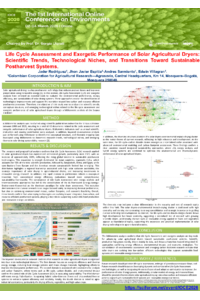
Life Cycle Assessment (LCA) applied to solar agricultural drying technologies has become a critical research area for quantifying postharvest sustainability and informing climate mitigation policies. Based on 42 documents indexed in Scopus (1999–2025), this bibliometric study integrates keyword co-occurrence (VOSviewer) and strategic thematic mapping (Bibliometrix) to identify research evolution, conceptual cores, and emerging opportunities in this field. Scientific production has intensified since 2020, with a 300% increase, driven by Asia (India 43%, followed by Bangladesh, China, and Egypt) and an emerging presence in the Americas and Europe. Results indicate increasing convergence among energy efficiency, environmental impact, and economic feasibility, with 4E approaches (Energy–Exergy–Environment–Economics) becoming the prevailing framework for comprehensive system evaluation. The co-occurrence network reveals four technological domains: (i) exergetic efficiency and thermal energy storage (heat storage, PCM, phase change materials), (ii) environmental analysis and carbon footprint (LCA, carbon dioxide, environmental impact), (iii) energy hybridization (hybrid solar–biomass dryers, photovoltaic/thermal systems), and (iv) agro-industrial applications (fruits, vegetables, high-value crops). The thematic map positions the solar dryers–environmental impact–drying cluster as the motor theme of current research, while life cycle–biogas–carbon dioxide constitutes an emerging niche associated with advanced environmental modeling. The scientific trend points toward multicriteria design and digitalization of solar drying systems, integrating LCA, thermoeconomics, and exergy analysis to optimize materials, geometry, and thermal flow behavior. Future research must strengthen dynamic and comparative LCA methodologies, AI-assisted control and adaptive optimization, and circular models of energy and material flow that transform agricultural drying into a low-carbon, measurable, and environmentally restorative process aligned with the goals of sustainable food systems and renewable energy transitions.
Keywords
Life Cycle Assessment
Exergy and sustainability
Hybrid solar–biomass systems.
Poster
Poster Rodriguez et al 2026.pdf
Techno-Economic Optimization of Solar Photovoltaic Systems for Industrial Sustainability: A Case Study of the Kenyan Tea Sector
Natural and anthropogenic contamination processes in the sediments of the Sacca di Goro lagoon (Po River delta, northern Italy)