Event submissions
Published
This submission belongs to the session S2. Environmental Impact and Risk Assessment of the event The 1st International Online Conference on Environments
Published date
27 Feb, 2026
Academic Editor
'%3e%3cpath%20d='M12.6657%2010.9104C12.4185%2010.325%2012.0599%209.79327%2011.6097%209.34482C11.1609%208.89508%2010.6293%208.5365%2010.0442%208.28888C10.0389%208.28626%2010.0337%208.28495%2010.0285%208.28233C10.8446%207.69279%2011.3752%206.73249%2011.3752%205.64904C11.3752%203.8542%209.92103%202.39999%208.1262%202.39999C6.33136%202.39999%204.87715%203.8542%204.87715%205.64904C4.87715%206.73249%205.40774%207.69279%206.22393%208.28364C6.21869%208.28626%206.21345%208.28757%206.20821%208.29019C5.62129%208.5378%205.09463%208.89284%204.64265%209.34613C4.1929%209.79493%203.83432%2010.3266%203.58671%2010.9117C3.34345%2011.4845%203.21226%2012.0987%203.20023%2012.7209C3.19988%2012.7349%203.20233%2012.7488%203.20744%2012.7619C3.21255%2012.7749%203.22022%2012.7867%203.22998%2012.7968C3.23975%2012.8068%203.25142%2012.8147%203.26431%2012.8202C3.2772%2012.8256%203.29105%2012.8284%203.30504%2012.8284H4.09109C4.14874%2012.8284%204.19459%2012.7825%204.1959%2012.7262C4.2221%2011.7148%204.62823%2010.7676%205.34617%2010.0497C6.08899%209.30683%207.0755%208.89808%208.1262%208.89808C9.17689%208.89808%2010.1634%209.30683%2010.9062%2010.0497C11.6242%2010.7676%2012.0303%2011.7148%2012.0565%2012.7262C12.0578%2012.7838%2012.1037%2012.8284%2012.1613%2012.8284H12.9474C12.9613%2012.8284%2012.9752%2012.8256%2012.9881%2012.8202C13.001%2012.8147%2013.0126%2012.8068%2013.0224%2012.7968C13.0322%2012.7867%2013.0398%2012.7749%2013.0449%2012.7619C13.0501%2012.7488%2013.0525%2012.7349%2013.0522%2012.7209C13.0391%2012.0947%2012.9094%2011.4855%2012.6657%2010.9104ZM8.1262%207.9024C7.52486%207.9024%206.9589%207.6679%206.53312%207.24211C6.10733%206.81633%205.87283%206.25037%205.87283%205.64904C5.87283%205.0477%206.10733%204.48174%206.53312%204.05596C6.9589%203.63018%207.52486%203.39567%208.1262%203.39567C8.72753%203.39567%209.29349%203.63018%209.71927%204.05596C10.1451%204.48174%2010.3796%205.0477%2010.3796%205.64904C10.3796%206.25037%2010.1451%206.81633%209.71927%207.24211C9.29349%207.6679%208.72753%207.9024%208.1262%207.9024Z'%20fill='%235D1EE1'/%3e%3c/g%3e%3c/svg%3e) Ioannis Kalavrouziotis
Ioannis KalavrouziotisCitation
Dimitra Rapti, Natural and anthropogenic contamination processes in the sediments of the Sacca di Goro lagoon (Po River delta, northern Italy), in Proceedings of The 1st International Online Conference on Environments, 2 March–4 March 2026, MDPI: Basel, Switzerland
Share
Email
Facebook
Twitter
LinkedIn
Natural and anthropogenic contamination processes in the sediments of the Sacca di Goro lagoon (Po River delta, northern Italy)

Dimitra Rapti 1
1. Department of Chemical, Pharmaceutical and Agricultural Sciences, University of Ferrara, Ferrara 44122, Italy
Abstract
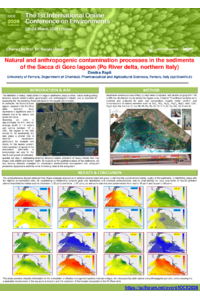
The Sacca di Goro lagoon, located in the Po River delta (Northern Italy), represents a significant area of interest due to its natural and economic value. Spanning an area of approximately 20 km², with an average depth of 1.5 meters and salinity levels of 29‰, the lagoon is not only crucial for its biodiversity but also plays a pivotal role in regional aquaculture, particularly for mussels and clams.
In the present study, 15 continuous core-drilling surveys were conducted, with depths ranging from 100 to 200 cm and distributed evenly across the lagoon area. A total of 70 sediment samples were collected and analyzed for grain size composition, organic matter content, and concentrations of various elements such as SiO2, TiO2, Al2O3, Fe2O3, MgO, MnO, CaO, Na2O, K2O, P2O5, Ba, Ce, Co, Cr, La, Nb, Ni, Pb, Rb, Sr, Th, V, Y, Zn, Cu, Ga, Nd, S, and Sr. Furthermore, in selected samples, sediment toxicity was evaluated using the bacterial bioluminescence toxicity assay, which provides insight into the potential biological impact of the sediments.
The comprehensive dataset obtained from these analyses enabled us to achieve several important goals: i) defining the overall environmental quality of the sediments, ii) identifying areas with the highest contamination risks, iii) establishing a relationship between grain size distribution and chemical concentrations, and iv) emphasizing the local occurrence of natural pollution phenomena linked to metals such as chromium (> 50 ppm) and nickel (> 30 ppm), as well as human-induced contamination from lead (> 30 ppm) and copper (> 60 ppm).
Keywords
contamination
lagoon
Po River delta
Poster
Rapti.pdf
Life Cycle Assessment and Exergetic Performance of Solar Agricultural Dryers: Scientific Trends, Technological Niches, and Transitions Toward Sustainable Postharvest Systems
Contribution of environmental interpretation activities to the Sustainable Development Goals in Mazatlán, Sinaloa (Mexico)