Event submissions
Published
This submission belongs to the session S2. Environmental Impact and Risk Assessment of the event The 1st International Online Conference on Environments
Published date
27 Feb, 2026
Academic Editor
'%3e%3cpath%20d='M12.6657%2010.9104C12.4185%2010.325%2012.0599%209.79327%2011.6097%209.34482C11.1609%208.89508%2010.6293%208.5365%2010.0442%208.28888C10.0389%208.28626%2010.0337%208.28495%2010.0285%208.28233C10.8446%207.69279%2011.3752%206.73249%2011.3752%205.64904C11.3752%203.8542%209.92103%202.39999%208.1262%202.39999C6.33136%202.39999%204.87715%203.8542%204.87715%205.64904C4.87715%206.73249%205.40774%207.69279%206.22393%208.28364C6.21869%208.28626%206.21345%208.28757%206.20821%208.29019C5.62129%208.5378%205.09463%208.89284%204.64265%209.34613C4.1929%209.79493%203.83432%2010.3266%203.58671%2010.9117C3.34345%2011.4845%203.21226%2012.0987%203.20023%2012.7209C3.19988%2012.7349%203.20233%2012.7488%203.20744%2012.7619C3.21255%2012.7749%203.22022%2012.7867%203.22998%2012.7968C3.23975%2012.8068%203.25142%2012.8147%203.26431%2012.8202C3.2772%2012.8256%203.29105%2012.8284%203.30504%2012.8284H4.09109C4.14874%2012.8284%204.19459%2012.7825%204.1959%2012.7262C4.2221%2011.7148%204.62823%2010.7676%205.34617%2010.0497C6.08899%209.30683%207.0755%208.89808%208.1262%208.89808C9.17689%208.89808%2010.1634%209.30683%2010.9062%2010.0497C11.6242%2010.7676%2012.0303%2011.7148%2012.0565%2012.7262C12.0578%2012.7838%2012.1037%2012.8284%2012.1613%2012.8284H12.9474C12.9613%2012.8284%2012.9752%2012.8256%2012.9881%2012.8202C13.001%2012.8147%2013.0126%2012.8068%2013.0224%2012.7968C13.0322%2012.7867%2013.0398%2012.7749%2013.0449%2012.7619C13.0501%2012.7488%2013.0525%2012.7349%2013.0522%2012.7209C13.0391%2012.0947%2012.9094%2011.4855%2012.6657%2010.9104ZM8.1262%207.9024C7.52486%207.9024%206.9589%207.6679%206.53312%207.24211C6.10733%206.81633%205.87283%206.25037%205.87283%205.64904C5.87283%205.0477%206.10733%204.48174%206.53312%204.05596C6.9589%203.63018%207.52486%203.39567%208.1262%203.39567C8.72753%203.39567%209.29349%203.63018%209.71927%204.05596C10.1451%204.48174%2010.3796%205.0477%2010.3796%205.64904C10.3796%206.25037%2010.1451%206.81633%209.71927%207.24211C9.29349%207.6679%208.72753%207.9024%208.1262%207.9024Z'%20fill='%235D1EE1'/%3e%3c/g%3e%3c/svg%3e) Gianniantonio Petruzzelli
Gianniantonio PetruzzelliCitation
Nathália Ferreira, Isabel Sá, Clotilde Nogueira, Ivone Fachada, Cristina Calheiros, Ana Maria Antão-Geraldes, Preliminary insights into macroinvertebrate communities associated with floating islands in two rivers under distinct anthropogenic pressures, in Proceedings of The 1st International Online Conference on Environments, 2 March–4 March 2026, MDPI: Basel, Switzerland
Share
Email
Facebook
Twitter
LinkedIn
Preliminary insights into macroinvertebrate communities associated with floating islands in two rivers under distinct anthropogenic pressures
'%3e%3cpath%20d='M12.6647%2010.9104C12.4176%2010.325%2012.0589%209.7933%2011.6088%209.34485C11.16%208.89511%2010.6283%208.53653%2010.0432%208.28891C10.038%208.28629%2010.0327%208.28498%2010.0275%208.28236C10.8437%207.69282%2011.3743%206.73252%2011.3743%205.64907C11.3743%203.85423%209.92005%202.40002%208.12522%202.40002C6.33038%202.40002%204.87618%203.85423%204.87618%205.64907C4.87618%206.73252%205.40677%207.69282%206.22296%208.28367C6.21772%208.28629%206.21248%208.2876%206.20724%208.29022C5.62031%208.53783%205.09365%208.89287%204.64167%209.34616C4.19192%209.79496%203.83334%2010.3266%203.58573%2010.9117C3.34247%2011.4846%203.21128%2012.0987%203.19925%2012.721C3.1989%2012.735%203.20135%2012.7489%203.20646%2012.7619C3.21157%2012.7749%203.21924%2012.7868%203.22901%2012.7968C3.23877%2012.8068%203.25045%2012.8148%203.26334%2012.8202C3.27623%2012.8256%203.29007%2012.8284%203.30406%2012.8284H4.09012C4.14776%2012.8284%204.19362%2012.7825%204.19493%2012.7262C4.22113%2011.7148%204.62726%2010.7676%205.34519%2010.0497C6.08802%209.30686%207.07452%208.89811%208.12522%208.89811C9.17592%208.89811%2010.1624%209.30686%2010.9052%2010.0497C11.6232%2010.7676%2012.0293%2011.7148%2012.0555%2012.7262C12.0568%2012.7839%2012.1027%2012.8284%2012.1603%2012.8284H12.9464C12.9604%2012.8284%2012.9742%2012.8256%2012.9871%2012.8202C13%2012.8148%2013.0117%2012.8068%2013.0214%2012.7968C13.0312%2012.7868%2013.0389%2012.7749%2013.044%2012.7619C13.0491%2012.7489%2013.0515%2012.735%2013.0512%2012.721C13.0381%2012.0947%2012.9084%2011.4856%2012.6647%2010.9104ZM8.12522%207.90243C7.52388%207.90243%206.95792%207.66793%206.53214%207.24215C6.10636%206.81636%205.87185%206.2504%205.87185%205.64907C5.87185%205.04773%206.10636%204.48177%206.53214%204.05599C6.95792%203.63021%207.52388%203.3957%208.12522%203.3957C8.72655%203.3957%209.29252%203.63021%209.7183%204.05599C10.1441%204.48177%2010.3786%205.04773%2010.3786%205.64907C10.3786%206.2504%2010.1441%206.81636%209.7183%207.24215C9.29252%207.66793%208.72655%207.90243%208.12522%207.90243Z'%20fill='%235D1EE1'/%3e%3c/g%3e%3c/svg%3e)
Nathália Ferreira 1
Isabel Sá 1
Clotilde Nogueira 1
Ivone Fachada 2

Cristina Calheiros 3

Ana Maria Antão-Geraldes 4
1. Bragança Ciência Viva Science Center, Rua do Beato Nicolao Dinis, Bragança, 5300-130, Portugal
2. Ciência Viva – National Agency for Scientific and Technological Culture, Largo José Mariano Gago No. 1, Parque das Nações, Lisbon, 1990-073, Portugal
3. Interdisciplinary Centre of Marine and Environmental Research (CIMAR), University of Porto, Avenida General Norton de Matos, S/N, Matosinhos, 4450-208, Portugal
4. CIMO, LA SusTEC, Instituto Politécnico de Bragança, Campus de Santa Apolónia, Bragança 5300-253, Portugal
Abstract
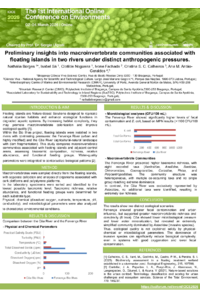
Floating islands are bioengineering structures vegetated with riparian plant species that replicate natural ecological functions in degraded aquatic environments. As Nature-Based Solutions, these structures create new microhabitats that can support biological recolonization, enhance ecological connectivity, and provide new opportunities for environmental monitoring. In the context of the Bio Ilhas project, pilot floating islands were installed in two fluvial systems under distinct anthropogenic pressures: the Fervença River, an urban and heavily modified watercourse, and the Côa River, located in an agricultural-natural landscape but with longitudinal connectivity disrupted by dams. The primary objective of this study is to compare the composition and structure of aquatic macroinvertebrate communities associated with floating islands and adjacent non-island areas in both rivers. Additionally, it aims to compare the species present in each system, identify taxa, and assess differences in richness, relative abundance, and functional feeding groups. To complement the biological analysis, available water-quality data (including physical and chemical parameters such as dissolved oxygen, nutrients, temperature, pH, and conductivity) were integrated to characterize the sampling sites and to contextualize macroinvertebrate sensitivity as bioindicators. Preliminary observations indicate that the macroinvertebrate communities in the Côa River were almost exclusively dominated by Astacidea (invasive crayfish). In contrast, the Fervença River exhibited greater taxonomic variability, primarily represented by organisms from the orders Crustacea, Mollusca, Hirudinea, and Odonata. This approach aims to determine whether floating islands support more diverse and sensitive communities than areas without islands, and to understand how different anthropogenic pressures, urban impacts in the Fervença, and hydromorphological alterations in the Côa influence patterns of colonization and ecological tolerance.
Keywords
Macroinvertebrate communities
Nature-Based Solutions
River ecosystem assessment
Poster
157982.pdf
Regeneration and Conservation Challenges of Alnus glutinosa (L.) Gaertn in riparian forests
Sustainable Single-Use Plastic Management in Morocco: Analysis and Environmental Policy Recommendations