Event submissions
Published
This submission belongs to the session S5. Shared Responsibility in Resource Use and Impact Generation of the event The 1st International Online Conference on Environments
Published date
27 Feb, 2026
Academic Editor
'%3e%3cpath%20d='M12.6657%2010.9104C12.4185%2010.325%2012.0599%209.79327%2011.6097%209.34482C11.1609%208.89508%2010.6293%208.5365%2010.0442%208.28888C10.0389%208.28626%2010.0337%208.28495%2010.0285%208.28233C10.8446%207.69279%2011.3752%206.73249%2011.3752%205.64904C11.3752%203.8542%209.92103%202.39999%208.1262%202.39999C6.33136%202.39999%204.87715%203.8542%204.87715%205.64904C4.87715%206.73249%205.40774%207.69279%206.22393%208.28364C6.21869%208.28626%206.21345%208.28757%206.20821%208.29019C5.62129%208.5378%205.09463%208.89284%204.64265%209.34613C4.1929%209.79493%203.83432%2010.3266%203.58671%2010.9117C3.34345%2011.4845%203.21226%2012.0987%203.20023%2012.7209C3.19988%2012.7349%203.20233%2012.7488%203.20744%2012.7619C3.21255%2012.7749%203.22022%2012.7867%203.22998%2012.7968C3.23975%2012.8068%203.25142%2012.8147%203.26431%2012.8202C3.2772%2012.8256%203.29105%2012.8284%203.30504%2012.8284H4.09109C4.14874%2012.8284%204.19459%2012.7825%204.1959%2012.7262C4.2221%2011.7148%204.62823%2010.7676%205.34617%2010.0497C6.08899%209.30683%207.0755%208.89808%208.1262%208.89808C9.17689%208.89808%2010.1634%209.30683%2010.9062%2010.0497C11.6242%2010.7676%2012.0303%2011.7148%2012.0565%2012.7262C12.0578%2012.7838%2012.1037%2012.8284%2012.1613%2012.8284H12.9474C12.9613%2012.8284%2012.9752%2012.8256%2012.9881%2012.8202C13.001%2012.8147%2013.0126%2012.8068%2013.0224%2012.7968C13.0322%2012.7867%2013.0398%2012.7749%2013.0449%2012.7619C13.0501%2012.7488%2013.0525%2012.7349%2013.0522%2012.7209C13.0391%2012.0947%2012.9094%2011.4855%2012.6657%2010.9104ZM8.1262%207.9024C7.52486%207.9024%206.9589%207.6679%206.53312%207.24211C6.10733%206.81633%205.87283%206.25037%205.87283%205.64904C5.87283%205.0477%206.10733%204.48174%206.53312%204.05596C6.9589%203.63018%207.52486%203.39567%208.1262%203.39567C8.72753%203.39567%209.29349%203.63018%209.71927%204.05596C10.1451%204.48174%2010.3796%205.0477%2010.3796%205.64904C10.3796%206.25037%2010.1451%206.81633%209.71927%207.24211C9.29349%207.6679%208.72753%207.9024%208.1262%207.9024Z'%20fill='%235D1EE1'/%3e%3c/g%3e%3c/svg%3e) Xi Ji
Xi JiCitation
Hafiz Muhammad Safdar Khan, Imran Shauket, Muhammad Yamin, Azhar Ali, Furqan Muhayodin, Rao Husnain Arshad, Agricultural Resource Management Through Shared Responsibility: Combining Technology, Policy, and Community Initiatives to Reduce Transboundary SMOG Across the Indo-Pak Border Region, in Proceedings of The 1st International Online Conference on Environments, 2 March–4 March 2026, MDPI: Basel, Switzerland
Share
Email
Facebook
Twitter
LinkedIn
Agricultural Resource Management Through Shared Responsibility: Combining Technology, Policy, and Community Initiatives to Reduce Transboundary SMOG Across the Indo-Pak Border Region
'%3e%3cpath%20d='M12.6647%2010.9104C12.4176%2010.325%2012.0589%209.7933%2011.6088%209.34485C11.16%208.89511%2010.6283%208.53653%2010.0432%208.28891C10.038%208.28629%2010.0327%208.28498%2010.0275%208.28236C10.8437%207.69282%2011.3743%206.73252%2011.3743%205.64907C11.3743%203.85423%209.92005%202.40002%208.12522%202.40002C6.33038%202.40002%204.87618%203.85423%204.87618%205.64907C4.87618%206.73252%205.40677%207.69282%206.22296%208.28367C6.21772%208.28629%206.21248%208.2876%206.20724%208.29022C5.62031%208.53783%205.09365%208.89287%204.64167%209.34616C4.19192%209.79496%203.83334%2010.3266%203.58573%2010.9117C3.34247%2011.4846%203.21128%2012.0987%203.19925%2012.721C3.1989%2012.735%203.20135%2012.7489%203.20646%2012.7619C3.21157%2012.7749%203.21924%2012.7868%203.22901%2012.7968C3.23877%2012.8068%203.25045%2012.8148%203.26334%2012.8202C3.27623%2012.8256%203.29007%2012.8284%203.30406%2012.8284H4.09012C4.14776%2012.8284%204.19362%2012.7825%204.19493%2012.7262C4.22113%2011.7148%204.62726%2010.7676%205.34519%2010.0497C6.08802%209.30686%207.07452%208.89811%208.12522%208.89811C9.17592%208.89811%2010.1624%209.30686%2010.9052%2010.0497C11.6232%2010.7676%2012.0293%2011.7148%2012.0555%2012.7262C12.0568%2012.7839%2012.1027%2012.8284%2012.1603%2012.8284H12.9464C12.9604%2012.8284%2012.9742%2012.8256%2012.9871%2012.8202C13%2012.8148%2013.0117%2012.8068%2013.0214%2012.7968C13.0312%2012.7868%2013.0389%2012.7749%2013.044%2012.7619C13.0491%2012.7489%2013.0515%2012.735%2013.0512%2012.721C13.0381%2012.0947%2012.9084%2011.4856%2012.6647%2010.9104ZM8.12522%207.90243C7.52388%207.90243%206.95792%207.66793%206.53214%207.24215C6.10636%206.81636%205.87185%206.2504%205.87185%205.64907C5.87185%205.04773%206.10636%204.48177%206.53214%204.05599C6.95792%203.63021%207.52388%203.3957%208.12522%203.3957C8.72655%203.3957%209.29252%203.63021%209.7183%204.05599C10.1441%204.48177%2010.3786%205.04773%2010.3786%205.64907C10.3786%206.2504%2010.1441%206.81636%209.7183%207.24215C9.29252%207.66793%208.72655%207.90243%208.12522%207.90243Z'%20fill='%235D1EE1'/%3e%3c/g%3e%3c/svg%3e)
Hafiz Muhammad Safdar Khan 1
Imran Shauket 1
Muhammad Yamin 2
Azhar Ali 3
Furqan Muhayodin 2
Rao Husnain Arshad 4
1. Department of Structures and Environmental Engineering, Faculty of Agricultural Engineering and Technology, University of Agriculture, Faisalabad 38000, Pakistan
2. Department of Farm Machinery and Power,Faculty of Agricultural Engineering and Technology, University of Agriculture, Faisalabad 38000, Pakistan
3. Department of Food Engineering, Faculty of Agricultural Engineering and Technology, University of Agriculture, Faisalabad 38000, Pakistan
4. Department of Irrigation and Drainage, Faculty of Agricultural Engineering and Technology, University of Agriculture, Faisalabad 38000, Pakistan
Abstract
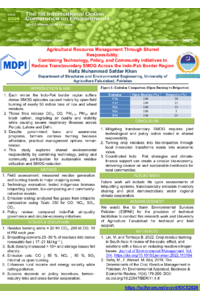
Seasonal SMOG across the Indo-Pak border has become one of South Asia’s most critical environmental and public health challenges. More than 50 million tons of rice and wheat residues are burned openly, which releases millions of tons of greenhouse gases, particulate matter (PM₂.₅ and PM₁₀), and notable amounts of black carbon. Severe respiratory illnesses and transboundary haze episodes that extend from Punjab to Delhi and Lahore are driven by these emissions, which also degrade regional air quality and visibility. Farmers continue to burn residues despite prohibitions and awareness campaigns because no accessible or reasonably priced management options are available. To investigate shared environmental responsibility in the management of agricultural residues, this study combines field data and policy analyses. It examines technological solutions such as biomass briquetting, bio-composting, and community-level residue collection that can lead to circular, low-emission rural economies. Briquetting alone can convert 25–30% of annual crop waste into renewable fuel, reducing CO and NOx emissions by up to 80% and providing additional income to rural households compared with open burning. The findings demonstrate that, to address SMOG as a shared resource-use issue rather than merely an agricultural one, integrated policies involving farmers, local governments, industries, and regional institutions are required. By converting residue burning from a source of pollution into a circular bioeconomy opportunity through incentive-based policies, coordinated technology adoption, and regional air quality frameworks, the Indo-Pak border region can benefit from cleaner air and sustainable livelihoods.
Keywords
Agricultural Residue Management
Air Quality Policy
Circular Economy
Shared Environmental Responsibility
South Asia and Transboundary SMOG
Poster
Hafiz.pdf
Assessment of Atmospheric Pollutants and Environmental Parameters in an Industrial Urban Area of Albania
Life Cycle Evaluation of Next-Generation Photovoltaic Systems with Emphasis on Material Flows and Circular Economy