Event submissions
Published
This submission belongs to the session S7. Solar and Stellar Physics of the event The 3rd International Online Conference on Universe
Published date
27 Feb, 2026
Academic Editor
'%3e%3cpath%20d='M12.6657%2010.9104C12.4185%2010.325%2012.0599%209.79327%2011.6097%209.34482C11.1609%208.89508%2010.6293%208.5365%2010.0442%208.28888C10.0389%208.28626%2010.0337%208.28495%2010.0285%208.28233C10.8446%207.69279%2011.3752%206.73249%2011.3752%205.64904C11.3752%203.8542%209.92103%202.39999%208.1262%202.39999C6.33136%202.39999%204.87715%203.8542%204.87715%205.64904C4.87715%206.73249%205.40774%207.69279%206.22393%208.28364C6.21869%208.28626%206.21345%208.28757%206.20821%208.29019C5.62129%208.5378%205.09463%208.89284%204.64265%209.34613C4.1929%209.79493%203.83432%2010.3266%203.58671%2010.9117C3.34345%2011.4845%203.21226%2012.0987%203.20023%2012.7209C3.19988%2012.7349%203.20233%2012.7488%203.20744%2012.7619C3.21255%2012.7749%203.22022%2012.7867%203.22998%2012.7968C3.23975%2012.8068%203.25142%2012.8147%203.26431%2012.8202C3.2772%2012.8256%203.29105%2012.8284%203.30504%2012.8284H4.09109C4.14874%2012.8284%204.19459%2012.7825%204.1959%2012.7262C4.2221%2011.7148%204.62823%2010.7676%205.34617%2010.0497C6.08899%209.30683%207.0755%208.89808%208.1262%208.89808C9.17689%208.89808%2010.1634%209.30683%2010.9062%2010.0497C11.6242%2010.7676%2012.0303%2011.7148%2012.0565%2012.7262C12.0578%2012.7838%2012.1037%2012.8284%2012.1613%2012.8284H12.9474C12.9613%2012.8284%2012.9752%2012.8256%2012.9881%2012.8202C13.001%2012.8147%2013.0126%2012.8068%2013.0224%2012.7968C13.0322%2012.7867%2013.0398%2012.7749%2013.0449%2012.7619C13.0501%2012.7488%2013.0525%2012.7349%2013.0522%2012.7209C13.0391%2012.0947%2012.9094%2011.4855%2012.6657%2010.9104ZM8.1262%207.9024C7.52486%207.9024%206.9589%207.6679%206.53312%207.24211C6.10733%206.81633%205.87283%206.25037%205.87283%205.64904C5.87283%205.0477%206.10733%204.48174%206.53312%204.05596C6.9589%203.63018%207.52486%203.39567%208.1262%203.39567C8.72753%203.39567%209.29349%203.63018%209.71927%204.05596C10.1451%204.48174%2010.3796%205.0477%2010.3796%205.64904C10.3796%206.25037%2010.1451%206.81633%209.71927%207.24211C9.29349%207.6679%208.72753%207.9024%208.1262%207.9024Z'%20fill='%235D1EE1'/%3e%3c/g%3e%3c/svg%3e) Jacco Th. van Loon
Jacco Th. van LoonCitation
Costantino Sigismondi, Francesco Vitali, Andrea Francesco Battaglia, Michele Bianda, Rythmic flaring regions in the maximum of solar cycle XXV, in Proceedings of The 3rd International Online Conference on Universe, 4 March–6 March 2026, MDPI: Basel, Switzerland
Share
Email
Facebook
Twitter
LinkedIn
Rythmic flaring regions in the maximum of solar cycle XXV
'%3e%3cpath%20d='M12.6647%2010.9104C12.4176%2010.325%2012.0589%209.7933%2011.6088%209.34485C11.16%208.89511%2010.6283%208.53653%2010.0432%208.28891C10.038%208.28629%2010.0327%208.28498%2010.0275%208.28236C10.8437%207.69282%2011.3743%206.73252%2011.3743%205.64907C11.3743%203.85423%209.92005%202.40002%208.12522%202.40002C6.33038%202.40002%204.87618%203.85423%204.87618%205.64907C4.87618%206.73252%205.40677%207.69282%206.22296%208.28367C6.21772%208.28629%206.21248%208.2876%206.20724%208.29022C5.62031%208.53783%205.09365%208.89287%204.64167%209.34616C4.19192%209.79496%203.83334%2010.3266%203.58573%2010.9117C3.34247%2011.4846%203.21128%2012.0987%203.19925%2012.721C3.1989%2012.735%203.20135%2012.7489%203.20646%2012.7619C3.21157%2012.7749%203.21924%2012.7868%203.22901%2012.7968C3.23877%2012.8068%203.25045%2012.8148%203.26334%2012.8202C3.27623%2012.8256%203.29007%2012.8284%203.30406%2012.8284H4.09012C4.14776%2012.8284%204.19362%2012.7825%204.19493%2012.7262C4.22113%2011.7148%204.62726%2010.7676%205.34519%2010.0497C6.08802%209.30686%207.07452%208.89811%208.12522%208.89811C9.17592%208.89811%2010.1624%209.30686%2010.9052%2010.0497C11.6232%2010.7676%2012.0293%2011.7148%2012.0555%2012.7262C12.0568%2012.7839%2012.1027%2012.8284%2012.1603%2012.8284H12.9464C12.9604%2012.8284%2012.9742%2012.8256%2012.9871%2012.8202C13%2012.8148%2013.0117%2012.8068%2013.0214%2012.7968C13.0312%2012.7868%2013.0389%2012.7749%2013.044%2012.7619C13.0491%2012.7489%2013.0515%2012.735%2013.0512%2012.721C13.0381%2012.0947%2012.9084%2011.4856%2012.6647%2010.9104ZM8.12522%207.90243C7.52388%207.90243%206.95792%207.66793%206.53214%207.24215C6.10636%206.81636%205.87185%206.2504%205.87185%205.64907C5.87185%205.04773%206.10636%204.48177%206.53214%204.05599C6.95792%203.63021%207.52388%203.3957%208.12522%203.3957C8.72655%203.3957%209.29252%203.63021%209.7183%204.05599C10.1441%204.48177%2010.3786%205.04773%2010.3786%205.64907C10.3786%206.2504%2010.1441%206.81636%209.7183%207.24215C9.29252%207.66793%208.72655%207.90243%208.12522%207.90243Z'%20fill='%235D1EE1'/%3e%3c/g%3e%3c/svg%3e)
Costantino Sigismondi 1,2
Francesco Vitali 3
Andrea Francesco Battaglia 3
Michele Bianda 3
1. ICRANet Pescara, Piazzale della Repubblica 10, 65122 Pescara, Italy
2. APRA, Pontifical Athaeneum Regina Apostolorum, via degli Aldobrandeschi 190, 00163 Roma, Italy
3. IRSOL, Istituto Ricerche Solari di Locarno, Università della Svizzera Italiana, Via Patocchi 57 · 6605 Locarno, Switzerland
Abstract
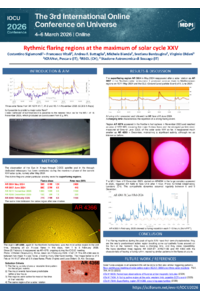
After the celebrated active region (AR) 3664, whose flares produced aurorae down to the Mediterranean area on 10-11 May 2024, AR3697 had a rhythmic behavior, which allowed us to predict flares’ timings with accuracy down to the hour in June 2024. Similar behavior was registered in AR4274 and AR4299 in November-December 2025, and again it produced the largest flare of 2025, on 11 November 2025, with geo-effectiveness again reaching locations significantly far from the magnetic poles.
Moreover, these active regions maintained their characteristics (timing and flaring directions) after two whole solar rotations.
An elevated degree of sympatheticity with nearby AR has been also verified: in nearby regions, they triggered other flares or they were excitated to flare, with a connecting time of up to one hour.
Sympathetic flares are usually considered when they are less than 20 minutes apart, but the predictability of such events extended this timescale.
The flaring events of 8 December 2025 with the AR4299 and the nearby giant complex AR4294-96-98 are analyzed in detail, with particular attention given to the sequence M1.1 at 13:05UT in AR4294 and C4.82 in AR4299 at 14:06UT: the propagation of the perturbing wave was visible through the excitation of spotless plages between the two classified ones. These observations were made with the H-alpha telescope.
The cooling phases of the flare X1.95 from AR4299 and M5.05, X1.2 and X5.16, sources of Solar Particle Events (SPEs) from AR 4274 (the same region one rotation before), and the one M9.75 of AR3697 (SPE and Ground Level Enhancement) are also analyzed in X-rays from GOES Satellite data.
Keywords
Solar flares
H-alpha plages
Solar Active Regions
Solar Cycle 25
Aurorae Borealis
Poster
sciforum-164024.pdf
Photometry of Antares from 1995 to 2025 with SOHO
High-Velocity Features in Type Ia Supernovae—A puzzle still waiting to be solved after 26 years