Event submissions
Published
This submission belongs to the session S2. Environmental Impact and Risk Assessment of the event The 1st International Online Conference on Environments
Published date
27 Feb, 2026
Academic Editor
'%3e%3cpath%20d='M12.6657%2010.9104C12.4185%2010.325%2012.0599%209.79327%2011.6097%209.34482C11.1609%208.89508%2010.6293%208.5365%2010.0442%208.28888C10.0389%208.28626%2010.0337%208.28495%2010.0285%208.28233C10.8446%207.69279%2011.3752%206.73249%2011.3752%205.64904C11.3752%203.8542%209.92103%202.39999%208.1262%202.39999C6.33136%202.39999%204.87715%203.8542%204.87715%205.64904C4.87715%206.73249%205.40774%207.69279%206.22393%208.28364C6.21869%208.28626%206.21345%208.28757%206.20821%208.29019C5.62129%208.5378%205.09463%208.89284%204.64265%209.34613C4.1929%209.79493%203.83432%2010.3266%203.58671%2010.9117C3.34345%2011.4845%203.21226%2012.0987%203.20023%2012.7209C3.19988%2012.7349%203.20233%2012.7488%203.20744%2012.7619C3.21255%2012.7749%203.22022%2012.7867%203.22998%2012.7968C3.23975%2012.8068%203.25142%2012.8147%203.26431%2012.8202C3.2772%2012.8256%203.29105%2012.8284%203.30504%2012.8284H4.09109C4.14874%2012.8284%204.19459%2012.7825%204.1959%2012.7262C4.2221%2011.7148%204.62823%2010.7676%205.34617%2010.0497C6.08899%209.30683%207.0755%208.89808%208.1262%208.89808C9.17689%208.89808%2010.1634%209.30683%2010.9062%2010.0497C11.6242%2010.7676%2012.0303%2011.7148%2012.0565%2012.7262C12.0578%2012.7838%2012.1037%2012.8284%2012.1613%2012.8284H12.9474C12.9613%2012.8284%2012.9752%2012.8256%2012.9881%2012.8202C13.001%2012.8147%2013.0126%2012.8068%2013.0224%2012.7968C13.0322%2012.7867%2013.0398%2012.7749%2013.0449%2012.7619C13.0501%2012.7488%2013.0525%2012.7349%2013.0522%2012.7209C13.0391%2012.0947%2012.9094%2011.4855%2012.6657%2010.9104ZM8.1262%207.9024C7.52486%207.9024%206.9589%207.6679%206.53312%207.24211C6.10733%206.81633%205.87283%206.25037%205.87283%205.64904C5.87283%205.0477%206.10733%204.48174%206.53312%204.05596C6.9589%203.63018%207.52486%203.39567%208.1262%203.39567C8.72753%203.39567%209.29349%203.63018%209.71927%204.05596C10.1451%204.48174%2010.3796%205.0477%2010.3796%205.64904C10.3796%206.25037%2010.1451%206.81633%209.71927%207.24211C9.29349%207.6679%208.72753%207.9024%208.1262%207.9024Z'%20fill='%235D1EE1'/%3e%3c/g%3e%3c/svg%3e) Gianniantonio Petruzzelli
Gianniantonio PetruzzelliCitation
Alena Voznakova, Ana Maria Antao-Geraldes, Moisés Canle, Urban River Contamination Case Study: Spatial–Temporal Dynamics of Emerging Contaminants in the Fervença River (Bragança, Portugal), in Proceedings of The 1st International Online Conference on Environments, 2 March–4 March 2026, MDPI: Basel, Switzerland
Share
Email
Facebook
Twitter
LinkedIn
Urban River Contamination Case Study: Spatial–Temporal Dynamics of Emerging Contaminants in the Fervença River (Bragança, Portugal)

Alena Voznakova 1

Ana Maria Antao-Geraldes 2

Moisés Canle 3
1. Department of Chemistry, Faculty of Science, Campus de Zapateira, University of A Coruña, A Coruña 15071, Spain
2. CIMO, LA SusTEC, Instituto Politécnico de Bragança, Campus de Santa Apolónia, 5300-253 Bragança, Portugal.
3. Departamento de Química, Facultade de Ciencias & CICA, Universidade da Coruña, E-15071 A Coruña, Spain.
Abstract
Urban rivers are subject to multiple anthropogenic pressures, particularly those associated with wastewater discharges and diffuse inputs from urbanized catchments. This study investigates the occurrence and spatial–temporal patterns of emerging contaminants in the Fervença River (Bragança, NE Portugal), with a specific focus on the influence of the municipal wastewater treatment plant (WWTP). Three riverine sampling sites were selected to represent upstream rural conditions, urban influence, and downstream areas receiving WWTP effluent. An additional sampling point was included at the WWTP discharge. Water and sediment samples were collected during four campaigns: one dataset from 2018 and three sampling campaigns conducted in March, May, and September 2024.
The analyses targeted a set of pharmaceutical products using HPLC-MS. Physicochemical parameters were also recorded in situ. The results show (i) a marked increase in contaminant concentrations in the urban section, (ii) the persistent detection of certain pharmaceutical products downstream of the WWTP, indicating incomplete removal, and (iii) differences in contaminant profiles between water and sediments, suggesting specific partitioning behavior of the compounds and possible long-term accumulation in benthic compartments. Comparison of data from 2018 and 2024 suggests temporal variability potentially related to changes in urban water use patterns and treatment efficiency.
This case study highlights the vulnerability of small urban rivers to wastewater-related contamination and the importance of integrating sediment monitoring to capture the environmental persistence of emerging contaminants. Findings contribute to a better understanding of contaminant dynamics in urban systems and support evidence-based management strategies to mitigate chemical pressures in freshwater environments.
Keywords
Urban river
Emerging contaminants
surface-water
sediments
wastewater treatment plant
Environmental monitoring
Poster
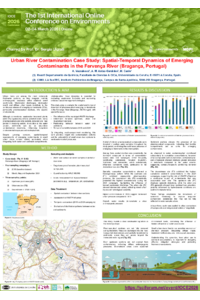
Alena_ IOCE 2026 Poster_FINAL.pdf
Life Cycle Evaluation of Next-Generation Photovoltaic Systems with Emphasis on Material Flows and Circular Economy
Valorization of lignin for the development of sustainable amphiphilic modifiers with high surface activity for environmentally responsible cement systems