Event submissions
Published
This submission belongs to the session S2. Environmental Impact and Risk Assessment of the event The 1st International Online Conference on Environments
Published date
27 Feb, 2026
Academic Editor
'%3e%3cpath%20d='M12.6657%2010.9104C12.4185%2010.325%2012.0599%209.79327%2011.6097%209.34482C11.1609%208.89508%2010.6293%208.5365%2010.0442%208.28888C10.0389%208.28626%2010.0337%208.28495%2010.0285%208.28233C10.8446%207.69279%2011.3752%206.73249%2011.3752%205.64904C11.3752%203.8542%209.92103%202.39999%208.1262%202.39999C6.33136%202.39999%204.87715%203.8542%204.87715%205.64904C4.87715%206.73249%205.40774%207.69279%206.22393%208.28364C6.21869%208.28626%206.21345%208.28757%206.20821%208.29019C5.62129%208.5378%205.09463%208.89284%204.64265%209.34613C4.1929%209.79493%203.83432%2010.3266%203.58671%2010.9117C3.34345%2011.4845%203.21226%2012.0987%203.20023%2012.7209C3.19988%2012.7349%203.20233%2012.7488%203.20744%2012.7619C3.21255%2012.7749%203.22022%2012.7867%203.22998%2012.7968C3.23975%2012.8068%203.25142%2012.8147%203.26431%2012.8202C3.2772%2012.8256%203.29105%2012.8284%203.30504%2012.8284H4.09109C4.14874%2012.8284%204.19459%2012.7825%204.1959%2012.7262C4.2221%2011.7148%204.62823%2010.7676%205.34617%2010.0497C6.08899%209.30683%207.0755%208.89808%208.1262%208.89808C9.17689%208.89808%2010.1634%209.30683%2010.9062%2010.0497C11.6242%2010.7676%2012.0303%2011.7148%2012.0565%2012.7262C12.0578%2012.7838%2012.1037%2012.8284%2012.1613%2012.8284H12.9474C12.9613%2012.8284%2012.9752%2012.8256%2012.9881%2012.8202C13.001%2012.8147%2013.0126%2012.8068%2013.0224%2012.7968C13.0322%2012.7867%2013.0398%2012.7749%2013.0449%2012.7619C13.0501%2012.7488%2013.0525%2012.7349%2013.0522%2012.7209C13.0391%2012.0947%2012.9094%2011.4855%2012.6657%2010.9104ZM8.1262%207.9024C7.52486%207.9024%206.9589%207.6679%206.53312%207.24211C6.10733%206.81633%205.87283%206.25037%205.87283%205.64904C5.87283%205.0477%206.10733%204.48174%206.53312%204.05596C6.9589%203.63018%207.52486%203.39567%208.1262%203.39567C8.72753%203.39567%209.29349%203.63018%209.71927%204.05596C10.1451%204.48174%2010.3796%205.0477%2010.3796%205.64904C10.3796%206.25037%2010.1451%206.81633%209.71927%207.24211C9.29349%207.6679%208.72753%207.9024%208.1262%207.9024Z'%20fill='%235D1EE1'/%3e%3c/g%3e%3c/svg%3e) Ioannis Kalavrouziotis
Ioannis KalavrouziotisCitation
Ryhane LOUNAS, Amina TIFOURA, Houda FELLAH, Samira SARIH, Sara HAOUAM, Nabila MESLEM-HAOUI, Combined Effects of Microplastics and Trace Metals on Stress-Response Gene Expression in the Mediterranean Mussel Mytilus galloprovincialis, in Proceedings of The 1st International Online Conference on Environments, 2 March–4 March 2026, MDPI: Basel, Switzerland
Share
Email
Facebook
Twitter
LinkedIn
Combined Effects of Microplastics and Trace Metals on Stress-Response Gene Expression in the Mediterranean Mussel Mytilus galloprovincialis
'%3e%3cpath%20d='M12.6647%2010.9104C12.4176%2010.325%2012.0589%209.7933%2011.6088%209.34485C11.16%208.89511%2010.6283%208.53653%2010.0432%208.28891C10.038%208.28629%2010.0327%208.28498%2010.0275%208.28236C10.8437%207.69282%2011.3743%206.73252%2011.3743%205.64907C11.3743%203.85423%209.92005%202.40002%208.12522%202.40002C6.33038%202.40002%204.87618%203.85423%204.87618%205.64907C4.87618%206.73252%205.40677%207.69282%206.22296%208.28367C6.21772%208.28629%206.21248%208.2876%206.20724%208.29022C5.62031%208.53783%205.09365%208.89287%204.64167%209.34616C4.19192%209.79496%203.83334%2010.3266%203.58573%2010.9117C3.34247%2011.4846%203.21128%2012.0987%203.19925%2012.721C3.1989%2012.735%203.20135%2012.7489%203.20646%2012.7619C3.21157%2012.7749%203.21924%2012.7868%203.22901%2012.7968C3.23877%2012.8068%203.25045%2012.8148%203.26334%2012.8202C3.27623%2012.8256%203.29007%2012.8284%203.30406%2012.8284H4.09012C4.14776%2012.8284%204.19362%2012.7825%204.19493%2012.7262C4.22113%2011.7148%204.62726%2010.7676%205.34519%2010.0497C6.08802%209.30686%207.07452%208.89811%208.12522%208.89811C9.17592%208.89811%2010.1624%209.30686%2010.9052%2010.0497C11.6232%2010.7676%2012.0293%2011.7148%2012.0555%2012.7262C12.0568%2012.7839%2012.1027%2012.8284%2012.1603%2012.8284H12.9464C12.9604%2012.8284%2012.9742%2012.8256%2012.9871%2012.8202C13%2012.8148%2013.0117%2012.8068%2013.0214%2012.7968C13.0312%2012.7868%2013.0389%2012.7749%2013.044%2012.7619C13.0491%2012.7489%2013.0515%2012.735%2013.0512%2012.721C13.0381%2012.0947%2012.9084%2011.4856%2012.6647%2010.9104ZM8.12522%207.90243C7.52388%207.90243%206.95792%207.66793%206.53214%207.24215C6.10636%206.81636%205.87185%206.2504%205.87185%205.64907C5.87185%205.04773%206.10636%204.48177%206.53214%204.05599C6.95792%203.63021%207.52388%203.3957%208.12522%203.3957C8.72655%203.3957%209.29252%203.63021%209.7183%204.05599C10.1441%204.48177%2010.3786%205.04773%2010.3786%205.64907C10.3786%206.2504%2010.1441%206.81636%209.7183%207.24215C9.29252%207.66793%208.72655%207.90243%208.12522%207.90243Z'%20fill='%235D1EE1'/%3e%3c/g%3e%3c/svg%3e)
Ryhane LOUNAS 1
Amina TIFOURA 2
Houda FELLAH 2
Samira SARIH 3
Sara HAOUAM 4
Nabila MESLEM-HAOUI 4
1. Department of Marine Science, Universidad de Las Palmas de Gran Canaria, Las Palmas de Gran Canaria 35017, Spain
2. Department of Marine Science, Faculty of Marine Studies, University of Alicante, Alicante 03080, Spain
3. Aquaculture Unit, National Institute for Research and Technology of Agrifood (INRTA), Tarragona 43004, Spain
4. Department of Living Resources, National Higher School of Marine Sciences and Coastal Management (ENSSMAL), Algiers 16320, Algeria
Abstract
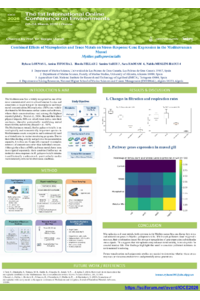
Microplastic (MP) contamination and trace metal pollution are pervasive and often co-occurring stressors in marine ecosystems, particularly in the Mediterranean Sea, one of the world’s most polluted semi-enclosed basins, posing increasing risks to marine biota. This study investigated the individual and combined effects of microplastics and trace metals—cadmium (Cd), lead (Pb), and arsenic (As) on antioxidant and stress-response pathways in the Mediterranean mussel Mytilus galloprovincialis. Mussels (27.04 ± 6.45 g; 4.02 ± 0.21 cm) were exposed for 14 days to four treatments: (1) control (synthetic seawater, 18 °C), (2) microplastics (=1 mg L⁻¹), (3) metals (Cd, Pb, As; 10 µg L⁻¹ each), and (4) combined microplastics + metals. At the end of exposure, gill and digestive gland tissues were analyzed by qPCR to assess the expression of antioxidant genes (cat, sod1, sod2) and the stress-inducible chaperone hsp70.
Both microplastics and metals individually induced moderate up-regulation of antioxidant genes, consistent with enhanced reactive oxygen species (ROS) generation and activation of cellular defense mechanisms. The combined treatment elicited the strongest transcriptional responses, particularly for sod2 and hsp70, indicating pronounced mitochondrial oxidative stress.
Overall, the findings demonstrate that co-exposure to microplastics and trace metals imposes a greater oxidative burden than exposure to either stressor alone, potentially compromising the physiological resilience of M. galloprovincialis. Understanding such multi-stressor interactions is essential for evaluating the ecological risks of emerging pollutants in the Mediterranean coastal environment.
Keywords
Emerging pollutants
Oxidative stress
qPCR
Antioxidant enzymes
Multiple stressors
Marine ecotoxicology
Poster
Ryhane-Lounas-Environment-MDPI-Mars-2026.pdf
Valorization of lignin for the development of sustainable amphiphilic modifiers with high surface activity for environmentally responsible cement systems
Zinc Oxide Nanoparticles and magneto-priming in Triticale: Environmental Behaviour, Biological Responses, and Risk Implications