Event submissions
Published
This submission belongs to the session S2. Environmental Impact and Risk Assessment of the event The 1st International Online Conference on Environments
Published date
27 Feb, 2026
Academic Editor
'%3e%3cpath%20d='M12.6657%2010.9104C12.4185%2010.325%2012.0599%209.79327%2011.6097%209.34482C11.1609%208.89508%2010.6293%208.5365%2010.0442%208.28888C10.0389%208.28626%2010.0337%208.28495%2010.0285%208.28233C10.8446%207.69279%2011.3752%206.73249%2011.3752%205.64904C11.3752%203.8542%209.92103%202.39999%208.1262%202.39999C6.33136%202.39999%204.87715%203.8542%204.87715%205.64904C4.87715%206.73249%205.40774%207.69279%206.22393%208.28364C6.21869%208.28626%206.21345%208.28757%206.20821%208.29019C5.62129%208.5378%205.09463%208.89284%204.64265%209.34613C4.1929%209.79493%203.83432%2010.3266%203.58671%2010.9117C3.34345%2011.4845%203.21226%2012.0987%203.20023%2012.7209C3.19988%2012.7349%203.20233%2012.7488%203.20744%2012.7619C3.21255%2012.7749%203.22022%2012.7867%203.22998%2012.7968C3.23975%2012.8068%203.25142%2012.8147%203.26431%2012.8202C3.2772%2012.8256%203.29105%2012.8284%203.30504%2012.8284H4.09109C4.14874%2012.8284%204.19459%2012.7825%204.1959%2012.7262C4.2221%2011.7148%204.62823%2010.7676%205.34617%2010.0497C6.08899%209.30683%207.0755%208.89808%208.1262%208.89808C9.17689%208.89808%2010.1634%209.30683%2010.9062%2010.0497C11.6242%2010.7676%2012.0303%2011.7148%2012.0565%2012.7262C12.0578%2012.7838%2012.1037%2012.8284%2012.1613%2012.8284H12.9474C12.9613%2012.8284%2012.9752%2012.8256%2012.9881%2012.8202C13.001%2012.8147%2013.0126%2012.8068%2013.0224%2012.7968C13.0322%2012.7867%2013.0398%2012.7749%2013.0449%2012.7619C13.0501%2012.7488%2013.0525%2012.7349%2013.0522%2012.7209C13.0391%2012.0947%2012.9094%2011.4855%2012.6657%2010.9104ZM8.1262%207.9024C7.52486%207.9024%206.9589%207.6679%206.53312%207.24211C6.10733%206.81633%205.87283%206.25037%205.87283%205.64904C5.87283%205.0477%206.10733%204.48174%206.53312%204.05596C6.9589%203.63018%207.52486%203.39567%208.1262%203.39567C8.72753%203.39567%209.29349%203.63018%209.71927%204.05596C10.1451%204.48174%2010.3796%205.0477%2010.3796%205.64904C10.3796%206.25037%2010.1451%206.81633%209.71927%207.24211C9.29349%207.6679%208.72753%207.9024%208.1262%207.9024Z'%20fill='%235D1EE1'/%3e%3c/g%3e%3c/svg%3e) Gianniantonio Petruzzelli
Gianniantonio PetruzzelliCitation
Mónica Montoya, José Álvarez, Marina de-Francisco, Patricia Almendros, Zinc Oxide Nanoparticles and magneto-priming in Triticale: Environmental Behaviour, Biological Responses, and Risk Implications, in Proceedings of The 1st International Online Conference on Environments, 2 March–4 March 2026, MDPI: Basel, Switzerland
Share
Email
Facebook
Twitter
LinkedIn
Zinc Oxide Nanoparticles and magneto-priming in Triticale: Environmental Behaviour, Biological Responses, and Risk Implications
'%3e%3cpath%20d='M12.6647%2010.9104C12.4176%2010.325%2012.0589%209.7933%2011.6088%209.34485C11.16%208.89511%2010.6283%208.53653%2010.0432%208.28891C10.038%208.28629%2010.0327%208.28498%2010.0275%208.28236C10.8437%207.69282%2011.3743%206.73252%2011.3743%205.64907C11.3743%203.85423%209.92005%202.40002%208.12522%202.40002C6.33038%202.40002%204.87618%203.85423%204.87618%205.64907C4.87618%206.73252%205.40677%207.69282%206.22296%208.28367C6.21772%208.28629%206.21248%208.2876%206.20724%208.29022C5.62031%208.53783%205.09365%208.89287%204.64167%209.34616C4.19192%209.79496%203.83334%2010.3266%203.58573%2010.9117C3.34247%2011.4846%203.21128%2012.0987%203.19925%2012.721C3.1989%2012.735%203.20135%2012.7489%203.20646%2012.7619C3.21157%2012.7749%203.21924%2012.7868%203.22901%2012.7968C3.23877%2012.8068%203.25045%2012.8148%203.26334%2012.8202C3.27623%2012.8256%203.29007%2012.8284%203.30406%2012.8284H4.09012C4.14776%2012.8284%204.19362%2012.7825%204.19493%2012.7262C4.22113%2011.7148%204.62726%2010.7676%205.34519%2010.0497C6.08802%209.30686%207.07452%208.89811%208.12522%208.89811C9.17592%208.89811%2010.1624%209.30686%2010.9052%2010.0497C11.6232%2010.7676%2012.0293%2011.7148%2012.0555%2012.7262C12.0568%2012.7839%2012.1027%2012.8284%2012.1603%2012.8284H12.9464C12.9604%2012.8284%2012.9742%2012.8256%2012.9871%2012.8202C13%2012.8148%2013.0117%2012.8068%2013.0214%2012.7968C13.0312%2012.7868%2013.0389%2012.7749%2013.044%2012.7619C13.0491%2012.7489%2013.0515%2012.735%2013.0512%2012.721C13.0381%2012.0947%2012.9084%2011.4856%2012.6647%2010.9104ZM8.12522%207.90243C7.52388%207.90243%206.95792%207.66793%206.53214%207.24215C6.10636%206.81636%205.87185%206.2504%205.87185%205.64907C5.87185%205.04773%206.10636%204.48177%206.53214%204.05599C6.95792%203.63021%207.52388%203.3957%208.12522%203.3957C8.72655%203.3957%209.29252%203.63021%209.7183%204.05599C10.1441%204.48177%2010.3786%205.04773%2010.3786%205.64907C10.3786%206.2504%2010.1441%206.81636%209.7183%207.24215C9.29252%207.66793%208.72655%207.90243%208.12522%207.90243Z'%20fill='%235D1EE1'/%3e%3c/g%3e%3c/svg%3e)
Mónica Montoya 1,2
José Álvarez 3
Marina de-Francisco 1
Patricia Almendros 1,2
1. Department of Chemistry and Food Technology, Agronomic, Food and Biosystems Engineering School, Universidad Politécnica de Madrid, 28040 Madrid, Spain
2. Research Centre for the Management of Agricultural and Environmental Risks (CEIGRAM), Universidad Politécnica de Madrid (UPM), 28040 Madrid, Spain
3. Department of Agroforestry Engineering, Agronomic, Food and Biosystems Engineering School, Universidad Politécnica de Madrid, 28040 Madrid, Spain
Abstract
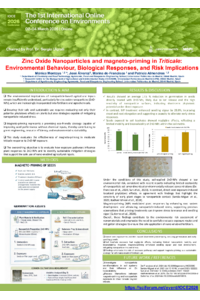
The environmental implications of nanoparticle-based agricultural inputs remain insufficiently understood, particularly for zinc oxide nanoparticles (ZnO-NPs), which are increasingly incorporated into fertilizers and agrochemicals. To ensure their safe and sustainable use, it is essential to evaluate both their potential phytotoxic effects and strategies to mitigate them. Magneto-priming (MP) has recently gained attention as a non-chemical, eco-friendly approach capable of enhancing seed germination, stimulating plant metabolism, and improving stress tolerance. In this study, Triticale (X Triticosecale Wittmack) seeds were subjected to two experimental approaches: (i) direct priming with ZnO-NPs at 500 and 5000 mg Zn L⁻¹, with or without MP, and (ii) exposure to soil leachates obtained from an acidic soil previously treated with the same nanoparticle concentrations. Germination percentage, shoot and root length, root number, and the Seedling Vigor Index were evaluated to assess nanoparticle-induced phytotoxicity and the potential mitigating role of MP treatment. Results showed an average 17.5 % reduction in germination in seeds directly treated with ZnO-NPs, likely due to ion release and the high reactivity of nanoparticle surfaces, indicating short-term phytotoxic potential under direct exposure. In contrast, MP treatment enhanced seedling vigour by 28.8%, improving shoot and root elongation and suggesting a capacity to alleviate early stress responses. Seeds exposed to soil leachates showed negligible effects, reflecting a limited mobility and bioavailability of ZnO-NPs within the soil matrix. These findings suggest that under the conditions of our study, soil-applied ZnO-NPs represent a low environmental risk, whereas direct contact with seeds can induce localized phytotoxic effects. In addition, MP treatment appears to modulate plant responses, enhancing root system development and mitigating nanoparticle-induced stress. Overall, the study contributes to environmental impact assessment of nanomaterials, emphasizing the need to evaluate exposure pathways and mitigation strategies for safe nano-enabled fertilizer use.
Keywords
Nano-enabled fertilizers
Environmental safety
Sustainable nanotechnology
Ecotoxicological assessment
Growth promotion
Plant-nanoparticle interactions
Magneto-priming
Poster
IOCE 2026 Poster_MM.pdf
Combined Effects of Microplastics and Trace Metals on Stress-Response Gene Expression in the Mediterranean Mussel Mytilus galloprovincialis
How could environmental conditions shape the outcome of a mitigation strategy? A short-term study in marinas of the NW Iberian Peninsula