Event submissions
Published
This submission belongs to the session S6. Ecological, Environmental and Circular Economics of the event The 1st International Online Conference on Environments
Published date
27 Feb, 2026
Academic Editor
'%3e%3cpath%20d='M12.6657%2010.9104C12.4185%2010.325%2012.0599%209.79327%2011.6097%209.34482C11.1609%208.89508%2010.6293%208.5365%2010.0442%208.28888C10.0389%208.28626%2010.0337%208.28495%2010.0285%208.28233C10.8446%207.69279%2011.3752%206.73249%2011.3752%205.64904C11.3752%203.8542%209.92103%202.39999%208.1262%202.39999C6.33136%202.39999%204.87715%203.8542%204.87715%205.64904C4.87715%206.73249%205.40774%207.69279%206.22393%208.28364C6.21869%208.28626%206.21345%208.28757%206.20821%208.29019C5.62129%208.5378%205.09463%208.89284%204.64265%209.34613C4.1929%209.79493%203.83432%2010.3266%203.58671%2010.9117C3.34345%2011.4845%203.21226%2012.0987%203.20023%2012.7209C3.19988%2012.7349%203.20233%2012.7488%203.20744%2012.7619C3.21255%2012.7749%203.22022%2012.7867%203.22998%2012.7968C3.23975%2012.8068%203.25142%2012.8147%203.26431%2012.8202C3.2772%2012.8256%203.29105%2012.8284%203.30504%2012.8284H4.09109C4.14874%2012.8284%204.19459%2012.7825%204.1959%2012.7262C4.2221%2011.7148%204.62823%2010.7676%205.34617%2010.0497C6.08899%209.30683%207.0755%208.89808%208.1262%208.89808C9.17689%208.89808%2010.1634%209.30683%2010.9062%2010.0497C11.6242%2010.7676%2012.0303%2011.7148%2012.0565%2012.7262C12.0578%2012.7838%2012.1037%2012.8284%2012.1613%2012.8284H12.9474C12.9613%2012.8284%2012.9752%2012.8256%2012.9881%2012.8202C13.001%2012.8147%2013.0126%2012.8068%2013.0224%2012.7968C13.0322%2012.7867%2013.0398%2012.7749%2013.0449%2012.7619C13.0501%2012.7488%2013.0525%2012.7349%2013.0522%2012.7209C13.0391%2012.0947%2012.9094%2011.4855%2012.6657%2010.9104ZM8.1262%207.9024C7.52486%207.9024%206.9589%207.6679%206.53312%207.24211C6.10733%206.81633%205.87283%206.25037%205.87283%205.64904C5.87283%205.0477%206.10733%204.48174%206.53312%204.05596C6.9589%203.63018%207.52486%203.39567%208.1262%203.39567C8.72753%203.39567%209.29349%203.63018%209.71927%204.05596C10.1451%204.48174%2010.3796%205.0477%2010.3796%205.64904C10.3796%206.25037%2010.1451%206.81633%209.71927%207.24211C9.29349%207.6679%208.72753%207.9024%208.1262%207.9024Z'%20fill='%235D1EE1'/%3e%3c/g%3e%3c/svg%3e) WALTER ALBERTO PENGUE
WALTER ALBERTO PENGUECitation
Patrícia Branco, Rúben Marques, Sofia Terpstra, Elisabete Muchagato Maurício, Sustainable Production of Antimicrobial Peptides from Fruit Waste Using Genetically Modified Yeast for Pathogen Control, in Proceedings of The 1st International Online Conference on Environments, 2 March–4 March 2026, MDPI: Basel, Switzerland
Share
Email
Facebook
Twitter
LinkedIn
Sustainable Production of Antimicrobial Peptides from Fruit Waste Using Genetically Modified Yeast for Pathogen Control

Patrícia Branco 1
'%3e%3cpath%20d='M12.6647%2010.9104C12.4176%2010.325%2012.0589%209.7933%2011.6088%209.34485C11.16%208.89511%2010.6283%208.53653%2010.0432%208.28891C10.038%208.28629%2010.0327%208.28498%2010.0275%208.28236C10.8437%207.69282%2011.3743%206.73252%2011.3743%205.64907C11.3743%203.85423%209.92005%202.40002%208.12522%202.40002C6.33038%202.40002%204.87618%203.85423%204.87618%205.64907C4.87618%206.73252%205.40677%207.69282%206.22296%208.28367C6.21772%208.28629%206.21248%208.2876%206.20724%208.29022C5.62031%208.53783%205.09365%208.89287%204.64167%209.34616C4.19192%209.79496%203.83334%2010.3266%203.58573%2010.9117C3.34247%2011.4846%203.21128%2012.0987%203.19925%2012.721C3.1989%2012.735%203.20135%2012.7489%203.20646%2012.7619C3.21157%2012.7749%203.21924%2012.7868%203.22901%2012.7968C3.23877%2012.8068%203.25045%2012.8148%203.26334%2012.8202C3.27623%2012.8256%203.29007%2012.8284%203.30406%2012.8284H4.09012C4.14776%2012.8284%204.19362%2012.7825%204.19493%2012.7262C4.22113%2011.7148%204.62726%2010.7676%205.34519%2010.0497C6.08802%209.30686%207.07452%208.89811%208.12522%208.89811C9.17592%208.89811%2010.1624%209.30686%2010.9052%2010.0497C11.6232%2010.7676%2012.0293%2011.7148%2012.0555%2012.7262C12.0568%2012.7839%2012.1027%2012.8284%2012.1603%2012.8284H12.9464C12.9604%2012.8284%2012.9742%2012.8256%2012.9871%2012.8202C13%2012.8148%2013.0117%2012.8068%2013.0214%2012.7968C13.0312%2012.7868%2013.0389%2012.7749%2013.044%2012.7619C13.0491%2012.7489%2013.0515%2012.735%2013.0512%2012.721C13.0381%2012.0947%2012.9084%2011.4856%2012.6647%2010.9104ZM8.12522%207.90243C7.52388%207.90243%206.95792%207.66793%206.53214%207.24215C6.10636%206.81636%205.87185%206.2504%205.87185%205.64907C5.87185%205.04773%206.10636%204.48177%206.53214%204.05599C6.95792%203.63021%207.52388%203.3957%208.12522%203.3957C8.72655%203.3957%209.29252%203.63021%209.7183%204.05599C10.1441%204.48177%2010.3786%205.04773%2010.3786%205.64907C10.3786%206.2504%2010.1441%206.81636%209.7183%207.24215C9.29252%207.66793%208.72655%207.90243%208.12522%207.90243Z'%20fill='%235D1EE1'/%3e%3c/g%3e%3c/svg%3e)
Rúben Marques 1
Sofia Terpstra 1
Elisabete Muchagato Maurício 1,2
1. BIORG - Bioengineering and Sustainability Research Group, Faculty of Engineering, Lusófona University, Campo Grande 376, 1749-024, Lisbon, Portugal
2. CBIOS – Research Center for Biosciences & Health Technologies, School of Health Sciences and Technologies, Lusófona University, Campo Grande 376, 1749-024, Lisbon, Portugal
Abstract
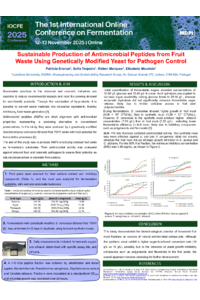
Fruit and vegetables are among the food groups with the highest post-harvest losses, with an estimated 40% of production discarded worldwide. This organic waste significantly contributes to greenhouse gas emissions, particularly methane, during decomposition, emphasising the need for sustainable and circular strategies to valorise resources. This study aimed to develop a sustainable method for producing antimicrobial peptides (AMPs) from fruit peel waste using genetically modified Saccharomyces cerevisiae expressing the Ethanol Red TDH1 (ER TDH1) gene and to evaluate their potential against microbial pathogens.
Waste peels of mango, pineapple, banana, and apple were processed into must. The musts underwent acid hydrolysis, followed by alcoholic fermentation with S. cerevisiae ER TDH1. After fermentation, peptides <10 kDa were extracted from the cell-free supernatant by ultrafiltration and tested against microbial pathogens, including E. coli, P. aeruginosa, S. aureus, and C. albicans. Glucose, fructose, and ethanol levels were monitored throughout. For peptide production comparison, alcoholic fermentation of a synthetic must was performed, yielding higher ethanol (14 g/L) than fermentation of fruit must (3 g/L). The <10 kDa peptide fraction from fruit must showed strong inhibition of S. aureus and C. albicans (MIC = 1.47 mg/mL), while synthetic must peptides performed better against E. coli and P. aeruginosa (MIC = 1.47 mg/mL). AMPs derived from fruit waste via fermentation show promising antimicrobial activity, particularly against Gram-positive bacteria and yeast, highlighting their potential as sustainable, natural antimicrobial agents for pharmaceutical or food product applications, while contributing to circular economy principles by transforming underutilized biomass into high-value bioactive compounds.
Keywords
Saccharomyces cerevisiae Ethanol Red TDH1
antimicrobial peptides
minimum inhibitory concentration
alcoholic fermentation
circular economy
Poster
poster_Sustainable Production of Antimicrobial Peptides from Fruit Waste Using Genetically Modified Yeast for Pathogen Control_.pdf
Index-based environmental risk assessment of micro- and nanoplastics: handbook for conscious, accurate, and standardized use
Tracing Anthropogenic Gadolinium in Portugal: Baseline Survey Across Five Transition Aquatic Systems