Event submissions
Published
This submission belongs to the session S4. Urban Systems and Ecosystems: Dynamics and Functioning of the event The 1st International Online Conference on Environments
Published date
27 Feb, 2026
Academic Editor
'%3e%3cpath%20d='M12.6657%2010.9104C12.4185%2010.325%2012.0599%209.79327%2011.6097%209.34482C11.1609%208.89508%2010.6293%208.5365%2010.0442%208.28888C10.0389%208.28626%2010.0337%208.28495%2010.0285%208.28233C10.8446%207.69279%2011.3752%206.73249%2011.3752%205.64904C11.3752%203.8542%209.92103%202.39999%208.1262%202.39999C6.33136%202.39999%204.87715%203.8542%204.87715%205.64904C4.87715%206.73249%205.40774%207.69279%206.22393%208.28364C6.21869%208.28626%206.21345%208.28757%206.20821%208.29019C5.62129%208.5378%205.09463%208.89284%204.64265%209.34613C4.1929%209.79493%203.83432%2010.3266%203.58671%2010.9117C3.34345%2011.4845%203.21226%2012.0987%203.20023%2012.7209C3.19988%2012.7349%203.20233%2012.7488%203.20744%2012.7619C3.21255%2012.7749%203.22022%2012.7867%203.22998%2012.7968C3.23975%2012.8068%203.25142%2012.8147%203.26431%2012.8202C3.2772%2012.8256%203.29105%2012.8284%203.30504%2012.8284H4.09109C4.14874%2012.8284%204.19459%2012.7825%204.1959%2012.7262C4.2221%2011.7148%204.62823%2010.7676%205.34617%2010.0497C6.08899%209.30683%207.0755%208.89808%208.1262%208.89808C9.17689%208.89808%2010.1634%209.30683%2010.9062%2010.0497C11.6242%2010.7676%2012.0303%2011.7148%2012.0565%2012.7262C12.0578%2012.7838%2012.1037%2012.8284%2012.1613%2012.8284H12.9474C12.9613%2012.8284%2012.9752%2012.8256%2012.9881%2012.8202C13.001%2012.8147%2013.0126%2012.8068%2013.0224%2012.7968C13.0322%2012.7867%2013.0398%2012.7749%2013.0449%2012.7619C13.0501%2012.7488%2013.0525%2012.7349%2013.0522%2012.7209C13.0391%2012.0947%2012.9094%2011.4855%2012.6657%2010.9104ZM8.1262%207.9024C7.52486%207.9024%206.9589%207.6679%206.53312%207.24211C6.10733%206.81633%205.87283%206.25037%205.87283%205.64904C5.87283%205.0477%206.10733%204.48174%206.53312%204.05596C6.9589%203.63018%207.52486%203.39567%208.1262%203.39567C8.72753%203.39567%209.29349%203.63018%209.71927%204.05596C10.1451%204.48174%2010.3796%205.0477%2010.3796%205.64904C10.3796%206.25037%2010.1451%206.81633%209.71927%207.24211C9.29349%207.6679%208.72753%207.9024%208.1262%207.9024Z'%20fill='%235D1EE1'/%3e%3c/g%3e%3c/svg%3e) Brian Fath
Brian FathCitation
Md. Nurjaman Ridoy, Sk. Tanjim Jaman Supto, Air Pollution Correlation and Seasonal Variability in Chattogram’s Urban Ecosystem, in Proceedings of The 1st International Online Conference on Environments, 2 March–4 March 2026, MDPI: Basel, Switzerland
Share
Email
Facebook
Twitter
LinkedIn
Air Pollution Correlation and Seasonal Variability in Chattogram’s Urban Ecosystem

Md. Nurjaman Ridoy 1

Sk. Tanjim Jaman Supto 1
1. Department of Environmental Research, Nano Research Centre, Sylhet, 3114, Bangladesh
Abstract
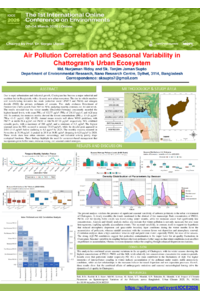
Due to rapid urbanization and industrial growth, Chattogram has become a major industrial and maritime hub in Bangladesh, with a dynamic new urban ecosystem. The rise in vehicle numbers and manufacturing industries has made particulate matter (PM2.5 and PM10) and nitrogen dioxide (NO2) the primary pollutants of concern. This study evaluates Department of Environment (DoE) records from 2013 to 2024, analyzing monthly extremes and decadal trends. The results revealed that the winter months (December–February) consistently recorded the highest hazard levels, with mean PM₂.₅ of 122.77 µg/m³, PM₁₀ of 216.15 µg/m³, and AQI near 188. In contrast, the monsoon months showed the lowest concentrations (PM₂.₅: 17–25 µg/m³; PM₁₀: 43–51 µg/m³; AQI: 43–55). Annual means remain well above WHO guidelines, with PM2.5 at 44.08–76.4 µg/m³ and PM10 at 106.78–162.83 µg/m³, respectively. NO₂ exhibited episodic peaks, with a maximum of 280 µg/m³, and a minimum of 0.2 µg/m³. The highest seasonal mean for NO₂ occurred in autumn (35.13 µg/m³), while the decadal peak appeared in 2018 (34.4 µg/m³) before declining to 6.3 µg/m³ by 2024. The monthly maxima occurred in November at 38.94 µg/m³. It peaked in 2018 at 34.40 µg/m³, dropping to 6.28 µg/m³ in 2024. These trends show how urban structure, meteorology, and industrial activity jointly shape ecological functions. These findings highlight the need for ecosystem-based management that incorporates green buffer zones, emission zoning, and seasonal control strategies to maintain air quality. This study provides a case model of sustainable air quality management in rapidly developing coastal ecosystems.
Keywords
urbanization
marine hub
urban ecosystem
particulate matter
chattogram
seasonal variation
air quality index
atmospheric pollution
meteorology
seasonal control
coastal ecosystem
environmental monitoring
Poster
(sciforum-155142)Air Pollution Correlation and Seasonal Variability in Chattogram’s Urban Ecosystem.pdf
Analysis of the Growth of Economic Units and Their Influence on the Water Quality of Wetlands receptors Wastewater in Mazatlán, Sinaloa (Mexico)
DNT-Induced Soil and Crop Toxicity: Mechanisms, Consequences, and Sustainable Remediation