Event submissions
Published
This submission belongs to the session 5. Digital Tools for Plant Protection of the event The 1st International Electronic Conference on Plant Protection
Published date
01 Mar, 2026
Academic Editor
'%3e%3cpath%20d='M12.6657%2010.9104C12.4185%2010.325%2012.0599%209.79327%2011.6097%209.34482C11.1609%208.89508%2010.6293%208.5365%2010.0442%208.28888C10.0389%208.28626%2010.0337%208.28495%2010.0285%208.28233C10.8446%207.69279%2011.3752%206.73249%2011.3752%205.64904C11.3752%203.8542%209.92103%202.39999%208.1262%202.39999C6.33136%202.39999%204.87715%203.8542%204.87715%205.64904C4.87715%206.73249%205.40774%207.69279%206.22393%208.28364C6.21869%208.28626%206.21345%208.28757%206.20821%208.29019C5.62129%208.5378%205.09463%208.89284%204.64265%209.34613C4.1929%209.79493%203.83432%2010.3266%203.58671%2010.9117C3.34345%2011.4845%203.21226%2012.0987%203.20023%2012.7209C3.19988%2012.7349%203.20233%2012.7488%203.20744%2012.7619C3.21255%2012.7749%203.22022%2012.7867%203.22998%2012.7968C3.23975%2012.8068%203.25142%2012.8147%203.26431%2012.8202C3.2772%2012.8256%203.29105%2012.8284%203.30504%2012.8284H4.09109C4.14874%2012.8284%204.19459%2012.7825%204.1959%2012.7262C4.2221%2011.7148%204.62823%2010.7676%205.34617%2010.0497C6.08899%209.30683%207.0755%208.89808%208.1262%208.89808C9.17689%208.89808%2010.1634%209.30683%2010.9062%2010.0497C11.6242%2010.7676%2012.0303%2011.7148%2012.0565%2012.7262C12.0578%2012.7838%2012.1037%2012.8284%2012.1613%2012.8284H12.9474C12.9613%2012.8284%2012.9752%2012.8256%2012.9881%2012.8202C13.001%2012.8147%2013.0126%2012.8068%2013.0224%2012.7968C13.0322%2012.7867%2013.0398%2012.7749%2013.0449%2012.7619C13.0501%2012.7488%2013.0525%2012.7349%2013.0522%2012.7209C13.0391%2012.0947%2012.9094%2011.4855%2012.6657%2010.9104ZM8.1262%207.9024C7.52486%207.9024%206.9589%207.6679%206.53312%207.24211C6.10733%206.81633%205.87283%206.25037%205.87283%205.64904C5.87283%205.0477%206.10733%204.48174%206.53312%204.05596C6.9589%203.63018%207.52486%203.39567%208.1262%203.39567C8.72753%203.39567%209.29349%203.63018%209.71927%204.05596C10.1451%204.48174%2010.3796%205.0477%2010.3796%205.64904C10.3796%206.25037%2010.1451%206.81633%209.71927%207.24211C9.29349%207.6679%208.72753%207.9024%208.1262%207.9024Z'%20fill='%235D1EE1'/%3e%3c/g%3e%3c/svg%3e) Jorge M. S. Faria
Jorge M. S. FariaCitation
Md Salah Uddin, Investigation of the Effects of Fly Ash-Enriched Soil on the Radish Growth Using a Multi-Attribute Decision-Making Method., in Proceedings of The 1st International Electronic Conference on Plant Protection, 2 March–8 March 2026, MDPI: Basel, Switzerland
Share
Email
Facebook
Twitter
LinkedIn
Investigation of the Effects of Fly Ash-Enriched Soil on the Radish Growth Using a Multi-Attribute Decision-Making Method.
'%3e%3cpath%20d='M12.6647%2010.9104C12.4176%2010.325%2012.0589%209.7933%2011.6088%209.34485C11.16%208.89511%2010.6283%208.53653%2010.0432%208.28891C10.038%208.28629%2010.0327%208.28498%2010.0275%208.28236C10.8437%207.69282%2011.3743%206.73252%2011.3743%205.64907C11.3743%203.85423%209.92005%202.40002%208.12522%202.40002C6.33038%202.40002%204.87618%203.85423%204.87618%205.64907C4.87618%206.73252%205.40677%207.69282%206.22296%208.28367C6.21772%208.28629%206.21248%208.2876%206.20724%208.29022C5.62031%208.53783%205.09365%208.89287%204.64167%209.34616C4.19192%209.79496%203.83334%2010.3266%203.58573%2010.9117C3.34247%2011.4846%203.21128%2012.0987%203.19925%2012.721C3.1989%2012.735%203.20135%2012.7489%203.20646%2012.7619C3.21157%2012.7749%203.21924%2012.7868%203.22901%2012.7968C3.23877%2012.8068%203.25045%2012.8148%203.26334%2012.8202C3.27623%2012.8256%203.29007%2012.8284%203.30406%2012.8284H4.09012C4.14776%2012.8284%204.19362%2012.7825%204.19493%2012.7262C4.22113%2011.7148%204.62726%2010.7676%205.34519%2010.0497C6.08802%209.30686%207.07452%208.89811%208.12522%208.89811C9.17592%208.89811%2010.1624%209.30686%2010.9052%2010.0497C11.6232%2010.7676%2012.0293%2011.7148%2012.0555%2012.7262C12.0568%2012.7839%2012.1027%2012.8284%2012.1603%2012.8284H12.9464C12.9604%2012.8284%2012.9742%2012.8256%2012.9871%2012.8202C13%2012.8148%2013.0117%2012.8068%2013.0214%2012.7968C13.0312%2012.7868%2013.0389%2012.7749%2013.044%2012.7619C13.0491%2012.7489%2013.0515%2012.735%2013.0512%2012.721C13.0381%2012.0947%2012.9084%2011.4856%2012.6647%2010.9104ZM8.12522%207.90243C7.52388%207.90243%206.95792%207.66793%206.53214%207.24215C6.10636%206.81636%205.87185%206.2504%205.87185%205.64907C5.87185%205.04773%206.10636%204.48177%206.53214%204.05599C6.95792%203.63021%207.52388%203.3957%208.12522%203.3957C8.72655%203.3957%209.29252%203.63021%209.7183%204.05599C10.1441%204.48177%2010.3786%205.04773%2010.3786%205.64907C10.3786%206.2504%2010.1441%206.81636%209.7183%207.24215C9.29252%207.66793%208.72655%207.90243%208.12522%207.90243Z'%20fill='%235D1EE1'/%3e%3c/g%3e%3c/svg%3e)
Md Salah Uddin 1
1. Department of Mathematics and Physics
School of Engineering and Physical Sciences
North South University
Dhaka, Bangladesh
Abstract
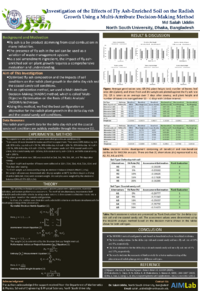
In recent years, sustainable industrial development has been expanding globally. Different industries produce by-products that pose significant environmental challenges. Fly ash is one of the by-products from the coal combustion process used by many industries. For the sustainable utilization of by-products, fly ash has gained increasing attention by improving soil quality, and can also be used as a potential solution for the waste management system. As a soil amendment ingredient, the impact of fly ash-enriched soil on plant growth requires a comprehensive evaluation and understanding. In this research, the growth of the radish plant is analyzed by a Multi-Attribute Decision-Making (MADM) method. The growth data of the radish plant were collected under two types of soil conditions with different fly-ash compositions. The experiment was performed under semi-controlled conditions in a greenhouse facility. In this research, we used a multi-objective optimization framework, which is one of the MADM methods, to analyze the impact of the fly ash composition in the delta clay-rich soil and coastal sandy soil on plant growth. The data for five fly ash compositions: 5%, 10%, 15%, and 20% were collected for the delta clay-rich soil and coastal sandy soil. The significant growth factors are germination rate, plant height, and number of leaves. We used the 'Multi-Objective Optimization on the Basis of Ratio Analysis' (MOORA) technique to understand the most significant configuration for evaluating the plant growth under different soil conditions. The MOORA technique is widely used in process parameters optimization, materials selection, and system performance assessment. The method simultaneously incorporates both desirable and undesirable criteria by using a ratio system to convert a decision matrix into a ranking system based on the sample configuration. Our research finds the optimized fly ash composition and the impacts of soil conditions on the radish plant growth in different soil conditions.
Keywords
Fly Ash
MOORA
Decision Making
Plant Growth
Soil Condtions
Poster
Plants2026.pdf
Genetic Resources and Breeding Strategies for Spring Wheat (Triticum aestivum L.) in the Non-Chernozem Zone (NCZ) of Russia: A Meta-Analysis
From waste to protection: evaluating the efficacy of Tenebrio molitor insect frass in the suppression of tomato soil-borne pathogens