Event submissions
Published
This submission belongs to the session 4. Biochemical and Biological Control of the event The 1st International Electronic Conference on Plant Protection
Published date
01 Mar, 2026
Academic Editor
'%3e%3cpath%20d='M12.6657%2010.9104C12.4185%2010.325%2012.0599%209.79327%2011.6097%209.34482C11.1609%208.89508%2010.6293%208.5365%2010.0442%208.28888C10.0389%208.28626%2010.0337%208.28495%2010.0285%208.28233C10.8446%207.69279%2011.3752%206.73249%2011.3752%205.64904C11.3752%203.8542%209.92103%202.39999%208.1262%202.39999C6.33136%202.39999%204.87715%203.8542%204.87715%205.64904C4.87715%206.73249%205.40774%207.69279%206.22393%208.28364C6.21869%208.28626%206.21345%208.28757%206.20821%208.29019C5.62129%208.5378%205.09463%208.89284%204.64265%209.34613C4.1929%209.79493%203.83432%2010.3266%203.58671%2010.9117C3.34345%2011.4845%203.21226%2012.0987%203.20023%2012.7209C3.19988%2012.7349%203.20233%2012.7488%203.20744%2012.7619C3.21255%2012.7749%203.22022%2012.7867%203.22998%2012.7968C3.23975%2012.8068%203.25142%2012.8147%203.26431%2012.8202C3.2772%2012.8256%203.29105%2012.8284%203.30504%2012.8284H4.09109C4.14874%2012.8284%204.19459%2012.7825%204.1959%2012.7262C4.2221%2011.7148%204.62823%2010.7676%205.34617%2010.0497C6.08899%209.30683%207.0755%208.89808%208.1262%208.89808C9.17689%208.89808%2010.1634%209.30683%2010.9062%2010.0497C11.6242%2010.7676%2012.0303%2011.7148%2012.0565%2012.7262C12.0578%2012.7838%2012.1037%2012.8284%2012.1613%2012.8284H12.9474C12.9613%2012.8284%2012.9752%2012.8256%2012.9881%2012.8202C13.001%2012.8147%2013.0126%2012.8068%2013.0224%2012.7968C13.0322%2012.7867%2013.0398%2012.7749%2013.0449%2012.7619C13.0501%2012.7488%2013.0525%2012.7349%2013.0522%2012.7209C13.0391%2012.0947%2012.9094%2011.4855%2012.6657%2010.9104ZM8.1262%207.9024C7.52486%207.9024%206.9589%207.6679%206.53312%207.24211C6.10733%206.81633%205.87283%206.25037%205.87283%205.64904C5.87283%205.0477%206.10733%204.48174%206.53312%204.05596C6.9589%203.63018%207.52486%203.39567%208.1262%203.39567C8.72753%203.39567%209.29349%203.63018%209.71927%204.05596C10.1451%204.48174%2010.3796%205.0477%2010.3796%205.64904C10.3796%206.25037%2010.1451%206.81633%209.71927%207.24211C9.29349%207.6679%208.72753%207.9024%208.1262%207.9024Z'%20fill='%235D1EE1'/%3e%3c/g%3e%3c/svg%3e) Jorge M. S. Faria
Jorge M. S. FariaCitation
Irene Zunzunegui, Sergio Estébanez, Jorge Poveda Arias, Óscar Santamaria Becerril, Jorge Martín García, From waste to protection: evaluating the efficacy of Tenebrio molitor insect frass in the suppression of tomato soil-borne pathogens, in Proceedings of The 1st International Electronic Conference on Plant Protection, 2 March–8 March 2026, MDPI: Basel, Switzerland
Share
Email
Facebook
Twitter
LinkedIn
From waste to protection: evaluating the efficacy of Tenebrio molitor insect frass in the suppression of tomato soil-borne pathogens
'%3e%3cpath%20d='M12.6647%2010.9104C12.4176%2010.325%2012.0589%209.7933%2011.6088%209.34485C11.16%208.89511%2010.6283%208.53653%2010.0432%208.28891C10.038%208.28629%2010.0327%208.28498%2010.0275%208.28236C10.8437%207.69282%2011.3743%206.73252%2011.3743%205.64907C11.3743%203.85423%209.92005%202.40002%208.12522%202.40002C6.33038%202.40002%204.87618%203.85423%204.87618%205.64907C4.87618%206.73252%205.40677%207.69282%206.22296%208.28367C6.21772%208.28629%206.21248%208.2876%206.20724%208.29022C5.62031%208.53783%205.09365%208.89287%204.64167%209.34616C4.19192%209.79496%203.83334%2010.3266%203.58573%2010.9117C3.34247%2011.4846%203.21128%2012.0987%203.19925%2012.721C3.1989%2012.735%203.20135%2012.7489%203.20646%2012.7619C3.21157%2012.7749%203.21924%2012.7868%203.22901%2012.7968C3.23877%2012.8068%203.25045%2012.8148%203.26334%2012.8202C3.27623%2012.8256%203.29007%2012.8284%203.30406%2012.8284H4.09012C4.14776%2012.8284%204.19362%2012.7825%204.19493%2012.7262C4.22113%2011.7148%204.62726%2010.7676%205.34519%2010.0497C6.08802%209.30686%207.07452%208.89811%208.12522%208.89811C9.17592%208.89811%2010.1624%209.30686%2010.9052%2010.0497C11.6232%2010.7676%2012.0293%2011.7148%2012.0555%2012.7262C12.0568%2012.7839%2012.1027%2012.8284%2012.1603%2012.8284H12.9464C12.9604%2012.8284%2012.9742%2012.8256%2012.9871%2012.8202C13%2012.8148%2013.0117%2012.8068%2013.0214%2012.7968C13.0312%2012.7868%2013.0389%2012.7749%2013.044%2012.7619C13.0491%2012.7489%2013.0515%2012.735%2013.0512%2012.721C13.0381%2012.0947%2012.9084%2011.4856%2012.6647%2010.9104ZM8.12522%207.90243C7.52388%207.90243%206.95792%207.66793%206.53214%207.24215C6.10636%206.81636%205.87185%206.2504%205.87185%205.64907C5.87185%205.04773%206.10636%204.48177%206.53214%204.05599C6.95792%203.63021%207.52388%203.3957%208.12522%203.3957C8.72655%203.3957%209.29252%203.63021%209.7183%204.05599C10.1441%204.48177%2010.3786%205.04773%2010.3786%205.64907C10.3786%206.2504%2010.1441%206.81636%209.7183%207.24215C9.29252%207.66793%208.72655%207.90243%208.12522%207.90243Z'%20fill='%235D1EE1'/%3e%3c/g%3e%3c/svg%3e)
Irene Zunzunegui 1
Sergio Estébanez 2
Jorge Poveda Arias 2

Óscar Santamaria Becerril 2
Jorge Martín García 2
1. Department of Plant Production and Sustainable Forestry Resources
2. Department of Plant Production and Sustainable Forestry Resources (University of Valladolid)
Abstract
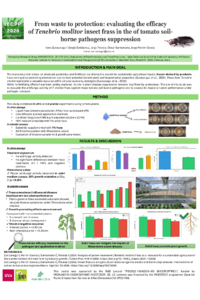
The rising demand for sustainable and eco-friendly alternatives to chemical pesticides has intensified research into the potential of insect-derived by-products for plant protection. This study investigates the antifungal efficacy of Tenebrio molitor frass against two major soil-borne pathogens, Rhizoctonia solani and Fusarium oxysporum f.sp. lycopersici, through a two-tiered experimental approach: in vitro and in planta assays using tomato plants (Solanum lycopersicum, cv. ‘Optima F1’).
In vitro experiments evaluated both liquid and solid forms of frass for their ability to inhibit fungal growth. Liquid extracts—both autoclaved and non-autoclaved—were tested via disk diffusion and direct application methods, using multiple controls, including commercial fungicide and pH-adjusted solutions. Significant growth inhibition was observed in R. solani when treated with frass extracts, while F. oxysporum remained largely unaffected. Solid media assays using PDA amended with 1% frass corroborated these findings, showing a 38.06% reduction in R. solani growth, with no statistically significant impact on F. oxysporum.
Following these promising in vitro results, in planta assays were conducted using frass-amended substrates to assess disease suppression and plant growth parameters under R. solani infection. Plants grown in the presence of 1% frass exhibited reduced disease symptoms, increased root biomass, and enhanced shoot length. Statistics analysis revealed that frass significantly influenced shoot elongation in both infected (+2.63 cm) and uninfected plants (+5.29 cm), with a more pronounced effect in the absence of the pathogen.
These results suggest that T. molitor frass holds potential as a biological soil amendment with dual benefits: mitigating disease impact and promoting plant growth. Further research is warranted to elucidate the mechanisms underlying its bioactivity and to optimize its application in integrated pest management (IPM) strategies.
Keywords
soil amendment
frass
Rhizoctonia solani
Fusarium oxysporum
Tenebrio molitor
sustainable agriculture
plant-pathogen interaction
Poster
POSTER_SCIFORUM_FRASS.pdf
Investigation of the Effects of Fly Ash-Enriched Soil on the Radish Growth Using a Multi-Attribute Decision-Making Method.
Endophytic Microorganisms from Apple and Pear Fruits as Biocontrol Agents Against Penicillium expansum, Botrytis cinerea and Other Postharvest Pathogens