Event submissions
Published
This submission belongs to the session 6. New Genomic Tools for Plant Defence of the event The 1st International Electronic Conference on Plant Protection
Published date
01 Mar, 2026
Academic Editor
'%3e%3cpath%20d='M12.6657%2010.9104C12.4185%2010.325%2012.0599%209.79327%2011.6097%209.34482C11.1609%208.89508%2010.6293%208.5365%2010.0442%208.28888C10.0389%208.28626%2010.0337%208.28495%2010.0285%208.28233C10.8446%207.69279%2011.3752%206.73249%2011.3752%205.64904C11.3752%203.8542%209.92103%202.39999%208.1262%202.39999C6.33136%202.39999%204.87715%203.8542%204.87715%205.64904C4.87715%206.73249%205.40774%207.69279%206.22393%208.28364C6.21869%208.28626%206.21345%208.28757%206.20821%208.29019C5.62129%208.5378%205.09463%208.89284%204.64265%209.34613C4.1929%209.79493%203.83432%2010.3266%203.58671%2010.9117C3.34345%2011.4845%203.21226%2012.0987%203.20023%2012.7209C3.19988%2012.7349%203.20233%2012.7488%203.20744%2012.7619C3.21255%2012.7749%203.22022%2012.7867%203.22998%2012.7968C3.23975%2012.8068%203.25142%2012.8147%203.26431%2012.8202C3.2772%2012.8256%203.29105%2012.8284%203.30504%2012.8284H4.09109C4.14874%2012.8284%204.19459%2012.7825%204.1959%2012.7262C4.2221%2011.7148%204.62823%2010.7676%205.34617%2010.0497C6.08899%209.30683%207.0755%208.89808%208.1262%208.89808C9.17689%208.89808%2010.1634%209.30683%2010.9062%2010.0497C11.6242%2010.7676%2012.0303%2011.7148%2012.0565%2012.7262C12.0578%2012.7838%2012.1037%2012.8284%2012.1613%2012.8284H12.9474C12.9613%2012.8284%2012.9752%2012.8256%2012.9881%2012.8202C13.001%2012.8147%2013.0126%2012.8068%2013.0224%2012.7968C13.0322%2012.7867%2013.0398%2012.7749%2013.0449%2012.7619C13.0501%2012.7488%2013.0525%2012.7349%2013.0522%2012.7209C13.0391%2012.0947%2012.9094%2011.4855%2012.6657%2010.9104ZM8.1262%207.9024C7.52486%207.9024%206.9589%207.6679%206.53312%207.24211C6.10733%206.81633%205.87283%206.25037%205.87283%205.64904C5.87283%205.0477%206.10733%204.48174%206.53312%204.05596C6.9589%203.63018%207.52486%203.39567%208.1262%203.39567C8.72753%203.39567%209.29349%203.63018%209.71927%204.05596C10.1451%204.48174%2010.3796%205.0477%2010.3796%205.64904C10.3796%206.25037%2010.1451%206.81633%209.71927%207.24211C9.29349%207.6679%208.72753%207.9024%208.1262%207.9024Z'%20fill='%235D1EE1'/%3e%3c/g%3e%3c/svg%3e) Ines Silva
Ines SilvaCitation
Elaine P. Laurio, Kim Elijah R. Dionisio, Genome-wide Identification and Characterization of Chitinase Genes in the Coffee Berry Borer (Hypothenemus hampei) and Its Potential as Molecular Targets for Pest Management, in Proceedings of The 1st International Electronic Conference on Plant Protection, 2 March–8 March 2026, MDPI: Basel, Switzerland
Share
Email
Facebook
Twitter
LinkedIn
Genome-wide Identification and Characterization of Chitinase Genes in the Coffee Berry Borer (Hypothenemus hampei) and Its Potential as Molecular Targets for Pest Management

Elaine P. Laurio 1
'%3e%3cpath%20d='M12.6647%2010.9104C12.4176%2010.325%2012.0589%209.7933%2011.6088%209.34485C11.16%208.89511%2010.6283%208.53653%2010.0432%208.28891C10.038%208.28629%2010.0327%208.28498%2010.0275%208.28236C10.8437%207.69282%2011.3743%206.73252%2011.3743%205.64907C11.3743%203.85423%209.92005%202.40002%208.12522%202.40002C6.33038%202.40002%204.87618%203.85423%204.87618%205.64907C4.87618%206.73252%205.40677%207.69282%206.22296%208.28367C6.21772%208.28629%206.21248%208.2876%206.20724%208.29022C5.62031%208.53783%205.09365%208.89287%204.64167%209.34616C4.19192%209.79496%203.83334%2010.3266%203.58573%2010.9117C3.34247%2011.4846%203.21128%2012.0987%203.19925%2012.721C3.1989%2012.735%203.20135%2012.7489%203.20646%2012.7619C3.21157%2012.7749%203.21924%2012.7868%203.22901%2012.7968C3.23877%2012.8068%203.25045%2012.8148%203.26334%2012.8202C3.27623%2012.8256%203.29007%2012.8284%203.30406%2012.8284H4.09012C4.14776%2012.8284%204.19362%2012.7825%204.19493%2012.7262C4.22113%2011.7148%204.62726%2010.7676%205.34519%2010.0497C6.08802%209.30686%207.07452%208.89811%208.12522%208.89811C9.17592%208.89811%2010.1624%209.30686%2010.9052%2010.0497C11.6232%2010.7676%2012.0293%2011.7148%2012.0555%2012.7262C12.0568%2012.7839%2012.1027%2012.8284%2012.1603%2012.8284H12.9464C12.9604%2012.8284%2012.9742%2012.8256%2012.9871%2012.8202C13%2012.8148%2013.0117%2012.8068%2013.0214%2012.7968C13.0312%2012.7868%2013.0389%2012.7749%2013.044%2012.7619C13.0491%2012.7489%2013.0515%2012.735%2013.0512%2012.721C13.0381%2012.0947%2012.9084%2011.4856%2012.6647%2010.9104ZM8.12522%207.90243C7.52388%207.90243%206.95792%207.66793%206.53214%207.24215C6.10636%206.81636%205.87185%206.2504%205.87185%205.64907C5.87185%205.04773%206.10636%204.48177%206.53214%204.05599C6.95792%203.63021%207.52388%203.3957%208.12522%203.3957C8.72655%203.3957%209.29252%203.63021%209.7183%204.05599C10.1441%204.48177%2010.3786%205.04773%2010.3786%205.64907C10.3786%206.2504%2010.1441%206.81636%209.7183%207.24215C9.29252%207.66793%208.72655%207.90243%208.12522%207.90243Z'%20fill='%235D1EE1'/%3e%3c/g%3e%3c/svg%3e)
Kim Elijah R. Dionisio 2
1. Institute of Plant Breeding, College of Agriculture and Food Science, University of the Philippines Los Baños, Laguna, 4031, Philippines
2. Institute of Chemistry, College of Arts and Sciences, University of the Philippines Los Baños, Laguna, 4031, Philippines
Abstract
Chitinases are vital to several physiological processes in insects such as growth and development, digestion, and even immune response. The coffee berry borer (CBB, Hypothenemus hampei) is regarded as a major pest directly infesting the economically important berry of the coffee plant. Yet unexplored, functions of chitinases in CBB offer avenues for further study. Here, 19 chitinase and chitinase-like genes were identified in CBB (HhCHTs) through BLAST-based homology search and conserved motif analysis. Phylogenetic analysis grouped these HhCHTs into seven clades, together with chitinases from other insect taxa. The HhCHTs exhibited coding sequences of 864-7998 bp which corresponded to protein lengths of 287-2665 amino acids. The HhCHTs showed an average isoelectric point of 5.97 and an average molecular weight of 82.2 kDa. Physicochemical analysis indicated that most proteins are stable, hydrophilic, and thermostable. Domain and motif analyses revealed the conserved structures among the genes, including the presence of GH18 catalytic domain (PF00704) and CBM14 chitin-binding domain. Subcellular localization prediction using CELLO v.2.5 suggested that HhCHT-03, -06, -07, -11, and -13 are extracellular which imply their roles in cuticle formation or remodeling. Protein interaction networks revealed a highly interconnected network, with several HhCHTs (e.g., HhCHT-08, -09, -10, -11, -15, -17, and -19) interacting closely with β-hexosaminidases and proteins containing GH20 or GH18 domains. These associations point to shared functions in glucosamine-containing compound catabolism, amino sugar and nucleotide sugar metabolism, glycosphingolipid biosynthesis, and chitinase-related activity. Additionally, protein structure modeling and predictions of transmembrane helices and signal peptides further clarified the structural and functional features of the identified chitinases. Overall, this study provides the first comprehensive characterization of the chitinase gene family in the coffee berry borer, offering foundational insights for the development of molecular pest management strategies, including RNA interference-based control.
Keywords
chitinase
coffee berry borer
bioinformatics
RNAi
pest management
Poster
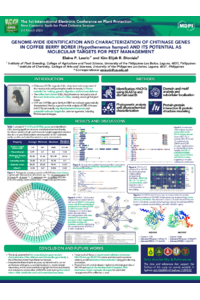
EPLaurio & KERDionisio_Poster.pdf
Fungal Extracts of Talaromyces ruber: a potential biostimulant on Tomato
Assessing Ridolfia segetum Aqueous Extract as a Plant-Based Bioherbicide: Growth and Seedling Responses of Sinapis alba