Event submissions
Published
This submission belongs to the session 4. Biochemical and Biological Control of the event The 1st International Electronic Conference on Plant Protection
Published date
01 Mar, 2026
Academic Editor
'%3e%3cpath%20d='M12.6657%2010.9104C12.4185%2010.325%2012.0599%209.79327%2011.6097%209.34482C11.1609%208.89508%2010.6293%208.5365%2010.0442%208.28888C10.0389%208.28626%2010.0337%208.28495%2010.0285%208.28233C10.8446%207.69279%2011.3752%206.73249%2011.3752%205.64904C11.3752%203.8542%209.92103%202.39999%208.1262%202.39999C6.33136%202.39999%204.87715%203.8542%204.87715%205.64904C4.87715%206.73249%205.40774%207.69279%206.22393%208.28364C6.21869%208.28626%206.21345%208.28757%206.20821%208.29019C5.62129%208.5378%205.09463%208.89284%204.64265%209.34613C4.1929%209.79493%203.83432%2010.3266%203.58671%2010.9117C3.34345%2011.4845%203.21226%2012.0987%203.20023%2012.7209C3.19988%2012.7349%203.20233%2012.7488%203.20744%2012.7619C3.21255%2012.7749%203.22022%2012.7867%203.22998%2012.7968C3.23975%2012.8068%203.25142%2012.8147%203.26431%2012.8202C3.2772%2012.8256%203.29105%2012.8284%203.30504%2012.8284H4.09109C4.14874%2012.8284%204.19459%2012.7825%204.1959%2012.7262C4.2221%2011.7148%204.62823%2010.7676%205.34617%2010.0497C6.08899%209.30683%207.0755%208.89808%208.1262%208.89808C9.17689%208.89808%2010.1634%209.30683%2010.9062%2010.0497C11.6242%2010.7676%2012.0303%2011.7148%2012.0565%2012.7262C12.0578%2012.7838%2012.1037%2012.8284%2012.1613%2012.8284H12.9474C12.9613%2012.8284%2012.9752%2012.8256%2012.9881%2012.8202C13.001%2012.8147%2013.0126%2012.8068%2013.0224%2012.7968C13.0322%2012.7867%2013.0398%2012.7749%2013.0449%2012.7619C13.0501%2012.7488%2013.0525%2012.7349%2013.0522%2012.7209C13.0391%2012.0947%2012.9094%2011.4855%2012.6657%2010.9104ZM8.1262%207.9024C7.52486%207.9024%206.9589%207.6679%206.53312%207.24211C6.10733%206.81633%205.87283%206.25037%205.87283%205.64904C5.87283%205.0477%206.10733%204.48174%206.53312%204.05596C6.9589%203.63018%207.52486%203.39567%208.1262%203.39567C8.72753%203.39567%209.29349%203.63018%209.71927%204.05596C10.1451%204.48174%2010.3796%205.0477%2010.3796%205.64904C10.3796%206.25037%2010.1451%206.81633%209.71927%207.24211C9.29349%207.6679%208.72753%207.9024%208.1262%207.9024Z'%20fill='%235D1EE1'/%3e%3c/g%3e%3c/svg%3e) Jorge M. S. Faria
Jorge M. S. FariaCitation
Sana Bashir, Fátima Gonçalves, El Hadi Erbiai, Cristina Carlos, Guilhermina Marques, Assessment of entomopathogenic fungi as a biocontrol agent against green leafhopper in Douro vineyards, in Proceedings of The 1st International Electronic Conference on Plant Protection, 2 March–8 March 2026, MDPI: Basel, Switzerland
Share
Email
Facebook
Twitter
LinkedIn
Assessment of entomopathogenic fungi as a biocontrol agent against green leafhopper in Douro vineyards

Sana Bashir 1
'%3e%3cpath%20d='M12.6647%2010.9104C12.4176%2010.325%2012.0589%209.7933%2011.6088%209.34485C11.16%208.89511%2010.6283%208.53653%2010.0432%208.28891C10.038%208.28629%2010.0327%208.28498%2010.0275%208.28236C10.8437%207.69282%2011.3743%206.73252%2011.3743%205.64907C11.3743%203.85423%209.92005%202.40002%208.12522%202.40002C6.33038%202.40002%204.87618%203.85423%204.87618%205.64907C4.87618%206.73252%205.40677%207.69282%206.22296%208.28367C6.21772%208.28629%206.21248%208.2876%206.20724%208.29022C5.62031%208.53783%205.09365%208.89287%204.64167%209.34616C4.19192%209.79496%203.83334%2010.3266%203.58573%2010.9117C3.34247%2011.4846%203.21128%2012.0987%203.19925%2012.721C3.1989%2012.735%203.20135%2012.7489%203.20646%2012.7619C3.21157%2012.7749%203.21924%2012.7868%203.22901%2012.7968C3.23877%2012.8068%203.25045%2012.8148%203.26334%2012.8202C3.27623%2012.8256%203.29007%2012.8284%203.30406%2012.8284H4.09012C4.14776%2012.8284%204.19362%2012.7825%204.19493%2012.7262C4.22113%2011.7148%204.62726%2010.7676%205.34519%2010.0497C6.08802%209.30686%207.07452%208.89811%208.12522%208.89811C9.17592%208.89811%2010.1624%209.30686%2010.9052%2010.0497C11.6232%2010.7676%2012.0293%2011.7148%2012.0555%2012.7262C12.0568%2012.7839%2012.1027%2012.8284%2012.1603%2012.8284H12.9464C12.9604%2012.8284%2012.9742%2012.8256%2012.9871%2012.8202C13%2012.8148%2013.0117%2012.8068%2013.0214%2012.7968C13.0312%2012.7868%2013.0389%2012.7749%2013.044%2012.7619C13.0491%2012.7489%2013.0515%2012.735%2013.0512%2012.721C13.0381%2012.0947%2012.9084%2011.4856%2012.6647%2010.9104ZM8.12522%207.90243C7.52388%207.90243%206.95792%207.66793%206.53214%207.24215C6.10636%206.81636%205.87185%206.2504%205.87185%205.64907C5.87185%205.04773%206.10636%204.48177%206.53214%204.05599C6.95792%203.63021%207.52388%203.3957%208.12522%203.3957C8.72655%203.3957%209.29252%203.63021%209.7183%204.05599C10.1441%204.48177%2010.3786%205.04773%2010.3786%205.64907C10.3786%206.2504%2010.1441%206.81636%209.7183%207.24215C9.29252%207.66793%208.72655%207.90243%208.12522%207.90243Z'%20fill='%235D1EE1'/%3e%3c/g%3e%3c/svg%3e)
Fátima Gonçalves 1

El Hadi Erbiai 1
Cristina Carlos 1
Guilhermina Marques 1
1. Centre for the Research and Technology of Agroenvironmental and Biological Sciences, CITAB, Inov4Agro, Universidade de Trás-os-Montes e Alto Douro, UTAD, Quinta de Prados, 5000-801 Vila Real, Portugal
Abstract
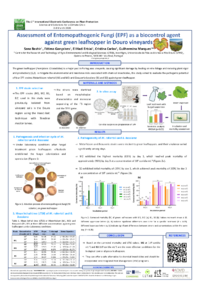
The green leafhopper (Hemiptera: Cicadellidae) is a major pest in Portuguese vineyards, causing significant damage by feeding on vine foliage and reducing plant vigor and productivity. Chemical insecticides often cause resistance and environmental issues by reducing the functional biodiversity, contaminating soil and water resources, and associated risks to human health, highlighting the use of entomopathogenic fungi (EPF) as a promising sustainable alternative for pest management. This study aimed to evaluate the in vitro pathogenic potential of four EPF strains, Metarhizium robertsii (M1, M2) and Beauveria bassiana (B1, B2), previously isolated from Douro vineyards, against the green leafhopper. The grapevine leaves were placed on 0.9% agar in petri plates and sprayed with EPF conidial suspensions at concentrations of 1×10⁶, 1×10⁷, and 1×10⁸ conidia/mL, with a control group without EPF. Green leafhoppers (nymphs and adults) were subsequently exposed to the treated leaves and incubated at 25 °C. The results showed that all isolates and conidial concentrations demonstrated high virulence, causing significantly higher mortality in a shorter time, compared to the untreated control. These findings indicate that, although the tested EPF isolates are pathogenic, further research is needed to optimize field application strategies to improve environmental persistence, determine the optimal timing of treatments, and integrate them effectively into vineyard pest management programs.
Acknowledgements: This work was supported by the project “ECOSPHEREWINES - Improving ecosystem services and green infrastructure in wine-growing areas of high ecological value” funded by INTERREG – SUDOE. We also acknowledge Duorum Vinhos S.A. and ADVID collaborators for their valuable support and collaboration during the field trials. This work was also supported by National Funds by the Portuguese Foundation for Science and Technology (FCT) under the projects UIDB/04033/2025: Centre for the Research and Technology of Agro-Environmental and Biological Sciences (CITAB) and LA/P/0126/2020 (Inov4Agro).SB acknowledges INTERREG – SUDOE for her fellowship grant (BI/UTAD/8/2025).
Keywords
Entomopathogenic fungi
green leafhopper
Metarhizium robertsii
Beauveria bassiana
biological control
Poster
IECPP2026_Poster_Sana Bashir_Id-164199.pdf
Dose- and species-dependent effects of wood vinegar as a biostimulant in soilless cultivation systems
Growth-Regulating Activity of Chalcogen-Functionalized Thiazoloquinazolines