Event submissions
Published
This submission belongs to the session 10. Submissions under other topics of Plant Protection of the event The 1st International Electronic Conference on Plant Protection
Published date
01 Mar, 2026
Academic Editor
'%3e%3cpath%20d='M12.6657%2010.9104C12.4185%2010.325%2012.0599%209.79327%2011.6097%209.34482C11.1609%208.89508%2010.6293%208.5365%2010.0442%208.28888C10.0389%208.28626%2010.0337%208.28495%2010.0285%208.28233C10.8446%207.69279%2011.3752%206.73249%2011.3752%205.64904C11.3752%203.8542%209.92103%202.39999%208.1262%202.39999C6.33136%202.39999%204.87715%203.8542%204.87715%205.64904C4.87715%206.73249%205.40774%207.69279%206.22393%208.28364C6.21869%208.28626%206.21345%208.28757%206.20821%208.29019C5.62129%208.5378%205.09463%208.89284%204.64265%209.34613C4.1929%209.79493%203.83432%2010.3266%203.58671%2010.9117C3.34345%2011.4845%203.21226%2012.0987%203.20023%2012.7209C3.19988%2012.7349%203.20233%2012.7488%203.20744%2012.7619C3.21255%2012.7749%203.22022%2012.7867%203.22998%2012.7968C3.23975%2012.8068%203.25142%2012.8147%203.26431%2012.8202C3.2772%2012.8256%203.29105%2012.8284%203.30504%2012.8284H4.09109C4.14874%2012.8284%204.19459%2012.7825%204.1959%2012.7262C4.2221%2011.7148%204.62823%2010.7676%205.34617%2010.0497C6.08899%209.30683%207.0755%208.89808%208.1262%208.89808C9.17689%208.89808%2010.1634%209.30683%2010.9062%2010.0497C11.6242%2010.7676%2012.0303%2011.7148%2012.0565%2012.7262C12.0578%2012.7838%2012.1037%2012.8284%2012.1613%2012.8284H12.9474C12.9613%2012.8284%2012.9752%2012.8256%2012.9881%2012.8202C13.001%2012.8147%2013.0126%2012.8068%2013.0224%2012.7968C13.0322%2012.7867%2013.0398%2012.7749%2013.0449%2012.7619C13.0501%2012.7488%2013.0525%2012.7349%2013.0522%2012.7209C13.0391%2012.0947%2012.9094%2011.4855%2012.6657%2010.9104ZM8.1262%207.9024C7.52486%207.9024%206.9589%207.6679%206.53312%207.24211C6.10733%206.81633%205.87283%206.25037%205.87283%205.64904C5.87283%205.0477%206.10733%204.48174%206.53312%204.05596C6.9589%203.63018%207.52486%203.39567%208.1262%203.39567C8.72753%203.39567%209.29349%203.63018%209.71927%204.05596C10.1451%204.48174%2010.3796%205.0477%2010.3796%205.64904C10.3796%206.25037%2010.1451%206.81633%209.71927%207.24211C9.29349%207.6679%208.72753%207.9024%208.1262%207.9024Z'%20fill='%235D1EE1'/%3e%3c/g%3e%3c/svg%3e) Jorge M. S. Faria
Jorge M. S. FariaCitation
Babur Ali Akbar, Moringa (Moringa oleifera)–Vegetable Agrisilviculture Under Fertilizer Inputs: Evidence Synthesis of Productivity Outcomes, Soil Fertility Trajectories, and Tree–Crop–Soil Mechanisms, in Proceedings of The 1st International Electronic Conference on Plant Protection, 2 March–8 March 2026, MDPI: Basel, Switzerland
Share
Email
Facebook
Twitter
LinkedIn
Moringa (Moringa oleifera)–Vegetable Agrisilviculture Under Fertilizer Inputs: Evidence Synthesis of Productivity Outcomes, Soil Fertility Trajectories, and Tree–Crop–Soil Mechanisms
'%3e%3cpath%20d='M12.6647%2010.9104C12.4176%2010.325%2012.0589%209.7933%2011.6088%209.34485C11.16%208.89511%2010.6283%208.53653%2010.0432%208.28891C10.038%208.28629%2010.0327%208.28498%2010.0275%208.28236C10.8437%207.69282%2011.3743%206.73252%2011.3743%205.64907C11.3743%203.85423%209.92005%202.40002%208.12522%202.40002C6.33038%202.40002%204.87618%203.85423%204.87618%205.64907C4.87618%206.73252%205.40677%207.69282%206.22296%208.28367C6.21772%208.28629%206.21248%208.2876%206.20724%208.29022C5.62031%208.53783%205.09365%208.89287%204.64167%209.34616C4.19192%209.79496%203.83334%2010.3266%203.58573%2010.9117C3.34247%2011.4846%203.21128%2012.0987%203.19925%2012.721C3.1989%2012.735%203.20135%2012.7489%203.20646%2012.7619C3.21157%2012.7749%203.21924%2012.7868%203.22901%2012.7968C3.23877%2012.8068%203.25045%2012.8148%203.26334%2012.8202C3.27623%2012.8256%203.29007%2012.8284%203.30406%2012.8284H4.09012C4.14776%2012.8284%204.19362%2012.7825%204.19493%2012.7262C4.22113%2011.7148%204.62726%2010.7676%205.34519%2010.0497C6.08802%209.30686%207.07452%208.89811%208.12522%208.89811C9.17592%208.89811%2010.1624%209.30686%2010.9052%2010.0497C11.6232%2010.7676%2012.0293%2011.7148%2012.0555%2012.7262C12.0568%2012.7839%2012.1027%2012.8284%2012.1603%2012.8284H12.9464C12.9604%2012.8284%2012.9742%2012.8256%2012.9871%2012.8202C13%2012.8148%2013.0117%2012.8068%2013.0214%2012.7968C13.0312%2012.7868%2013.0389%2012.7749%2013.044%2012.7619C13.0491%2012.7489%2013.0515%2012.735%2013.0512%2012.721C13.0381%2012.0947%2012.9084%2011.4856%2012.6647%2010.9104ZM8.12522%207.90243C7.52388%207.90243%206.95792%207.66793%206.53214%207.24215C6.10636%206.81636%205.87185%206.2504%205.87185%205.64907C5.87185%205.04773%206.10636%204.48177%206.53214%204.05599C6.95792%203.63021%207.52388%203.3957%208.12522%203.3957C8.72655%203.3957%209.29252%203.63021%209.7183%204.05599C10.1441%204.48177%2010.3786%205.04773%2010.3786%205.64907C10.3786%206.2504%2010.1441%206.81636%209.7183%207.24215C9.29252%207.66793%208.72655%207.90243%208.12522%207.90243Z'%20fill='%235D1EE1'/%3e%3c/g%3e%3c/svg%3e)
Babur Ali Akbar 1
1. Centre of Agricultural Biochemistry and Biotechnology, faculty of Agriculture, University of Agriculture Faisalabad, Faisalabad, 64101 , Pakistan
Abstract
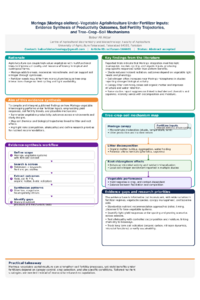
Agrisilvicultural systems integrating woody perennials with annual crops have garnered considerable attention within sustainable agriculture discourse, offering potential synergies between productivity enhancement and environmental stewardship. Moringa oleifera, a multipurpose tree species native to the Indian subcontinent, possesses nutritional and phytochemical attributes alongside demonstrated capacity to ameliorate edaphic conditions through nitrogen fixation and organic matter accumulation. The interaction between M. oleifera-based agroforestry frameworks and exogenous fertilizer regimes in influencing vegetable crop performance and soil chemical properties remains inadequately characterized within the scientific literature. This review synthesizes available evidence regarding the effects of Moringa intercropping systems on vegetable productivity, examining mechanisms through which tree-crop interactions modify nutrient availability, microclimatic conditions, and soil biological activity. Literature indicates that M. oleifera integration typically reduces direct solar radiation incident upon intercrops, with variable consequences for different vegetable species depending upon light saturation requirements and phenological stage. The nitrogen-fixing capacity of Moringa, mediated through nodule-associated Rhizobium populations, contributes to elevated soil nitrogen concentrations in proximal rhizospheres, potentially reducing dependency upon synthetic nitrogen inputs for associated vegetables. Concurrent research demonstrates that litter fall from Moringa canopies enriches soil organic matter, facilitating improvements in soil structure, water retention, and microbial community composition. However, phenolic and saponin compounds present within Moringa leaf material may exert allelopathic effects on intercroped vegetables, the magnitude of which varies according to litter decomposition kinetics and prevailing soil moisture regimes. The efficacy of combined Moringa integration and supplementary fertilizer application in sustaining vegetable yields while maintaining or restoring soil fertility has received limited systematic investigation across diverse agroecological contexts. Existing studies exhibit considerable methodological heterogeneity regarding experimental design, cultivar selection, and edaphic baseline conditions, complicating comparative analysis and generalization of findings. The literature suggests that fertilizer recommendation protocols for M. oleifera-vegetable systems cannot be extrapolated directly from monoculture frameworks, yet standardized approaches for determining optimal nutrient inputs remain underdeveloped. This review appraises the current evidence base concerning productivity outcomes and soil fertility trajectories in Moringa agrisilvicultural systems, identifies critical knowledge deficiencies regarding mechanistic understanding of tree-crop-soil interactions, and discusses methodological standardization requirements. Enhanced understanding of these complex interactions could inform evidence-based management practices suited to smallholder farming contexts, particularly in tropical and subtropical regions where resource constraints necessitate integrated approaches maximizing ecosystem services alongside crop production objectives.
Keywords
annual crops
M. oleifera-based agroforestry ,modify nutrient availability
synthetic nitrogen
Moringa agrisilvicultural systems,
Poster
Babur Ali Akbar (6).pdf
Assessing Long-Term Ecological Resilience in Punjab's Paddy-Dominated Agroecosystems through Integrated Geospatial Analysis (2001–2023)
Peroxidase–Proline Coordination as a Biochemical Signature of Photoperiod Tolerance in Ginger (Zingiber officinale): Antioxidant Mechanisms, Shade Adaptation, and Biomarker-Guided Selection