Event submissions
EventsThe 5th International Electronic Conference on Brain Sciences & 1st International Electronic Conference on Neurosciences
Published
This submission belongs to the session S1. Neurodegenerative Diseases of the event The 5th International Electronic Conference on Brain Sciences & 1st International Electronic Conference on Neurosciences
Published date
04 Mar, 2026
Academic Editor
'%3e%3cpath%20d='M12.6657%2010.9104C12.4185%2010.325%2012.0599%209.79327%2011.6097%209.34482C11.1609%208.89508%2010.6293%208.5365%2010.0442%208.28888C10.0389%208.28626%2010.0337%208.28495%2010.0285%208.28233C10.8446%207.69279%2011.3752%206.73249%2011.3752%205.64904C11.3752%203.8542%209.92103%202.39999%208.1262%202.39999C6.33136%202.39999%204.87715%203.8542%204.87715%205.64904C4.87715%206.73249%205.40774%207.69279%206.22393%208.28364C6.21869%208.28626%206.21345%208.28757%206.20821%208.29019C5.62129%208.5378%205.09463%208.89284%204.64265%209.34613C4.1929%209.79493%203.83432%2010.3266%203.58671%2010.9117C3.34345%2011.4845%203.21226%2012.0987%203.20023%2012.7209C3.19988%2012.7349%203.20233%2012.7488%203.20744%2012.7619C3.21255%2012.7749%203.22022%2012.7867%203.22998%2012.7968C3.23975%2012.8068%203.25142%2012.8147%203.26431%2012.8202C3.2772%2012.8256%203.29105%2012.8284%203.30504%2012.8284H4.09109C4.14874%2012.8284%204.19459%2012.7825%204.1959%2012.7262C4.2221%2011.7148%204.62823%2010.7676%205.34617%2010.0497C6.08899%209.30683%207.0755%208.89808%208.1262%208.89808C9.17689%208.89808%2010.1634%209.30683%2010.9062%2010.0497C11.6242%2010.7676%2012.0303%2011.7148%2012.0565%2012.7262C12.0578%2012.7838%2012.1037%2012.8284%2012.1613%2012.8284H12.9474C12.9613%2012.8284%2012.9752%2012.8256%2012.9881%2012.8202C13.001%2012.8147%2013.0126%2012.8068%2013.0224%2012.7968C13.0322%2012.7867%2013.0398%2012.7749%2013.0449%2012.7619C13.0501%2012.7488%2013.0525%2012.7349%2013.0522%2012.7209C13.0391%2012.0947%2012.9094%2011.4855%2012.6657%2010.9104ZM8.1262%207.9024C7.52486%207.9024%206.9589%207.6679%206.53312%207.24211C6.10733%206.81633%205.87283%206.25037%205.87283%205.64904C5.87283%205.0477%206.10733%204.48174%206.53312%204.05596C6.9589%203.63018%207.52486%203.39567%208.1262%203.39567C8.72753%203.39567%209.29349%203.63018%209.71927%204.05596C10.1451%204.48174%2010.3796%205.0477%2010.3796%205.64904C10.3796%206.25037%2010.1451%206.81633%209.71927%207.24211C9.29349%207.6679%208.72753%207.9024%208.1262%207.9024Z'%20fill='%235D1EE1'/%3e%3c/g%3e%3c/svg%3e) Grazyna Lietzau
Grazyna LietzauCitation
Jose Joaquin Merino, José María Parmigiani-Izquierdo, Adolfo Toledano Gasca, María Eugenia Cabaña-Muñoz, Is there any relationship between mercury from dental amalgams and Alzheimer's disease?: Role of mercury and peripheral CCL2 chemokines as biomarker of disease progression, in Proceedings of The 5th International Electronic Conference on Brain Sciences & 1st International Electronic Conference on Neurosciences, 9 March–11 March 2026, MDPI: Basel, Switzerland
Share
Email
Facebook
Twitter
LinkedIn
Is there any relationship between mercury from dental amalgams and Alzheimer's disease?: Role of mercury and peripheral CCL2 chemokines as biomarker of disease progression
'%3e%3cpath%20d='M12.6647%2010.9104C12.4176%2010.325%2012.0589%209.7933%2011.6088%209.34485C11.16%208.89511%2010.6283%208.53653%2010.0432%208.28891C10.038%208.28629%2010.0327%208.28498%2010.0275%208.28236C10.8437%207.69282%2011.3743%206.73252%2011.3743%205.64907C11.3743%203.85423%209.92005%202.40002%208.12522%202.40002C6.33038%202.40002%204.87618%203.85423%204.87618%205.64907C4.87618%206.73252%205.40677%207.69282%206.22296%208.28367C6.21772%208.28629%206.21248%208.2876%206.20724%208.29022C5.62031%208.53783%205.09365%208.89287%204.64167%209.34616C4.19192%209.79496%203.83334%2010.3266%203.58573%2010.9117C3.34247%2011.4846%203.21128%2012.0987%203.19925%2012.721C3.1989%2012.735%203.20135%2012.7489%203.20646%2012.7619C3.21157%2012.7749%203.21924%2012.7868%203.22901%2012.7968C3.23877%2012.8068%203.25045%2012.8148%203.26334%2012.8202C3.27623%2012.8256%203.29007%2012.8284%203.30406%2012.8284H4.09012C4.14776%2012.8284%204.19362%2012.7825%204.19493%2012.7262C4.22113%2011.7148%204.62726%2010.7676%205.34519%2010.0497C6.08802%209.30686%207.07452%208.89811%208.12522%208.89811C9.17592%208.89811%2010.1624%209.30686%2010.9052%2010.0497C11.6232%2010.7676%2012.0293%2011.7148%2012.0555%2012.7262C12.0568%2012.7839%2012.1027%2012.8284%2012.1603%2012.8284H12.9464C12.9604%2012.8284%2012.9742%2012.8256%2012.9871%2012.8202C13%2012.8148%2013.0117%2012.8068%2013.0214%2012.7968C13.0312%2012.7868%2013.0389%2012.7749%2013.044%2012.7619C13.0491%2012.7489%2013.0515%2012.735%2013.0512%2012.721C13.0381%2012.0947%2012.9084%2011.4856%2012.6647%2010.9104ZM8.12522%207.90243C7.52388%207.90243%206.95792%207.66793%206.53214%207.24215C6.10636%206.81636%205.87185%206.2504%205.87185%205.64907C5.87185%205.04773%206.10636%204.48177%206.53214%204.05599C6.95792%203.63021%207.52388%203.3957%208.12522%203.3957C8.72655%203.3957%209.29252%203.63021%209.7183%204.05599C10.1441%204.48177%2010.3786%205.04773%2010.3786%205.64907C10.3786%206.2504%2010.1441%206.81636%209.7183%207.24215C9.29252%207.66793%208.72655%207.90243%208.12522%207.90243Z'%20fill='%235D1EE1'/%3e%3c/g%3e%3c/svg%3e)
Jose Joaquin Merino 1,2,3
José María Parmigiani-Izquierdo 4
Adolfo Toledano Gasca 5
María Eugenia Cabaña-Muñoz 4,6
1. Facultad de Farmacia, Departamento de Farmacología, Farmacognosia y Botánica, Universidad Complutense de Madrid (UCM), 28040 Madrid, Spain
2. Instituto Pluridisciplinar (UCM), Madrid, Spain
3. Grupo de Medicina Regenerativa, Instituto de Investigación Sanitaria Hospital 12 de Octubre (imas12), 28041 Madrid, Spain
4. Clínica CIROM, Murcia, Spain
5. Cajal Institute CSIC, Madrid, Spain
6. Private Dentist Practice, Private Clinic, 30001 Murcia, Spain
Abstract
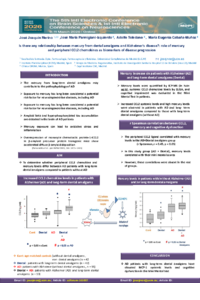
Studies comparing mercury (Hg) levels with those of age-matched controls often focus on identifying exposure risks in patients with Alzheimer’s disease (AD), including the release of mercury from long-term dental amalgams. Mercury exposure can lead to oxidative stress and inflammation, along with Abeta and hyperphosphorylated tau accumulation in the brain. Mercury accumulation has been demonstrated in AD transgenic mice, and certain chemokines have been shown to contribute to cognitive impairment. However, the link between mercury, cognitive dysfunction and chemokines remains to be elucidated in AD patients with long-term dental amalgams.
Our study aims to determine whether peripheral CCL2 chemokine and mercury levels differ between AD patients with long-term dental amalgams compared to patients without AD.
Mercury levels were quantified by ICP-MS (in hair: µg/g), peripheral CCL2 chemokine ligand levels were measured by ELISA, and cognitive impairment was evaluated by a Mini Mental Test. We compared the CCL2 biomarker and mercury levels in patients with long-term dental amalgams without AD (n = 42), AD patients without dental amalgams (n = 55), AD patients with long-term dental amalgams (n = 13 AD + dental amalgams), and age-matched controls without dental amalgams (n = 42 without AD).
Our results indicate a 17% rise in mercury levels in patients with AD and dental amalgams compared to AD patients without dental amalgams, while a rise in MCP-1 levels was observed using the Mann–Whitney test (p = 0.048). Within the AD+dental amalgam group, 16% showed cognitive impairment according to their Mini Mental scores. These peripheral MCP-1 increases correlated with mercury levels in AD patients with long-term dental amalgams. MCP-1 levels correlated with Mini Mental scores using the Spearman correlation test (r = 0.45, p < 0.05, AD + dental amalgam group). Additionally, mercury levels correlated with MMSE scores. However, these correlations were absent in the other study groups.
Conclusion: AD patients with long-term dental amalgams have higher peripheral MCP-1 levels and lower Mini Mental scores.
Keywords
mercury
heavy metals
CCL2
chemokines
cognitive dysfunction in Alzheimer
dental amalgams
dentistry
neurodegeneration
neuroinflammation
neurodegenerative diseases
Poster
sciforum-161097 Jose Joaquin Meirno.pdf
Histomorphology and histomorphometry changes in the hippocampal regions of hydrocephalic adult rats induced using intracisternal kaolin suspension.