Event submissions
EventsThe 5th International Electronic Conference on Brain Sciences & 1st International Electronic Conference on Neurosciences
Published
This submission belongs to the session S1. Neurodegenerative Diseases of the event The 5th International Electronic Conference on Brain Sciences & 1st International Electronic Conference on Neurosciences
Published date
04 Mar, 2026
Academic Editor
'%3e%3cpath%20d='M12.6657%2010.9104C12.4185%2010.325%2012.0599%209.79327%2011.6097%209.34482C11.1609%208.89508%2010.6293%208.5365%2010.0442%208.28888C10.0389%208.28626%2010.0337%208.28495%2010.0285%208.28233C10.8446%207.69279%2011.3752%206.73249%2011.3752%205.64904C11.3752%203.8542%209.92103%202.39999%208.1262%202.39999C6.33136%202.39999%204.87715%203.8542%204.87715%205.64904C4.87715%206.73249%205.40774%207.69279%206.22393%208.28364C6.21869%208.28626%206.21345%208.28757%206.20821%208.29019C5.62129%208.5378%205.09463%208.89284%204.64265%209.34613C4.1929%209.79493%203.83432%2010.3266%203.58671%2010.9117C3.34345%2011.4845%203.21226%2012.0987%203.20023%2012.7209C3.19988%2012.7349%203.20233%2012.7488%203.20744%2012.7619C3.21255%2012.7749%203.22022%2012.7867%203.22998%2012.7968C3.23975%2012.8068%203.25142%2012.8147%203.26431%2012.8202C3.2772%2012.8256%203.29105%2012.8284%203.30504%2012.8284H4.09109C4.14874%2012.8284%204.19459%2012.7825%204.1959%2012.7262C4.2221%2011.7148%204.62823%2010.7676%205.34617%2010.0497C6.08899%209.30683%207.0755%208.89808%208.1262%208.89808C9.17689%208.89808%2010.1634%209.30683%2010.9062%2010.0497C11.6242%2010.7676%2012.0303%2011.7148%2012.0565%2012.7262C12.0578%2012.7838%2012.1037%2012.8284%2012.1613%2012.8284H12.9474C12.9613%2012.8284%2012.9752%2012.8256%2012.9881%2012.8202C13.001%2012.8147%2013.0126%2012.8068%2013.0224%2012.7968C13.0322%2012.7867%2013.0398%2012.7749%2013.0449%2012.7619C13.0501%2012.7488%2013.0525%2012.7349%2013.0522%2012.7209C13.0391%2012.0947%2012.9094%2011.4855%2012.6657%2010.9104ZM8.1262%207.9024C7.52486%207.9024%206.9589%207.6679%206.53312%207.24211C6.10733%206.81633%205.87283%206.25037%205.87283%205.64904C5.87283%205.0477%206.10733%204.48174%206.53312%204.05596C6.9589%203.63018%207.52486%203.39567%208.1262%203.39567C8.72753%203.39567%209.29349%203.63018%209.71927%204.05596C10.1451%204.48174%2010.3796%205.0477%2010.3796%205.64904C10.3796%206.25037%2010.1451%206.81633%209.71927%207.24211C9.29349%207.6679%208.72753%207.9024%208.1262%207.9024Z'%20fill='%235D1EE1'/%3e%3c/g%3e%3c/svg%3e) Grazyna Lietzau
Grazyna LietzauCitation
Poulami Kar, Investigating Subtype-Specific Neuroplastic Changes Through White Matter Tractography in Parkinson's Disease, in Proceedings of The 5th International Electronic Conference on Brain Sciences & 1st International Electronic Conference on Neurosciences, 9 March–11 March 2026, MDPI: Basel, Switzerland
Share
Email
Facebook
Twitter
LinkedIn
Investigating Subtype-Specific Neuroplastic Changes Through White Matter Tractography in Parkinson's Disease
'%3e%3cpath%20d='M12.6647%2010.9104C12.4176%2010.325%2012.0589%209.7933%2011.6088%209.34485C11.16%208.89511%2010.6283%208.53653%2010.0432%208.28891C10.038%208.28629%2010.0327%208.28498%2010.0275%208.28236C10.8437%207.69282%2011.3743%206.73252%2011.3743%205.64907C11.3743%203.85423%209.92005%202.40002%208.12522%202.40002C6.33038%202.40002%204.87618%203.85423%204.87618%205.64907C4.87618%206.73252%205.40677%207.69282%206.22296%208.28367C6.21772%208.28629%206.21248%208.2876%206.20724%208.29022C5.62031%208.53783%205.09365%208.89287%204.64167%209.34616C4.19192%209.79496%203.83334%2010.3266%203.58573%2010.9117C3.34247%2011.4846%203.21128%2012.0987%203.19925%2012.721C3.1989%2012.735%203.20135%2012.7489%203.20646%2012.7619C3.21157%2012.7749%203.21924%2012.7868%203.22901%2012.7968C3.23877%2012.8068%203.25045%2012.8148%203.26334%2012.8202C3.27623%2012.8256%203.29007%2012.8284%203.30406%2012.8284H4.09012C4.14776%2012.8284%204.19362%2012.7825%204.19493%2012.7262C4.22113%2011.7148%204.62726%2010.7676%205.34519%2010.0497C6.08802%209.30686%207.07452%208.89811%208.12522%208.89811C9.17592%208.89811%2010.1624%209.30686%2010.9052%2010.0497C11.6232%2010.7676%2012.0293%2011.7148%2012.0555%2012.7262C12.0568%2012.7839%2012.1027%2012.8284%2012.1603%2012.8284H12.9464C12.9604%2012.8284%2012.9742%2012.8256%2012.9871%2012.8202C13%2012.8148%2013.0117%2012.8068%2013.0214%2012.7968C13.0312%2012.7868%2013.0389%2012.7749%2013.044%2012.7619C13.0491%2012.7489%2013.0515%2012.735%2013.0512%2012.721C13.0381%2012.0947%2012.9084%2011.4856%2012.6647%2010.9104ZM8.12522%207.90243C7.52388%207.90243%206.95792%207.66793%206.53214%207.24215C6.10636%206.81636%205.87185%206.2504%205.87185%205.64907C5.87185%205.04773%206.10636%204.48177%206.53214%204.05599C6.95792%203.63021%207.52388%203.3957%208.12522%203.3957C8.72655%203.3957%209.29252%203.63021%209.7183%204.05599C10.1441%204.48177%2010.3786%205.04773%2010.3786%205.64907C10.3786%206.2504%2010.1441%206.81636%209.7183%207.24215C9.29252%207.66793%208.72655%207.90243%208.12522%207.90243Z'%20fill='%235D1EE1'/%3e%3c/g%3e%3c/svg%3e)
Poulami Kar 1
1. Centre of Behavioural & Cognitive Sciences (CBCS), University of Allahabad, Prayagraj, India
Abstract
Introduction
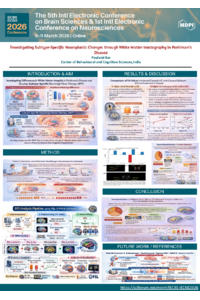
Parkinson’s disease (PD) presents heterogeneous motor deficits associated with disruptions in distinct neural circuits. White-matter plasticity can be examined using diffusion tensor imaging (DTI) and fractional anisotropy (FA). Rhythmic Auditory Stimulation (RAS) induces compensatory plasticity within the basal ganglia-thalamo-cortical (BGTC) and cerebello-thalamo-cortical (CTC) networks, which are differentially preserved in rigidity-dominant (RD) and tremor-dominant (TD) PD, respectively. However, tract-specific plasticity underlying these effects remains poorly understood. This study examined FA differences in the internal capsule (IC), cerebellar projections, and corpus callosum (CC) to characterize subtype-specific neuroplasticity relevant to Neurologic Music Therapy (NMT).
Methods
Seventeen PD patients were classified as TD (n=11) or RD (n=6) using UPDRS scores. DTI data were processed in FSL and analyzed using tract-based spatial statistics. FA differences were assessed in predefined white-matter tracts. Principal component analysis (PCA) examined cerebellar peduncle (CP) organization.
Results
RD patients showed significantly higher FA in the left IC and across all CC subregions compared to TD patients. No group differences were observed in cerebellar projections. PCA revealed a unilateral left superior CP contribution in RD, whereas TD patients showed distributed bilateral contributions across all CPs.
Discussion
Findings suggest localized motor tract alterations and stronger interhemispheric connectivity in RD, contrasted with preserved, distributed cerebellar organization in TD. These subtype-specific patterns have implications for tailoring NMT interventions, with RD potentially benefiting from bilateral and cognitive–motor strategies and TD from cerebellar-based motor sequencing approaches.
Keywords
Diffusion Tensor Imaging
Parkinson's Disease
White Matter Tractography
Poster
IECBS_POULAMI.pdf
Multi-Omics and Structural Modeling for Identifying Phytochemical Modulators of Pathogenic Tau States: Integrative Discovery Pipeline of Tau-Targeting Phytochemicals Using SNP Biomarker Screening, Structural Modeling, and Network Pharmacology
Omega-3 Supplementation Improves Cortico-Limbic Neuroplasticity and Reduces Amyloid-Related Pathology