Event submissions
EventsThe 5th International Electronic Conference on Brain Sciences & 1st International Electronic Conference on Neurosciences
Published
This submission belongs to the session S1. Neurodegenerative Diseases of the event The 5th International Electronic Conference on Brain Sciences & 1st International Electronic Conference on Neurosciences
Published date
04 Mar, 2026
Academic Editor
'%3e%3cpath%20d='M12.6657%2010.9104C12.4185%2010.325%2012.0599%209.79327%2011.6097%209.34482C11.1609%208.89508%2010.6293%208.5365%2010.0442%208.28888C10.0389%208.28626%2010.0337%208.28495%2010.0285%208.28233C10.8446%207.69279%2011.3752%206.73249%2011.3752%205.64904C11.3752%203.8542%209.92103%202.39999%208.1262%202.39999C6.33136%202.39999%204.87715%203.8542%204.87715%205.64904C4.87715%206.73249%205.40774%207.69279%206.22393%208.28364C6.21869%208.28626%206.21345%208.28757%206.20821%208.29019C5.62129%208.5378%205.09463%208.89284%204.64265%209.34613C4.1929%209.79493%203.83432%2010.3266%203.58671%2010.9117C3.34345%2011.4845%203.21226%2012.0987%203.20023%2012.7209C3.19988%2012.7349%203.20233%2012.7488%203.20744%2012.7619C3.21255%2012.7749%203.22022%2012.7867%203.22998%2012.7968C3.23975%2012.8068%203.25142%2012.8147%203.26431%2012.8202C3.2772%2012.8256%203.29105%2012.8284%203.30504%2012.8284H4.09109C4.14874%2012.8284%204.19459%2012.7825%204.1959%2012.7262C4.2221%2011.7148%204.62823%2010.7676%205.34617%2010.0497C6.08899%209.30683%207.0755%208.89808%208.1262%208.89808C9.17689%208.89808%2010.1634%209.30683%2010.9062%2010.0497C11.6242%2010.7676%2012.0303%2011.7148%2012.0565%2012.7262C12.0578%2012.7838%2012.1037%2012.8284%2012.1613%2012.8284H12.9474C12.9613%2012.8284%2012.9752%2012.8256%2012.9881%2012.8202C13.001%2012.8147%2013.0126%2012.8068%2013.0224%2012.7968C13.0322%2012.7867%2013.0398%2012.7749%2013.0449%2012.7619C13.0501%2012.7488%2013.0525%2012.7349%2013.0522%2012.7209C13.0391%2012.0947%2012.9094%2011.4855%2012.6657%2010.9104ZM8.1262%207.9024C7.52486%207.9024%206.9589%207.6679%206.53312%207.24211C6.10733%206.81633%205.87283%206.25037%205.87283%205.64904C5.87283%205.0477%206.10733%204.48174%206.53312%204.05596C6.9589%203.63018%207.52486%203.39567%208.1262%203.39567C8.72753%203.39567%209.29349%203.63018%209.71927%204.05596C10.1451%204.48174%2010.3796%205.0477%2010.3796%205.64904C10.3796%206.25037%2010.1451%206.81633%209.71927%207.24211C9.29349%207.6679%208.72753%207.9024%208.1262%207.9024Z'%20fill='%235D1EE1'/%3e%3c/g%3e%3c/svg%3e) Grazyna Lietzau
Grazyna LietzauCitation
Maja Wojasiewicz, Sara Gniadek, Aleksandra Kotecka, Oliwia Kłódczyńska, Kinga Matysiak, Miłosz Paciorek, Gabriela Zeidler, Łukasz Witucki, Joanna Perła-Kaján, Homocysteine and homocysteine thiolactone contribute to Alzheimer's disease via TAU modifications in N2A-APPswe cells, in Proceedings of The 5th International Electronic Conference on Brain Sciences & 1st International Electronic Conference on Neurosciences, 9 March–11 March 2026, MDPI: Basel, Switzerland
Share
Email
Facebook
Twitter
LinkedIn
Homocysteine and homocysteine thiolactone contribute to Alzheimer's disease via TAU modifications in N2A-APPswe cells
'%3e%3cpath%20d='M12.6647%2010.9104C12.4176%2010.325%2012.0589%209.7933%2011.6088%209.34485C11.16%208.89511%2010.6283%208.53653%2010.0432%208.28891C10.038%208.28629%2010.0327%208.28498%2010.0275%208.28236C10.8437%207.69282%2011.3743%206.73252%2011.3743%205.64907C11.3743%203.85423%209.92005%202.40002%208.12522%202.40002C6.33038%202.40002%204.87618%203.85423%204.87618%205.64907C4.87618%206.73252%205.40677%207.69282%206.22296%208.28367C6.21772%208.28629%206.21248%208.2876%206.20724%208.29022C5.62031%208.53783%205.09365%208.89287%204.64167%209.34616C4.19192%209.79496%203.83334%2010.3266%203.58573%2010.9117C3.34247%2011.4846%203.21128%2012.0987%203.19925%2012.721C3.1989%2012.735%203.20135%2012.7489%203.20646%2012.7619C3.21157%2012.7749%203.21924%2012.7868%203.22901%2012.7968C3.23877%2012.8068%203.25045%2012.8148%203.26334%2012.8202C3.27623%2012.8256%203.29007%2012.8284%203.30406%2012.8284H4.09012C4.14776%2012.8284%204.19362%2012.7825%204.19493%2012.7262C4.22113%2011.7148%204.62726%2010.7676%205.34519%2010.0497C6.08802%209.30686%207.07452%208.89811%208.12522%208.89811C9.17592%208.89811%2010.1624%209.30686%2010.9052%2010.0497C11.6232%2010.7676%2012.0293%2011.7148%2012.0555%2012.7262C12.0568%2012.7839%2012.1027%2012.8284%2012.1603%2012.8284H12.9464C12.9604%2012.8284%2012.9742%2012.8256%2012.9871%2012.8202C13%2012.8148%2013.0117%2012.8068%2013.0214%2012.7968C13.0312%2012.7868%2013.0389%2012.7749%2013.044%2012.7619C13.0491%2012.7489%2013.0515%2012.735%2013.0512%2012.721C13.0381%2012.0947%2012.9084%2011.4856%2012.6647%2010.9104ZM8.12522%207.90243C7.52388%207.90243%206.95792%207.66793%206.53214%207.24215C6.10636%206.81636%205.87185%206.2504%205.87185%205.64907C5.87185%205.04773%206.10636%204.48177%206.53214%204.05599C6.95792%203.63021%207.52388%203.3957%208.12522%203.3957C8.72655%203.3957%209.29252%203.63021%209.7183%204.05599C10.1441%204.48177%2010.3786%205.04773%2010.3786%205.64907C10.3786%206.2504%2010.1441%206.81636%209.7183%207.24215C9.29252%207.66793%208.72655%207.90243%208.12522%207.90243Z'%20fill='%235D1EE1'/%3e%3c/g%3e%3c/svg%3e)
Maja Wojasiewicz 1
Sara Gniadek 1
Aleksandra Kotecka 1
Oliwia Kłódczyńska 1
Kinga Matysiak 1
Miłosz Paciorek 1
Gabriela Zeidler 1
Łukasz Witucki 1
Joanna Perła-Kaján 1
1. Department of Biochemistry and Biotechnology, Poznań University of Life Sciences, Poznań, Poland
Abstract
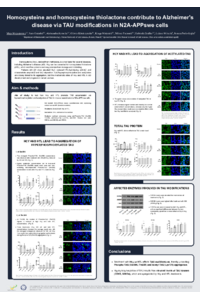
Background: Elevated levels of homocysteine (Hcy) and/or homocysteine thiolactone (HTL) are linked to neurodegenerative diseases, including Alzheimer’s disease (AD). Hyperphosphorylation or elevated acetylation of TAU protein are hallmarks of AD. However, the mechanistic roles of Hcy and HTL in the development and progression of AD are not fully understood.
Aim: We tested a hypothesis that Hcy and HTL promote TAU accumulation via hyperphosphorylation and acetylation of TAU in mouse neuroblastoma N2A-APPswe cells.
Methods: Neuroblastoma N2A-APPswe cells (N2A-APPswe) harboring a human transgene with mutation in the amyloid precursor protein (APP) gene were grown on the complete DMEM/F12 medium. Cells were treated with 20-200 μM Hcy or HTL. Phosphorylation and acetylation of TAU, as well as selected enzymes involved in TAU modification, were quantified by Immunofluorescence and Western blotting.
Results: Immunofluorescent analysis showed that Hcy and HTL upregulate phosphorylated TAU at threonine 205 and serine 396 and acetylated TAU at lysine 174, relative to untreated cells. However levels of total TAU were not affected in cells after Hcy and HTL treatment compared to control cells. At the same time, Western blots showed upregulation of CDK5 and GSK3α after Hcy and HTL treatments compared to untreated cells, while GSK3β level was not affected.
Conclusion: Treatment with Hcy or HTL affects TAU modifications which, in turn, promote TAU aggregation in mouse neuroblastoma N2A-APPswe cells. The hyperphosphorylated TAU at Ser396 and at Thr205 results from elevated levels of TAU kinases, CDK5 and GSK3α, which are upregulated by Hcy and HTL treatments.
Acknowledgements: This work was supported by NCN grant 2021/43/B/NZ4/00339 and by Prof. Daniel Lipiński, Dean of the Faculty of Agriculture, Horticulture and Biotechnology, PULS, on the occasion of the 20th anniversary of the establishment of the Operon Scientific Club.
* First seven authors contributed equally to this work
Keywords
Homocysteine
Homocysteine thiolactone
TAU
Alzheimer`s disease
Poster
Homocysteine and homocysteine thiolactone contribute to Alzheimer's disease via TAU modifications in N2A-APPswe cells.pdf
Bleomycin hydrolase deficiency and Homocysteine metabolism promote ER Stress, UPR dysregulation and apoptosis in mouse neuroblastoma N2a-APPSwe cells
Social Cognition impairments in Huntington’s Disease progression