Event submissions
EventsThe 5th International Electronic Conference on Brain Sciences & 1st International Electronic Conference on Neurosciences
Published
This submission belongs to the session S3. Behavioral Neuroscience of the event The 5th International Electronic Conference on Brain Sciences & 1st International Electronic Conference on Neurosciences
Published date
04 Mar, 2026
Academic Editor
'%3e%3cpath%20d='M12.6657%2010.9104C12.4185%2010.325%2012.0599%209.79327%2011.6097%209.34482C11.1609%208.89508%2010.6293%208.5365%2010.0442%208.28888C10.0389%208.28626%2010.0337%208.28495%2010.0285%208.28233C10.8446%207.69279%2011.3752%206.73249%2011.3752%205.64904C11.3752%203.8542%209.92103%202.39999%208.1262%202.39999C6.33136%202.39999%204.87715%203.8542%204.87715%205.64904C4.87715%206.73249%205.40774%207.69279%206.22393%208.28364C6.21869%208.28626%206.21345%208.28757%206.20821%208.29019C5.62129%208.5378%205.09463%208.89284%204.64265%209.34613C4.1929%209.79493%203.83432%2010.3266%203.58671%2010.9117C3.34345%2011.4845%203.21226%2012.0987%203.20023%2012.7209C3.19988%2012.7349%203.20233%2012.7488%203.20744%2012.7619C3.21255%2012.7749%203.22022%2012.7867%203.22998%2012.7968C3.23975%2012.8068%203.25142%2012.8147%203.26431%2012.8202C3.2772%2012.8256%203.29105%2012.8284%203.30504%2012.8284H4.09109C4.14874%2012.8284%204.19459%2012.7825%204.1959%2012.7262C4.2221%2011.7148%204.62823%2010.7676%205.34617%2010.0497C6.08899%209.30683%207.0755%208.89808%208.1262%208.89808C9.17689%208.89808%2010.1634%209.30683%2010.9062%2010.0497C11.6242%2010.7676%2012.0303%2011.7148%2012.0565%2012.7262C12.0578%2012.7838%2012.1037%2012.8284%2012.1613%2012.8284H12.9474C12.9613%2012.8284%2012.9752%2012.8256%2012.9881%2012.8202C13.001%2012.8147%2013.0126%2012.8068%2013.0224%2012.7968C13.0322%2012.7867%2013.0398%2012.7749%2013.0449%2012.7619C13.0501%2012.7488%2013.0525%2012.7349%2013.0522%2012.7209C13.0391%2012.0947%2012.9094%2011.4855%2012.6657%2010.9104ZM8.1262%207.9024C7.52486%207.9024%206.9589%207.6679%206.53312%207.24211C6.10733%206.81633%205.87283%206.25037%205.87283%205.64904C5.87283%205.0477%206.10733%204.48174%206.53312%204.05596C6.9589%203.63018%207.52486%203.39567%208.1262%203.39567C8.72753%203.39567%209.29349%203.63018%209.71927%204.05596C10.1451%204.48174%2010.3796%205.0477%2010.3796%205.64904C10.3796%206.25037%2010.1451%206.81633%209.71927%207.24211C9.29349%207.6679%208.72753%207.9024%208.1262%207.9024Z'%20fill='%235D1EE1'/%3e%3c/g%3e%3c/svg%3e) Woon‑Man Kung
Woon‑Man KungCitation
Mukundan M, The Proximal Chemical Mandate Principle: A Framework for Invariant Biological Dynamic Optimization, in Proceedings of The 5th International Electronic Conference on Brain Sciences & 1st International Electronic Conference on Neurosciences, 9 March–11 March 2026, MDPI: Basel, Switzerland
Share
Email
Facebook
Twitter
LinkedIn
The Proximal Chemical Mandate Principle: A Framework for Invariant Biological Dynamic Optimization
'%3e%3cpath%20d='M12.6647%2010.9104C12.4176%2010.325%2012.0589%209.7933%2011.6088%209.34485C11.16%208.89511%2010.6283%208.53653%2010.0432%208.28891C10.038%208.28629%2010.0327%208.28498%2010.0275%208.28236C10.8437%207.69282%2011.3743%206.73252%2011.3743%205.64907C11.3743%203.85423%209.92005%202.40002%208.12522%202.40002C6.33038%202.40002%204.87618%203.85423%204.87618%205.64907C4.87618%206.73252%205.40677%207.69282%206.22296%208.28367C6.21772%208.28629%206.21248%208.2876%206.20724%208.29022C5.62031%208.53783%205.09365%208.89287%204.64167%209.34616C4.19192%209.79496%203.83334%2010.3266%203.58573%2010.9117C3.34247%2011.4846%203.21128%2012.0987%203.19925%2012.721C3.1989%2012.735%203.20135%2012.7489%203.20646%2012.7619C3.21157%2012.7749%203.21924%2012.7868%203.22901%2012.7968C3.23877%2012.8068%203.25045%2012.8148%203.26334%2012.8202C3.27623%2012.8256%203.29007%2012.8284%203.30406%2012.8284H4.09012C4.14776%2012.8284%204.19362%2012.7825%204.19493%2012.7262C4.22113%2011.7148%204.62726%2010.7676%205.34519%2010.0497C6.08802%209.30686%207.07452%208.89811%208.12522%208.89811C9.17592%208.89811%2010.1624%209.30686%2010.9052%2010.0497C11.6232%2010.7676%2012.0293%2011.7148%2012.0555%2012.7262C12.0568%2012.7839%2012.1027%2012.8284%2012.1603%2012.8284H12.9464C12.9604%2012.8284%2012.9742%2012.8256%2012.9871%2012.8202C13%2012.8148%2013.0117%2012.8068%2013.0214%2012.7968C13.0312%2012.7868%2013.0389%2012.7749%2013.044%2012.7619C13.0491%2012.7489%2013.0515%2012.735%2013.0512%2012.721C13.0381%2012.0947%2012.9084%2011.4856%2012.6647%2010.9104ZM8.12522%207.90243C7.52388%207.90243%206.95792%207.66793%206.53214%207.24215C6.10636%206.81636%205.87185%206.2504%205.87185%205.64907C5.87185%205.04773%206.10636%204.48177%206.53214%204.05599C6.95792%203.63021%207.52388%203.3957%208.12522%203.3957C8.72655%203.3957%209.29252%203.63021%209.7183%204.05599C10.1441%204.48177%2010.3786%205.04773%2010.3786%205.64907C10.3786%206.2504%2010.1441%206.81636%209.7183%207.24215C9.29252%207.66793%208.72655%207.90243%208.12522%207.90243Z'%20fill='%235D1EE1'/%3e%3c/g%3e%3c/svg%3e)
Mukundan M 1
1. Independent Researcher, Perambalur 621116, India
Abstract
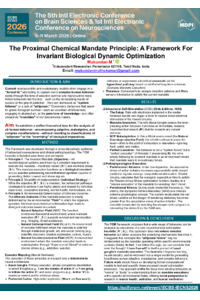
Introduction: Current explanations of motivated behavior remain theoretically fragmented across neuroscience, psychology, evolutionary biology, etc. The Proximal Chemical Mandate Principle addresses this fragmentation by proposing that all motivated behavior can be reduced (for unification) to two invariant neurobiological objectives: reward neurochemicals maximization (R↑) (e.g., Dopamine, Opioid , Oxytocin, and more) and/or stress neurochemicals minimization (S↓) (e.g., Norepinephrine, Cortisol, and more).
Methods: We developed this novel theoretical reductionist framework by synthesizing direct evidence from decades of behavioral neuroscience literature, including intracranial self-stimulation, conditioned avoidance paradigms, fiber photometry, and optogenetic studies. The model establishes causal relationships with specific neurochemical signals to motivated behaviors and its ultimate outcome.
Results: Direct experimental evidence demonstrates the following:
Compulsive reward maximization via intracranial self-stimulation, whereby rats repeatedly press levers to stimulate reward pathways despite physiological exhaustion (Olds & Milner, 1954).
Immediate subsecond dopamine encoding of reward value, with nucleus accumbens transients driving motivated action (R↑) within 150–300 ms (Hamid et al., 2021; Mohebi et al., 2024).
Learned stress minimization through conditioned avoidance behaviors (by prediction) that trigger immediately and persist even without immediate threat.
Rapid-onset threat processing via specialized amygdala circuits that detect threats within 120 ms and initiate defensive responses (S↓) within 200 ms (Li et al., 2022).
Real-time instantaneous value–threat integration through prefrontal–striatal circuits that resolve decision conflicts (S↓) within 400–600ms (Zhou et al., 2023).
Conclusions: These findings support a unified novel, testable framework that potentially resolves apparent behavioral paradoxes—including altruism (S↓via altruistic act), addiction (R↑via supernormal stimuli), suicide (S↓), and voluntary childlessness—by demonstrating how identical (R↑,S↓) mandates produce divergent outcomes through contextual implementation. The principle provides testable predictions (if direct mesolimbic dopamine self-stimulation ever stops voluntarily without any other strong environment stimuli, the theory is falsified) for behavioral neuroscience and psychiatry.
Conflicts of interest: None
Keywords
Neurochemical Optimization
Reward Maximization
Stress Minimization
Theoretical Neuroscience.
Poster
Poster sciforum-161025 .pdf
The Importance of Behavioral Phenotyping in Evaluating Multitarget Phytochemicals in the 5xFAD Model of Alzheimer’s Disease
Feasibility of identifying catatonia using the Bush-Francis Catatonia Rating Scale via remote motor assessments