Event submissions
EventsThe 5th International Electronic Conference on Brain Sciences & 1st International Electronic Conference on Neurosciences
Published
This submission belongs to the session S7. Systems Neuroscience of the event The 5th International Electronic Conference on Brain Sciences & 1st International Electronic Conference on Neurosciences
Published date
04 Mar, 2026
Academic Editor
'%3e%3cpath%20d='M12.6657%2010.9104C12.4185%2010.325%2012.0599%209.79327%2011.6097%209.34482C11.1609%208.89508%2010.6293%208.5365%2010.0442%208.28888C10.0389%208.28626%2010.0337%208.28495%2010.0285%208.28233C10.8446%207.69279%2011.3752%206.73249%2011.3752%205.64904C11.3752%203.8542%209.92103%202.39999%208.1262%202.39999C6.33136%202.39999%204.87715%203.8542%204.87715%205.64904C4.87715%206.73249%205.40774%207.69279%206.22393%208.28364C6.21869%208.28626%206.21345%208.28757%206.20821%208.29019C5.62129%208.5378%205.09463%208.89284%204.64265%209.34613C4.1929%209.79493%203.83432%2010.3266%203.58671%2010.9117C3.34345%2011.4845%203.21226%2012.0987%203.20023%2012.7209C3.19988%2012.7349%203.20233%2012.7488%203.20744%2012.7619C3.21255%2012.7749%203.22022%2012.7867%203.22998%2012.7968C3.23975%2012.8068%203.25142%2012.8147%203.26431%2012.8202C3.2772%2012.8256%203.29105%2012.8284%203.30504%2012.8284H4.09109C4.14874%2012.8284%204.19459%2012.7825%204.1959%2012.7262C4.2221%2011.7148%204.62823%2010.7676%205.34617%2010.0497C6.08899%209.30683%207.0755%208.89808%208.1262%208.89808C9.17689%208.89808%2010.1634%209.30683%2010.9062%2010.0497C11.6242%2010.7676%2012.0303%2011.7148%2012.0565%2012.7262C12.0578%2012.7838%2012.1037%2012.8284%2012.1613%2012.8284H12.9474C12.9613%2012.8284%2012.9752%2012.8256%2012.9881%2012.8202C13.001%2012.8147%2013.0126%2012.8068%2013.0224%2012.7968C13.0322%2012.7867%2013.0398%2012.7749%2013.0449%2012.7619C13.0501%2012.7488%2013.0525%2012.7349%2013.0522%2012.7209C13.0391%2012.0947%2012.9094%2011.4855%2012.6657%2010.9104ZM8.1262%207.9024C7.52486%207.9024%206.9589%207.6679%206.53312%207.24211C6.10733%206.81633%205.87283%206.25037%205.87283%205.64904C5.87283%205.0477%206.10733%204.48174%206.53312%204.05596C6.9589%203.63018%207.52486%203.39567%208.1262%203.39567C8.72753%203.39567%209.29349%203.63018%209.71927%204.05596C10.1451%204.48174%2010.3796%205.0477%2010.3796%205.64904C10.3796%206.25037%2010.1451%206.81633%209.71927%207.24211C9.29349%207.6679%208.72753%207.9024%208.1262%207.9024Z'%20fill='%235D1EE1'/%3e%3c/g%3e%3c/svg%3e) Vasileios T. Papaliagkas
Vasileios T. PapaliagkasCitation
Ashish Kumar, Sahil Singh, Vijay Kumar, A Systems Biology Approach to unravel the common genes and pathways in Amyotrophic Lateral Sclerosis and Traumatic Brain Injury, in Proceedings of The 5th International Electronic Conference on Brain Sciences & 1st International Electronic Conference on Neurosciences, 9 March–11 March 2026, MDPI: Basel, Switzerland
Share
Email
Facebook
Twitter
LinkedIn
A Systems Biology Approach to unravel the common genes and pathways in Amyotrophic Lateral Sclerosis and Traumatic Brain Injury
'%3e%3cpath%20d='M12.6647%2010.9104C12.4176%2010.325%2012.0589%209.7933%2011.6088%209.34485C11.16%208.89511%2010.6283%208.53653%2010.0432%208.28891C10.038%208.28629%2010.0327%208.28498%2010.0275%208.28236C10.8437%207.69282%2011.3743%206.73252%2011.3743%205.64907C11.3743%203.85423%209.92005%202.40002%208.12522%202.40002C6.33038%202.40002%204.87618%203.85423%204.87618%205.64907C4.87618%206.73252%205.40677%207.69282%206.22296%208.28367C6.21772%208.28629%206.21248%208.2876%206.20724%208.29022C5.62031%208.53783%205.09365%208.89287%204.64167%209.34616C4.19192%209.79496%203.83334%2010.3266%203.58573%2010.9117C3.34247%2011.4846%203.21128%2012.0987%203.19925%2012.721C3.1989%2012.735%203.20135%2012.7489%203.20646%2012.7619C3.21157%2012.7749%203.21924%2012.7868%203.22901%2012.7968C3.23877%2012.8068%203.25045%2012.8148%203.26334%2012.8202C3.27623%2012.8256%203.29007%2012.8284%203.30406%2012.8284H4.09012C4.14776%2012.8284%204.19362%2012.7825%204.19493%2012.7262C4.22113%2011.7148%204.62726%2010.7676%205.34519%2010.0497C6.08802%209.30686%207.07452%208.89811%208.12522%208.89811C9.17592%208.89811%2010.1624%209.30686%2010.9052%2010.0497C11.6232%2010.7676%2012.0293%2011.7148%2012.0555%2012.7262C12.0568%2012.7839%2012.1027%2012.8284%2012.1603%2012.8284H12.9464C12.9604%2012.8284%2012.9742%2012.8256%2012.9871%2012.8202C13%2012.8148%2013.0117%2012.8068%2013.0214%2012.7968C13.0312%2012.7868%2013.0389%2012.7749%2013.044%2012.7619C13.0491%2012.7489%2013.0515%2012.735%2013.0512%2012.721C13.0381%2012.0947%2012.9084%2011.4856%2012.6647%2010.9104ZM8.12522%207.90243C7.52388%207.90243%206.95792%207.66793%206.53214%207.24215C6.10636%206.81636%205.87185%206.2504%205.87185%205.64907C5.87185%205.04773%206.10636%204.48177%206.53214%204.05599C6.95792%203.63021%207.52388%203.3957%208.12522%203.3957C8.72655%203.3957%209.29252%203.63021%209.7183%204.05599C10.1441%204.48177%2010.3786%205.04773%2010.3786%205.64907C10.3786%206.2504%2010.1441%206.81636%209.7183%207.24215C9.29252%207.66793%208.72655%207.90243%208.12522%207.90243Z'%20fill='%235D1EE1'/%3e%3c/g%3e%3c/svg%3e)
Ashish Kumar 1
Sahil Singh 1
Vijay Kumar 1
1. Amity Institute of Biotechnology, Amity University, Noida, UP-201303, India
Abstract
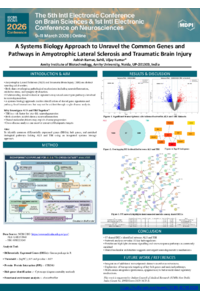
Background: Amyotrophic lateral sclerosis (ALS) and traumatic brain injury (TBI) are distinct neurological disorders that share overlapping molecular and cellular mechanisms, including neuroinflammation, oxidative stress, and synaptic dysfunction.
Methods: This study employs a systems biology approach to identify common genes and pathways linking ALS and TBI. Differentially expressed genes (DEGs) from publicly available transcriptomic datasets (GSE89866 for TBI and GSE153960 for ALS) were integrated and analyzed through network-based and enrichment analyses. Protein–protein interaction (PPI) networks were constructed to highlight key hub genes and regulatory modules shared between both conditions.
Results: A total of 3885 DEGs were identified in ALS (GSE153960) whereas 449 DEGs were obtained in TBI (GSE89866). Total number of common overlapping DEGs between the two datasets were 20, out of which 13 common DEGs were upregulated in both the cases, while 7 DEGs were downregulated. Important upregulated genes were MAFB, IL13RA1, PLBD1, CYP1B1, FBP1, TLR5, and RAB20. Similarly, key downregulated genes were ZNF541, DNAI2, NYAP1, TRIM17, and TRPV6. The functional enrichment analysis indicated that these key genes are involved largely in the innate immune system, muscle contraction, aldosterone synthesis and secretion, cellular responses to stimuli, cytosolic DNA-sensing pathway and cellular senescence.
Conclusion: These findings provide novel insights into shared molecular mechanisms and may contribute to identifying potential therapeutic targets for neuroprotection and disease modification in ALS and TBI.
Keywords
ALS
TBI
Differential Gen Expression
Protein-Protein interaction network
Functional Enrichment
Poster
161849.pdf
Intergenerational effects of childhood stress on depressive-like behaviors and function of glucocorticoids in the Nucleus Accumbens: therapeutic potential of Centella asiatica
Task-dependent modulation of aftereffects during visuomotor adaptation