Event submissions
EventsThe 5th International Electronic Conference on Brain Sciences & 1st International Electronic Conference on Neurosciences
Published
This submission belongs to the session S2. Cellular and Molecular Neuroscience of the event The 5th International Electronic Conference on Brain Sciences & 1st International Electronic Conference on Neurosciences
Published date
04 Mar, 2026
Academic Editor
'%3e%3cpath%20d='M12.6657%2010.9104C12.4185%2010.325%2012.0599%209.79327%2011.6097%209.34482C11.1609%208.89508%2010.6293%208.5365%2010.0442%208.28888C10.0389%208.28626%2010.0337%208.28495%2010.0285%208.28233C10.8446%207.69279%2011.3752%206.73249%2011.3752%205.64904C11.3752%203.8542%209.92103%202.39999%208.1262%202.39999C6.33136%202.39999%204.87715%203.8542%204.87715%205.64904C4.87715%206.73249%205.40774%207.69279%206.22393%208.28364C6.21869%208.28626%206.21345%208.28757%206.20821%208.29019C5.62129%208.5378%205.09463%208.89284%204.64265%209.34613C4.1929%209.79493%203.83432%2010.3266%203.58671%2010.9117C3.34345%2011.4845%203.21226%2012.0987%203.20023%2012.7209C3.19988%2012.7349%203.20233%2012.7488%203.20744%2012.7619C3.21255%2012.7749%203.22022%2012.7867%203.22998%2012.7968C3.23975%2012.8068%203.25142%2012.8147%203.26431%2012.8202C3.2772%2012.8256%203.29105%2012.8284%203.30504%2012.8284H4.09109C4.14874%2012.8284%204.19459%2012.7825%204.1959%2012.7262C4.2221%2011.7148%204.62823%2010.7676%205.34617%2010.0497C6.08899%209.30683%207.0755%208.89808%208.1262%208.89808C9.17689%208.89808%2010.1634%209.30683%2010.9062%2010.0497C11.6242%2010.7676%2012.0303%2011.7148%2012.0565%2012.7262C12.0578%2012.7838%2012.1037%2012.8284%2012.1613%2012.8284H12.9474C12.9613%2012.8284%2012.9752%2012.8256%2012.9881%2012.8202C13.001%2012.8147%2013.0126%2012.8068%2013.0224%2012.7968C13.0322%2012.7867%2013.0398%2012.7749%2013.0449%2012.7619C13.0501%2012.7488%2013.0525%2012.7349%2013.0522%2012.7209C13.0391%2012.0947%2012.9094%2011.4855%2012.6657%2010.9104ZM8.1262%207.9024C7.52486%207.9024%206.9589%207.6679%206.53312%207.24211C6.10733%206.81633%205.87283%206.25037%205.87283%205.64904C5.87283%205.0477%206.10733%204.48174%206.53312%204.05596C6.9589%203.63018%207.52486%203.39567%208.1262%203.39567C8.72753%203.39567%209.29349%203.63018%209.71927%204.05596C10.1451%204.48174%2010.3796%205.0477%2010.3796%205.64904C10.3796%206.25037%2010.1451%206.81633%209.71927%207.24211C9.29349%207.6679%208.72753%207.9024%208.1262%207.9024Z'%20fill='%235D1EE1'/%3e%3c/g%3e%3c/svg%3e) Keehoon Lee
Keehoon LeeCitation
Mehwish Majeed, Muhammad Zurgham Akram, Computational Modeling and Molecular Dynamics of Nonsynonymous CSDE1 Variants Associated with Autism Spectrum Disorder, in Proceedings of The 5th International Electronic Conference on Brain Sciences & 1st International Electronic Conference on Neurosciences, 9 March–11 March 2026, MDPI: Basel, Switzerland
Share
Email
Facebook
Twitter
LinkedIn
Computational Modeling and Molecular Dynamics of Nonsynonymous CSDE1 Variants Associated with Autism Spectrum Disorder
'%3e%3cpath%20d='M12.6647%2010.9104C12.4176%2010.325%2012.0589%209.7933%2011.6088%209.34485C11.16%208.89511%2010.6283%208.53653%2010.0432%208.28891C10.038%208.28629%2010.0327%208.28498%2010.0275%208.28236C10.8437%207.69282%2011.3743%206.73252%2011.3743%205.64907C11.3743%203.85423%209.92005%202.40002%208.12522%202.40002C6.33038%202.40002%204.87618%203.85423%204.87618%205.64907C4.87618%206.73252%205.40677%207.69282%206.22296%208.28367C6.21772%208.28629%206.21248%208.2876%206.20724%208.29022C5.62031%208.53783%205.09365%208.89287%204.64167%209.34616C4.19192%209.79496%203.83334%2010.3266%203.58573%2010.9117C3.34247%2011.4846%203.21128%2012.0987%203.19925%2012.721C3.1989%2012.735%203.20135%2012.7489%203.20646%2012.7619C3.21157%2012.7749%203.21924%2012.7868%203.22901%2012.7968C3.23877%2012.8068%203.25045%2012.8148%203.26334%2012.8202C3.27623%2012.8256%203.29007%2012.8284%203.30406%2012.8284H4.09012C4.14776%2012.8284%204.19362%2012.7825%204.19493%2012.7262C4.22113%2011.7148%204.62726%2010.7676%205.34519%2010.0497C6.08802%209.30686%207.07452%208.89811%208.12522%208.89811C9.17592%208.89811%2010.1624%209.30686%2010.9052%2010.0497C11.6232%2010.7676%2012.0293%2011.7148%2012.0555%2012.7262C12.0568%2012.7839%2012.1027%2012.8284%2012.1603%2012.8284H12.9464C12.9604%2012.8284%2012.9742%2012.8256%2012.9871%2012.8202C13%2012.8148%2013.0117%2012.8068%2013.0214%2012.7968C13.0312%2012.7868%2013.0389%2012.7749%2013.044%2012.7619C13.0491%2012.7489%2013.0515%2012.735%2013.0512%2012.721C13.0381%2012.0947%2012.9084%2011.4856%2012.6647%2010.9104ZM8.12522%207.90243C7.52388%207.90243%206.95792%207.66793%206.53214%207.24215C6.10636%206.81636%205.87185%206.2504%205.87185%205.64907C5.87185%205.04773%206.10636%204.48177%206.53214%204.05599C6.95792%203.63021%207.52388%203.3957%208.12522%203.3957C8.72655%203.3957%209.29252%203.63021%209.7183%204.05599C10.1441%204.48177%2010.3786%205.04773%2010.3786%205.64907C10.3786%206.2504%2010.1441%206.81636%209.7183%207.24215C9.29252%207.66793%208.72655%207.90243%208.12522%207.90243Z'%20fill='%235D1EE1'/%3e%3c/g%3e%3c/svg%3e)
Mehwish Majeed 1,2
Muhammad Zurgham Akram 1,2
1. College of Medicine and Biological Information Engineering , Northeastern University ,Shenyang, Liaoning, 110819, China.
2. Department of Computer Science, University of Agriculture Faisalabad ,Agriculture University Road, 38000, Faisalabad, Pakistan.
Abstract
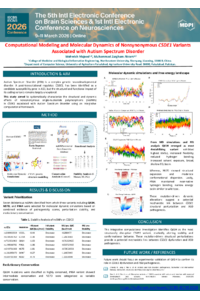
Background: Autism Spectrum Disorder is a complex neurodevelopmental condition with a strong genetic basis, yet the molecular mechanisms by which many risk-associated variants disrupt neuronal function remain poorly understood. CSDE1, a post-transcriptional regulator implicated in neurodevelopment, has recently emerged as a candidate susceptibility gene in Autism Spectrum Disorder, although the structural and functional consequences of its coding variants remain largely unexplored.
Objective: This study aimed to systematically characterize the structural and dynamic effects of nonsynonymous single-nucleotide polymorphisms in CSDE1 associated with Autism Spectrum Disorder using an integrative computational framework.
Methods: A comprehensive in silico pipeline was employed to prioritize potentially deleterious CSDE1 variants using sequence- and structure-based prediction tools, including SIFT, PolyPhen-2, MutPred2, I-Mutant 2.0, MUpro, DynaMut, and ConSurf. The CSDE1 protein structure was obtained from the AlphaFold Protein Structure Database, refined using GalaxyRefine, and validated with MolProbity. Functionally relevant domains harboring high-confidence variants were subjected to all-atom molecular dynamics simulations. Structural dynamics were evaluated over 100 ns simulation trajectories using root mean square deviation, root mean square fluctuation, radius of gyration, hydrogen bond occupancy, and solvent-accessible surface area.
Results: Comparative analyses between wild-type and mutant CSDE1 proteins revealed pronounced conformational instability, altered residue flexibility, disrupted compactness, and changes in intramolecular interaction networks in selected variants. These perturbations suggest compromised structural integrity and functional dynamics of CSDE1, supporting their potential pathogenic relevance in Autism Spectrum Disorder.
Conclusion:This study provides the first detailed molecular-level characterization of Autism Spectrum Disorder-associated CSDE1 nonsynonymous variants using computational modeling and molecular dynamics simulations. The findings highlight candidate variants with functional relevance and establish a framework for future experimental validation, offering insights into the mechanistic role of CSDE1 in neurodevelopmental dysfunction and its potential utility as a molecular biomarker.
Keywords
Autism Spectrum Disorder
CSDE1
Nonsynonymous single nucleotide polymorphisms
Computational modeling
Molecular dynamics simulations
Neurodevelopmental genetics
Poster
Poster MM, MZA.pdf
Long COVID-19 effects on the olfactory, gustatory, and cognitive functions
Can Music Training Enhance/Affect Working Memory and Speech-in-Noise Perception in Cochlear Implant Users? A Randomized Controlled Study of EEG Measures of Improvement