Event submissions
EventsThe 5th International Electronic Conference on Brain Sciences & 1st International Electronic Conference on Neurosciences
Published
This submission belongs to the session S4. Cognitive Neuroscience of the event The 5th International Electronic Conference on Brain Sciences & 1st International Electronic Conference on Neurosciences
Published date
04 Mar, 2026
Academic Editor
'%3e%3cpath%20d='M12.6657%2010.9104C12.4185%2010.325%2012.0599%209.79327%2011.6097%209.34482C11.1609%208.89508%2010.6293%208.5365%2010.0442%208.28888C10.0389%208.28626%2010.0337%208.28495%2010.0285%208.28233C10.8446%207.69279%2011.3752%206.73249%2011.3752%205.64904C11.3752%203.8542%209.92103%202.39999%208.1262%202.39999C6.33136%202.39999%204.87715%203.8542%204.87715%205.64904C4.87715%206.73249%205.40774%207.69279%206.22393%208.28364C6.21869%208.28626%206.21345%208.28757%206.20821%208.29019C5.62129%208.5378%205.09463%208.89284%204.64265%209.34613C4.1929%209.79493%203.83432%2010.3266%203.58671%2010.9117C3.34345%2011.4845%203.21226%2012.0987%203.20023%2012.7209C3.19988%2012.7349%203.20233%2012.7488%203.20744%2012.7619C3.21255%2012.7749%203.22022%2012.7867%203.22998%2012.7968C3.23975%2012.8068%203.25142%2012.8147%203.26431%2012.8202C3.2772%2012.8256%203.29105%2012.8284%203.30504%2012.8284H4.09109C4.14874%2012.8284%204.19459%2012.7825%204.1959%2012.7262C4.2221%2011.7148%204.62823%2010.7676%205.34617%2010.0497C6.08899%209.30683%207.0755%208.89808%208.1262%208.89808C9.17689%208.89808%2010.1634%209.30683%2010.9062%2010.0497C11.6242%2010.7676%2012.0303%2011.7148%2012.0565%2012.7262C12.0578%2012.7838%2012.1037%2012.8284%2012.1613%2012.8284H12.9474C12.9613%2012.8284%2012.9752%2012.8256%2012.9881%2012.8202C13.001%2012.8147%2013.0126%2012.8068%2013.0224%2012.7968C13.0322%2012.7867%2013.0398%2012.7749%2013.0449%2012.7619C13.0501%2012.7488%2013.0525%2012.7349%2013.0522%2012.7209C13.0391%2012.0947%2012.9094%2011.4855%2012.6657%2010.9104ZM8.1262%207.9024C7.52486%207.9024%206.9589%207.6679%206.53312%207.24211C6.10733%206.81633%205.87283%206.25037%205.87283%205.64904C5.87283%205.0477%206.10733%204.48174%206.53312%204.05596C6.9589%203.63018%207.52486%203.39567%208.1262%203.39567C8.72753%203.39567%209.29349%203.63018%209.71927%204.05596C10.1451%204.48174%2010.3796%205.0477%2010.3796%205.64904C10.3796%206.25037%2010.1451%206.81633%209.71927%207.24211C9.29349%207.6679%208.72753%207.9024%208.1262%207.9024Z'%20fill='%235D1EE1'/%3e%3c/g%3e%3c/svg%3e) Carla Masala
Carla MasalaCitation
Elizaveta Kozhevnikova, Valeria Karpinskaya, Vsevolod Lyakhovetskii, Daria Podvigina, Maria Elovikova, Psychophysiological Correlates of Geometric Visual Illusions: A Comparative Study of the Ponzo and Müller-Lyer Effects., in Proceedings of The 5th International Electronic Conference on Brain Sciences & 1st International Electronic Conference on Neurosciences, 9 March–11 March 2026, MDPI: Basel, Switzerland
Share
Email
Facebook
Twitter
LinkedIn
Psychophysiological Correlates of Geometric Visual Illusions: A Comparative Study of the Ponzo and Müller-Lyer Effects.
'%3e%3cpath%20d='M12.6647%2010.9104C12.4176%2010.325%2012.0589%209.7933%2011.6088%209.34485C11.16%208.89511%2010.6283%208.53653%2010.0432%208.28891C10.038%208.28629%2010.0327%208.28498%2010.0275%208.28236C10.8437%207.69282%2011.3743%206.73252%2011.3743%205.64907C11.3743%203.85423%209.92005%202.40002%208.12522%202.40002C6.33038%202.40002%204.87618%203.85423%204.87618%205.64907C4.87618%206.73252%205.40677%207.69282%206.22296%208.28367C6.21772%208.28629%206.21248%208.2876%206.20724%208.29022C5.62031%208.53783%205.09365%208.89287%204.64167%209.34616C4.19192%209.79496%203.83334%2010.3266%203.58573%2010.9117C3.34247%2011.4846%203.21128%2012.0987%203.19925%2012.721C3.1989%2012.735%203.20135%2012.7489%203.20646%2012.7619C3.21157%2012.7749%203.21924%2012.7868%203.22901%2012.7968C3.23877%2012.8068%203.25045%2012.8148%203.26334%2012.8202C3.27623%2012.8256%203.29007%2012.8284%203.30406%2012.8284H4.09012C4.14776%2012.8284%204.19362%2012.7825%204.19493%2012.7262C4.22113%2011.7148%204.62726%2010.7676%205.34519%2010.0497C6.08802%209.30686%207.07452%208.89811%208.12522%208.89811C9.17592%208.89811%2010.1624%209.30686%2010.9052%2010.0497C11.6232%2010.7676%2012.0293%2011.7148%2012.0555%2012.7262C12.0568%2012.7839%2012.1027%2012.8284%2012.1603%2012.8284H12.9464C12.9604%2012.8284%2012.9742%2012.8256%2012.9871%2012.8202C13%2012.8148%2013.0117%2012.8068%2013.0214%2012.7968C13.0312%2012.7868%2013.0389%2012.7749%2013.044%2012.7619C13.0491%2012.7489%2013.0515%2012.735%2013.0512%2012.721C13.0381%2012.0947%2012.9084%2011.4856%2012.6647%2010.9104ZM8.12522%207.90243C7.52388%207.90243%206.95792%207.66793%206.53214%207.24215C6.10636%206.81636%205.87185%206.2504%205.87185%205.64907C5.87185%205.04773%206.10636%204.48177%206.53214%204.05599C6.95792%203.63021%207.52388%203.3957%208.12522%203.3957C8.72655%203.3957%209.29252%203.63021%209.7183%204.05599C10.1441%204.48177%2010.3786%205.04773%2010.3786%205.64907C10.3786%206.2504%2010.1441%206.81636%209.7183%207.24215C9.29252%207.66793%208.72655%207.90243%208.12522%207.90243Z'%20fill='%235D1EE1'/%3e%3c/g%3e%3c/svg%3e)
Elizaveta Kozhevnikova 1
Valeria Karpinskaya 1
Vsevolod Lyakhovetskii 1,2
Daria Podvigina 1,3
Maria Elovikova 4
1. Institute of Cognitive Studies, Saint Petersburg State University (SPbU), Saint Petersburg, 199034, Russia
2. Laboratory of Movement Physiology, Pavlov Institute of Physiology, Russian Academy of Sciences (RAS), Saint Petersburg, 199034, Russia
3. Primate Sensory Systems Physiology Group, Pavlov Institute of Physiology, Russian Academy of Sciences (RAS), Saint Petersburg, 199034, Russia
4. Interdisciplinary Brain Research Unit, Laboratory of Cognitive Psychology and Psychophysiology, N.P. Bekhtereva Institute of the Human Brain, Russian Academy of Sciences (RAS), Saint Petersburg, 197376, Russia
Abstract
Introduction:
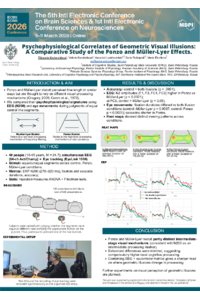
Although the Ponzo and Müller-Lyer illusions distort line length similarly, they may involve distinct perceptual mechanisms. Both illusions make equal line segments appear unequal, yet prior studies classify them into different categories of visual processing (Gregory, 2009; Coren et al., 1978). Evidence suggests that the N200 component reflects intermediate visual processing, bridging low- and high-level stages of perception (Yang & Sui, 2022). Eye movement studies indicate that the Müller-Lyer illusion distorts saccadic trajectories (Chen et al., 2020), whereas in the Ponzo illusion, fixations tend to be longer on the upper segment than the lower one (Yildiz et al., 2019). This study compared the psychophysiological correlates of Ponzo and Müller-Lyer illusions by analyzing electrophysiological and oculomotor activity during the perception of equal central line segments.
Methods:
Forty participants (aged 18–45, M = 24.7) underwent synchronous EEG (64-channel BrainVision ActiChamp) and eye-tracking (EyeLink 1000). Stimuli included equal and unequal line segments in three conditions: control, Ponzo, and Müller-Lyer. ERPs (N200 270–320 ms), fixation and saccade durations, and response accuracy were analyzed using a repeated-measures ANOVA and the Friedman test.
Results:
The accuracy of the responses was significantly higher in the control condition than in both illusion conditions (p < 0.0001). N2 amplitudes (F1, F3, FC1, FC3) were higher for Ponzo than for Müller-Lyer (p < 0.0001), and in FC3, the control exceeded the Müller-Lyer group (p < 0.05). Fixation durations differed between the control and Müller-Lyer (p = 0.0097) groups and the Ponzo (p < 0.0001) group, while saccades were shorter in the Ponzo group. Eye movement heat maps revealed distinct viewing patterns across conditions.
Conclusions:
It was found that Ponzo and Müller-Lyer illusions engage partially distinct visual mechanisms. Behavioral differences were minimal, suggesting compensatory higher-level cognitive processing. Oculomotor and electrophysiological data together provide a nuanced understanding of the intermediate stages of geometric illusion perception.
Keywords
Geometric illusions
Visual perception
Event-related potentials
Eye movements.
Poster
Kozhevnikova - Psychophysiological Correlates of Geometric Visual Illusions A Comparative Study of the Ponzo and Müller-Lyer Effects..pdf
Perineural Injection Treatment - Dextrose for Chronic Migraine: A Case Study Analysis
Prioritizing components for a healthy lifestyle intervention post-stroke: a cross-country Patient and Public Involvement-based descriptive analysis