Event submissions
Published
This submission belongs to the session S3. Terrestrial and Marine Biodiversity and Habitat Loss Prevention of the event The 1st International Online Conference on Environments
Published date
05 Mar, 2026
Academic Editor
'%3e%3cpath%20d='M12.6657%2010.9104C12.4185%2010.325%2012.0599%209.79327%2011.6097%209.34482C11.1609%208.89508%2010.6293%208.5365%2010.0442%208.28888C10.0389%208.28626%2010.0337%208.28495%2010.0285%208.28233C10.8446%207.69279%2011.3752%206.73249%2011.3752%205.64904C11.3752%203.8542%209.92103%202.39999%208.1262%202.39999C6.33136%202.39999%204.87715%203.8542%204.87715%205.64904C4.87715%206.73249%205.40774%207.69279%206.22393%208.28364C6.21869%208.28626%206.21345%208.28757%206.20821%208.29019C5.62129%208.5378%205.09463%208.89284%204.64265%209.34613C4.1929%209.79493%203.83432%2010.3266%203.58671%2010.9117C3.34345%2011.4845%203.21226%2012.0987%203.20023%2012.7209C3.19988%2012.7349%203.20233%2012.7488%203.20744%2012.7619C3.21255%2012.7749%203.22022%2012.7867%203.22998%2012.7968C3.23975%2012.8068%203.25142%2012.8147%203.26431%2012.8202C3.2772%2012.8256%203.29105%2012.8284%203.30504%2012.8284H4.09109C4.14874%2012.8284%204.19459%2012.7825%204.1959%2012.7262C4.2221%2011.7148%204.62823%2010.7676%205.34617%2010.0497C6.08899%209.30683%207.0755%208.89808%208.1262%208.89808C9.17689%208.89808%2010.1634%209.30683%2010.9062%2010.0497C11.6242%2010.7676%2012.0303%2011.7148%2012.0565%2012.7262C12.0578%2012.7838%2012.1037%2012.8284%2012.1613%2012.8284H12.9474C12.9613%2012.8284%2012.9752%2012.8256%2012.9881%2012.8202C13.001%2012.8147%2013.0126%2012.8068%2013.0224%2012.7968C13.0322%2012.7867%2013.0398%2012.7749%2013.0449%2012.7619C13.0501%2012.7488%2013.0525%2012.7349%2013.0522%2012.7209C13.0391%2012.0947%2012.9094%2011.4855%2012.6657%2010.9104ZM8.1262%207.9024C7.52486%207.9024%206.9589%207.6679%206.53312%207.24211C6.10733%206.81633%205.87283%206.25037%205.87283%205.64904C5.87283%205.0477%206.10733%204.48174%206.53312%204.05596C6.9589%203.63018%207.52486%203.39567%208.1262%203.39567C8.72753%203.39567%209.29349%203.63018%209.71927%204.05596C10.1451%204.48174%2010.3796%205.0477%2010.3796%205.64904C10.3796%206.25037%2010.1451%206.81633%209.71927%207.24211C9.29349%207.6679%208.72753%207.9024%208.1262%207.9024Z'%20fill='%235D1EE1'/%3e%3c/g%3e%3c/svg%3e) Claudio Agnisola
Claudio AgnisolaCitation
Konstantinos Stefanidis, Eva Papastergiadou, Freshwater quillworts of Greece: Updated distribution patterns and conservation threats, in Proceedings of The 1st International Online Conference on Environments, 2 March–4 March 2026, MDPI: Basel, Switzerland
Share
Email
Facebook
Twitter
LinkedIn
Freshwater quillworts of Greece: Updated distribution patterns and conservation threats

Konstantinos Stefanidis 1

Eva Papastergiadou 1
1. Department of Biology, University of Patras, Patras, Greece
Abstract
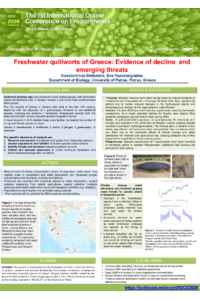
Freshwater plants remain understudied relative to other biotic groups, resulting in substantial gaps in knowledge of their distribution and ecology. One such group is the aquatic quillworts (Isoetes spp.), with many species found mainly in freshwater ecosystems, including temporary ponds, lakes, and estuaries. Particularly in Greece, quillworts are among the most undercollected plant groups, revealing significant knowledge gaps in their distribution and conservation status.
Methods:
Extensive field surveys were conducted in freshwater habitats with historical records of Isoetes occurrence, including Lesvos, Crete, and western Greece. Habitat conditions were documented, potential threats were recorded, and population sizes were estimated to assess species status and establish conservation priorities.
Results:
Survey results revealed a substantial decline in Isoetes populations and occurrence over recent decades. The two Greek endemic species, I. heldreichii and I. haussknechtii. were absent from their previously reported localities. The primary threats identified were hydrological changes driven by climate change, which accelerate the drying of temporary ponds, as well as overgrazing and general habitat degradation.
Conclusions:
These findings underscore an urgent need for targeted conservation and restoration actions focused on freshwater habitats, particularly temporary ponds, to safeguard remaining Isoetes populations. Conservation efforts should prioritize the Greek endemic species, the Pindus quillwort (I. heldreichii) and the Greek quillwort (I. haussknechtii), both facing a high risk of extinction, with the Pindus quillwort likely already extinct. Strengthened monitoring, habitat management, and water regulation policies are essential to ensure the long-term survival of these unique aquatic plants in Greece.
Keywords
Isoetes
endemics
conservation
temporary ponds
Poster
sciforum-158253_poster.pdf
Environmental Impact Assessment of Industrial and Urban Discharges on Groundwater and Surface Water in the Commune of Dar Bouazza
The impacts of producing bio briquettes made from organic waste as an alternative source of fuel