Event submissions
Published
This submission belongs to the session S6. Ecological, Environmental and Circular Economics of the event The 1st International Online Conference on Environments
Published date
05 Mar, 2026
Academic Editor
'%3e%3cpath%20d='M12.6657%2010.9104C12.4185%2010.325%2012.0599%209.79327%2011.6097%209.34482C11.1609%208.89508%2010.6293%208.5365%2010.0442%208.28888C10.0389%208.28626%2010.0337%208.28495%2010.0285%208.28233C10.8446%207.69279%2011.3752%206.73249%2011.3752%205.64904C11.3752%203.8542%209.92103%202.39999%208.1262%202.39999C6.33136%202.39999%204.87715%203.8542%204.87715%205.64904C4.87715%206.73249%205.40774%207.69279%206.22393%208.28364C6.21869%208.28626%206.21345%208.28757%206.20821%208.29019C5.62129%208.5378%205.09463%208.89284%204.64265%209.34613C4.1929%209.79493%203.83432%2010.3266%203.58671%2010.9117C3.34345%2011.4845%203.21226%2012.0987%203.20023%2012.7209C3.19988%2012.7349%203.20233%2012.7488%203.20744%2012.7619C3.21255%2012.7749%203.22022%2012.7867%203.22998%2012.7968C3.23975%2012.8068%203.25142%2012.8147%203.26431%2012.8202C3.2772%2012.8256%203.29105%2012.8284%203.30504%2012.8284H4.09109C4.14874%2012.8284%204.19459%2012.7825%204.1959%2012.7262C4.2221%2011.7148%204.62823%2010.7676%205.34617%2010.0497C6.08899%209.30683%207.0755%208.89808%208.1262%208.89808C9.17689%208.89808%2010.1634%209.30683%2010.9062%2010.0497C11.6242%2010.7676%2012.0303%2011.7148%2012.0565%2012.7262C12.0578%2012.7838%2012.1037%2012.8284%2012.1613%2012.8284H12.9474C12.9613%2012.8284%2012.9752%2012.8256%2012.9881%2012.8202C13.001%2012.8147%2013.0126%2012.8068%2013.0224%2012.7968C13.0322%2012.7867%2013.0398%2012.7749%2013.0449%2012.7619C13.0501%2012.7488%2013.0525%2012.7349%2013.0522%2012.7209C13.0391%2012.0947%2012.9094%2011.4855%2012.6657%2010.9104ZM8.1262%207.9024C7.52486%207.9024%206.9589%207.6679%206.53312%207.24211C6.10733%206.81633%205.87283%206.25037%205.87283%205.64904C5.87283%205.0477%206.10733%204.48174%206.53312%204.05596C6.9589%203.63018%207.52486%203.39567%208.1262%203.39567C8.72753%203.39567%209.29349%203.63018%209.71927%204.05596C10.1451%204.48174%2010.3796%205.0477%2010.3796%205.64904C10.3796%206.25037%2010.1451%206.81633%209.71927%207.24211C9.29349%207.6679%208.72753%207.9024%208.1262%207.9024Z'%20fill='%235D1EE1'/%3e%3c/g%3e%3c/svg%3e) WALTER ALBERTO PENGUE
WALTER ALBERTO PENGUECitation
Edwin Villagran, Jhon Javier Espitia, Fabian Velasquez, Jader Rodriguez, Andres Sarmiento, Transitions Toward a Circular Economy in Protected Agriculture Across the Americas: A Bibliometric Analysis of Trends, Approaches, and Research Gaps, in Proceedings of The 1st International Online Conference on Environments, 2 March–4 March 2026, MDPI: Basel, Switzerland
Share
Email
Facebook
Twitter
LinkedIn
Transitions Toward a Circular Economy in Protected Agriculture Across the Americas: A Bibliometric Analysis of Trends, Approaches, and Research Gaps

Edwin Villagran 1
'%3e%3cpath%20d='M12.6647%2010.9104C12.4176%2010.325%2012.0589%209.7933%2011.6088%209.34485C11.16%208.89511%2010.6283%208.53653%2010.0432%208.28891C10.038%208.28629%2010.0327%208.28498%2010.0275%208.28236C10.8437%207.69282%2011.3743%206.73252%2011.3743%205.64907C11.3743%203.85423%209.92005%202.40002%208.12522%202.40002C6.33038%202.40002%204.87618%203.85423%204.87618%205.64907C4.87618%206.73252%205.40677%207.69282%206.22296%208.28367C6.21772%208.28629%206.21248%208.2876%206.20724%208.29022C5.62031%208.53783%205.09365%208.89287%204.64167%209.34616C4.19192%209.79496%203.83334%2010.3266%203.58573%2010.9117C3.34247%2011.4846%203.21128%2012.0987%203.19925%2012.721C3.1989%2012.735%203.20135%2012.7489%203.20646%2012.7619C3.21157%2012.7749%203.21924%2012.7868%203.22901%2012.7968C3.23877%2012.8068%203.25045%2012.8148%203.26334%2012.8202C3.27623%2012.8256%203.29007%2012.8284%203.30406%2012.8284H4.09012C4.14776%2012.8284%204.19362%2012.7825%204.19493%2012.7262C4.22113%2011.7148%204.62726%2010.7676%205.34519%2010.0497C6.08802%209.30686%207.07452%208.89811%208.12522%208.89811C9.17592%208.89811%2010.1624%209.30686%2010.9052%2010.0497C11.6232%2010.7676%2012.0293%2011.7148%2012.0555%2012.7262C12.0568%2012.7839%2012.1027%2012.8284%2012.1603%2012.8284H12.9464C12.9604%2012.8284%2012.9742%2012.8256%2012.9871%2012.8202C13%2012.8148%2013.0117%2012.8068%2013.0214%2012.7968C13.0312%2012.7868%2013.0389%2012.7749%2013.044%2012.7619C13.0491%2012.7489%2013.0515%2012.735%2013.0512%2012.721C13.0381%2012.0947%2012.9084%2011.4856%2012.6647%2010.9104ZM8.12522%207.90243C7.52388%207.90243%206.95792%207.66793%206.53214%207.24215C6.10636%206.81636%205.87185%206.2504%205.87185%205.64907C5.87185%205.04773%206.10636%204.48177%206.53214%204.05599C6.95792%203.63021%207.52388%203.3957%208.12522%203.3957C8.72655%203.3957%209.29252%203.63021%209.7183%204.05599C10.1441%204.48177%2010.3786%205.04773%2010.3786%205.64907C10.3786%206.2504%2010.1441%206.81636%209.7183%207.24215C9.29252%207.66793%208.72655%207.90243%208.12522%207.90243Z'%20fill='%235D1EE1'/%3e%3c/g%3e%3c/svg%3e)
Jhon Javier Espitia 2
Fabian Velasquez 2

Jader Rodriguez 2
Andres Sarmiento 2
1. Colombian Corporation for Agricultural Research—Agrosavia, Central Headquarters, Km 14, Mosquera–Bogotá, Mosquera 250040, Colombia
2. Colombian Corporation for Agricultural Research—Agrosavia, Tibaitatá Research Center, Km 14, Mosquera–Bogotá. Mosquera 250040, Colombia
Abstract
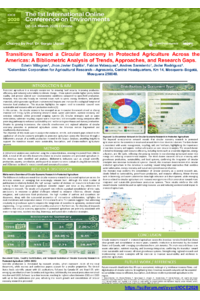
The transition toward a circular protected agriculture in the Americas represents a strategic challenge to harmonize productivity, sustainability, and environmental restoration. This study presents a bibliometric analysis of scientific production on the application of circular economy principles to greenhouse, nursery, and protected agriculture systems, based on 34 documents indexed in Scopus between 1994 and 2025, originating from the United States, Canada, Brazil, Argentina, and Colombia. The results show a steady increase over the last decade, driven by the expansion of the bioeconomy, the valorization of agricultural residues, and the pursuit of low-carbon food systems. The leading countries, the United States (47%) and Canada (26%), concentrate their studies on organic waste management, anaerobic digestion, and nutrient recovery, whereas in South America, emerging approaches focus on water reuse, substrate recycling, and energy efficiency in intensive greenhouse horticulture. The keyword co-occurrence analysis (VOSviewer) identifies three main conceptual axes: (i) waste management and soil fertility, (ii) bioeconomy and energy recycling, and (iii) sustainability in protected agriculture. Although the European model of Almería is widely regarded as a global technological reference, research across the Americas is shifting toward regional adaptation through appropriate technologies and ecological transition policies. Future research should prioritize life cycle assessment of materials and resources, the redesign of metabolic flows in greenhouses, the digitalization of circular systems, and multilevel governance that integrates science, policy, and producers. Strengthening inter-American research networks will be essential to consolidate a paradigm of circular protected agriculture that is resource-efficient, low-carbon, and climate-resilient, serving as a cornerstone for food security and environmental sustainability in the region.
Keywords
Circular economy
Protected agriculture
Bioeconomy
Environmental sustainability.
Poster
sciforum-158173.pdf
PHENOLOGICAL AND AESTHETIC DYNAMICS OF URBAN TREES: IMPLICATIONS FOR LANDSCAPE PLANNING
CHARACTERIZATION AND SAMPLING OF LOCAL PLANT SPECIES FROM THE PURUÁNDIRO REGION (MEXICO) AS OPTIONS FOR THE RESTORATION OF THE LOCAL AGROECOSYSTEM