Event submissions
Published
This submission belongs to the session S1. Mineral Geochemistry: Environmental Applications and Recent Advances of the event The 3rd International Online Conference on Mineral Science
Published date
06 Mar, 2026
Academic Editor
'%3e%3cpath%20d='M12.6657%2010.9104C12.4185%2010.325%2012.0599%209.79327%2011.6097%209.34482C11.1609%208.89508%2010.6293%208.5365%2010.0442%208.28888C10.0389%208.28626%2010.0337%208.28495%2010.0285%208.28233C10.8446%207.69279%2011.3752%206.73249%2011.3752%205.64904C11.3752%203.8542%209.92103%202.39999%208.1262%202.39999C6.33136%202.39999%204.87715%203.8542%204.87715%205.64904C4.87715%206.73249%205.40774%207.69279%206.22393%208.28364C6.21869%208.28626%206.21345%208.28757%206.20821%208.29019C5.62129%208.5378%205.09463%208.89284%204.64265%209.34613C4.1929%209.79493%203.83432%2010.3266%203.58671%2010.9117C3.34345%2011.4845%203.21226%2012.0987%203.20023%2012.7209C3.19988%2012.7349%203.20233%2012.7488%203.20744%2012.7619C3.21255%2012.7749%203.22022%2012.7867%203.22998%2012.7968C3.23975%2012.8068%203.25142%2012.8147%203.26431%2012.8202C3.2772%2012.8256%203.29105%2012.8284%203.30504%2012.8284H4.09109C4.14874%2012.8284%204.19459%2012.7825%204.1959%2012.7262C4.2221%2011.7148%204.62823%2010.7676%205.34617%2010.0497C6.08899%209.30683%207.0755%208.89808%208.1262%208.89808C9.17689%208.89808%2010.1634%209.30683%2010.9062%2010.0497C11.6242%2010.7676%2012.0303%2011.7148%2012.0565%2012.7262C12.0578%2012.7838%2012.1037%2012.8284%2012.1613%2012.8284H12.9474C12.9613%2012.8284%2012.9752%2012.8256%2012.9881%2012.8202C13.001%2012.8147%2013.0126%2012.8068%2013.0224%2012.7968C13.0322%2012.7867%2013.0398%2012.7749%2013.0449%2012.7619C13.0501%2012.7488%2013.0525%2012.7349%2013.0522%2012.7209C13.0391%2012.0947%2012.9094%2011.4855%2012.6657%2010.9104ZM8.1262%207.9024C7.52486%207.9024%206.9589%207.6679%206.53312%207.24211C6.10733%206.81633%205.87283%206.25037%205.87283%205.64904C5.87283%205.0477%206.10733%204.48174%206.53312%204.05596C6.9589%203.63018%207.52486%203.39567%208.1262%203.39567C8.72753%203.39567%209.29349%203.63018%209.71927%204.05596C10.1451%204.48174%2010.3796%205.0477%2010.3796%205.64904C10.3796%206.25037%2010.1451%206.81633%209.71927%207.24211C9.29349%207.6679%208.72753%207.9024%208.1262%207.9024Z'%20fill='%235D1EE1'/%3e%3c/g%3e%3c/svg%3e) Urs Klötzli
Urs KlötzliCitation
Oxana Spinu, Igor Povar, THERMODYNAMIC CONTROL OF VIVIANITE FORMATION IN WASTEWATER, in Proceedings of The 3rd International Online Conference on Mineral Science, 10 March–12 March 2026, MDPI: Basel, Switzerland
Share
Email
Facebook
Twitter
LinkedIn
THERMODYNAMIC CONTROL OF VIVIANITE FORMATION IN WASTEWATER

Oxana Spinu 1
'%3e%3cpath%20d='M12.6647%2010.9104C12.4176%2010.325%2012.0589%209.7933%2011.6088%209.34485C11.16%208.89511%2010.6283%208.53653%2010.0432%208.28891C10.038%208.28629%2010.0327%208.28498%2010.0275%208.28236C10.8437%207.69282%2011.3743%206.73252%2011.3743%205.64907C11.3743%203.85423%209.92005%202.40002%208.12522%202.40002C6.33038%202.40002%204.87618%203.85423%204.87618%205.64907C4.87618%206.73252%205.40677%207.69282%206.22296%208.28367C6.21772%208.28629%206.21248%208.2876%206.20724%208.29022C5.62031%208.53783%205.09365%208.89287%204.64167%209.34616C4.19192%209.79496%203.83334%2010.3266%203.58573%2010.9117C3.34247%2011.4846%203.21128%2012.0987%203.19925%2012.721C3.1989%2012.735%203.20135%2012.7489%203.20646%2012.7619C3.21157%2012.7749%203.21924%2012.7868%203.22901%2012.7968C3.23877%2012.8068%203.25045%2012.8148%203.26334%2012.8202C3.27623%2012.8256%203.29007%2012.8284%203.30406%2012.8284H4.09012C4.14776%2012.8284%204.19362%2012.7825%204.19493%2012.7262C4.22113%2011.7148%204.62726%2010.7676%205.34519%2010.0497C6.08802%209.30686%207.07452%208.89811%208.12522%208.89811C9.17592%208.89811%2010.1624%209.30686%2010.9052%2010.0497C11.6232%2010.7676%2012.0293%2011.7148%2012.0555%2012.7262C12.0568%2012.7839%2012.1027%2012.8284%2012.1603%2012.8284H12.9464C12.9604%2012.8284%2012.9742%2012.8256%2012.9871%2012.8202C13%2012.8148%2013.0117%2012.8068%2013.0214%2012.7968C13.0312%2012.7868%2013.0389%2012.7749%2013.044%2012.7619C13.0491%2012.7489%2013.0515%2012.735%2013.0512%2012.721C13.0381%2012.0947%2012.9084%2011.4856%2012.6647%2010.9104ZM8.12522%207.90243C7.52388%207.90243%206.95792%207.66793%206.53214%207.24215C6.10636%206.81636%205.87185%206.2504%205.87185%205.64907C5.87185%205.04773%206.10636%204.48177%206.53214%204.05599C6.95792%203.63021%207.52388%203.3957%208.12522%203.3957C8.72655%203.3957%209.29252%203.63021%209.7183%204.05599C10.1441%204.48177%2010.3786%205.04773%2010.3786%205.64907C10.3786%206.2504%2010.1441%206.81636%209.7183%207.24215C9.29252%207.66793%208.72655%207.90243%208.12522%207.90243Z'%20fill='%235D1EE1'/%3e%3c/g%3e%3c/svg%3e)
Igor Povar 1
1. Laboratory of Physical and Chemical Methods of Research and Analysis, Institute of Chemistry of the Moldova State University, Chisinau MD2028, Republic of Moldova
Abstract
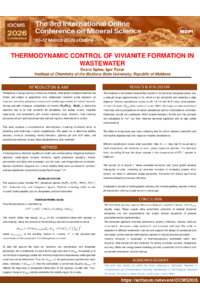
This study presents a thermodynamic modeling framework for optimizing phosphorus recovery from wastewater through the crystallization of vivianite Fe3(PO4)2·8H2O. With phosphorus identified as a critical raw material in the European Union and global phosphate reserves under geopolitical stress, recovering phosphorus from wastewater has become both an environmental and economic priority. The methodology involves constructing a thermodynamic model that integrates heterogeneous chemical equilibria, including hydrolysis, complex formation, ligand protonation, and mineral precipitation. The model evaluates interactions among phosphate, iron(II) ions, and potential complexing agents across a pH range of 7 to 11. Gibbs free energy ∆Goverall changes for the overall crystallization–dissolution process including competing reactions are calculated to define the thermodynamic stability areas for vivianite and co-precipitates such as hydroxyapatite, calcium phosphates, and iron hydroxides. Species distribution diagrams for the analyzed heterogeneous systems and overall Gibbs free energy ∆Goverall stability maps were constructed based on both synthetic and real wastewater compositions. Obtained thermodynamic results show that phosphorus recovery efficiency improves with Fe:P molar ratios between 1.5 and 1.8, with optimal crystallization occurring at pH 7.0 to 7.5. At higher pH values, the formation of competing mineral phases reduces the selectivity for vivianite. The model also provides quantitative predictions of residual phosphate and iron concentrations after the wastewater treatment. The developed thermodynamic framework facilitates improved control of vivianite crystallization parameters and supports nutrient recovery strategies aligned with circular economy principles. This model is adaptable to a range of wastewater types and informs the design of efficient, low-impact phosphorus recovery technologies.
Keywords
Gibbs free energy
Phosphorus recovery
Vivianite
Poster
The 3rd International Online Conference on Mineral Science_146800.pdf
Pb–(Sn)–(Sb) Oxides in Incineration Bottom Ash: Characterization, Carbonation Behavior, and Antimony Treatment Implications
A THERMODYNAMIC FRAMEWORK FOR PREDICTING SYNERGISTIC MINERAL DISSOLUTION AND BUFFERING IN WASTEWATER TREATMENT SYSTEMS