Event submissions
Published
This submission belongs to the session S1. Mineral Geochemistry: Environmental Applications and Recent Advances of the event The 3rd International Online Conference on Mineral Science
Published date
06 Mar, 2026
Academic Editor
'%3e%3cpath%20d='M12.6657%2010.9104C12.4185%2010.325%2012.0599%209.79327%2011.6097%209.34482C11.1609%208.89508%2010.6293%208.5365%2010.0442%208.28888C10.0389%208.28626%2010.0337%208.28495%2010.0285%208.28233C10.8446%207.69279%2011.3752%206.73249%2011.3752%205.64904C11.3752%203.8542%209.92103%202.39999%208.1262%202.39999C6.33136%202.39999%204.87715%203.8542%204.87715%205.64904C4.87715%206.73249%205.40774%207.69279%206.22393%208.28364C6.21869%208.28626%206.21345%208.28757%206.20821%208.29019C5.62129%208.5378%205.09463%208.89284%204.64265%209.34613C4.1929%209.79493%203.83432%2010.3266%203.58671%2010.9117C3.34345%2011.4845%203.21226%2012.0987%203.20023%2012.7209C3.19988%2012.7349%203.20233%2012.7488%203.20744%2012.7619C3.21255%2012.7749%203.22022%2012.7867%203.22998%2012.7968C3.23975%2012.8068%203.25142%2012.8147%203.26431%2012.8202C3.2772%2012.8256%203.29105%2012.8284%203.30504%2012.8284H4.09109C4.14874%2012.8284%204.19459%2012.7825%204.1959%2012.7262C4.2221%2011.7148%204.62823%2010.7676%205.34617%2010.0497C6.08899%209.30683%207.0755%208.89808%208.1262%208.89808C9.17689%208.89808%2010.1634%209.30683%2010.9062%2010.0497C11.6242%2010.7676%2012.0303%2011.7148%2012.0565%2012.7262C12.0578%2012.7838%2012.1037%2012.8284%2012.1613%2012.8284H12.9474C12.9613%2012.8284%2012.9752%2012.8256%2012.9881%2012.8202C13.001%2012.8147%2013.0126%2012.8068%2013.0224%2012.7968C13.0322%2012.7867%2013.0398%2012.7749%2013.0449%2012.7619C13.0501%2012.7488%2013.0525%2012.7349%2013.0522%2012.7209C13.0391%2012.0947%2012.9094%2011.4855%2012.6657%2010.9104ZM8.1262%207.9024C7.52486%207.9024%206.9589%207.6679%206.53312%207.24211C6.10733%206.81633%205.87283%206.25037%205.87283%205.64904C5.87283%205.0477%206.10733%204.48174%206.53312%204.05596C6.9589%203.63018%207.52486%203.39567%208.1262%203.39567C8.72753%203.39567%209.29349%203.63018%209.71927%204.05596C10.1451%204.48174%2010.3796%205.0477%2010.3796%205.64904C10.3796%206.25037%2010.1451%206.81633%209.71927%207.24211C9.29349%207.6679%208.72753%207.9024%208.1262%207.9024Z'%20fill='%235D1EE1'/%3e%3c/g%3e%3c/svg%3e) Rafael M. Santos
Rafael M. SantosCitation
Ekaterina Ovdina, Vera Strakhovenko, Andrei Kartoziia, Georgy Malov, Viktor Malov, Geochemistry of bottom sediments in the limnosystems of the Baraba Lowland (South of Western Siberia) as an indicator of the technogenesis processes, in Proceedings of The 3rd International Online Conference on Mineral Science, 10 March–12 March 2026, MDPI: Basel, Switzerland
Share
Email
Facebook
Twitter
LinkedIn
Geochemistry of bottom sediments in the limnosystems of the Baraba Lowland (South of Western Siberia) as an indicator of the technogenesis processes
'%3e%3cpath%20d='M12.6647%2010.9104C12.4176%2010.325%2012.0589%209.7933%2011.6088%209.34485C11.16%208.89511%2010.6283%208.53653%2010.0432%208.28891C10.038%208.28629%2010.0327%208.28498%2010.0275%208.28236C10.8437%207.69282%2011.3743%206.73252%2011.3743%205.64907C11.3743%203.85423%209.92005%202.40002%208.12522%202.40002C6.33038%202.40002%204.87618%203.85423%204.87618%205.64907C4.87618%206.73252%205.40677%207.69282%206.22296%208.28367C6.21772%208.28629%206.21248%208.2876%206.20724%208.29022C5.62031%208.53783%205.09365%208.89287%204.64167%209.34616C4.19192%209.79496%203.83334%2010.3266%203.58573%2010.9117C3.34247%2011.4846%203.21128%2012.0987%203.19925%2012.721C3.1989%2012.735%203.20135%2012.7489%203.20646%2012.7619C3.21157%2012.7749%203.21924%2012.7868%203.22901%2012.7968C3.23877%2012.8068%203.25045%2012.8148%203.26334%2012.8202C3.27623%2012.8256%203.29007%2012.8284%203.30406%2012.8284H4.09012C4.14776%2012.8284%204.19362%2012.7825%204.19493%2012.7262C4.22113%2011.7148%204.62726%2010.7676%205.34519%2010.0497C6.08802%209.30686%207.07452%208.89811%208.12522%208.89811C9.17592%208.89811%2010.1624%209.30686%2010.9052%2010.0497C11.6232%2010.7676%2012.0293%2011.7148%2012.0555%2012.7262C12.0568%2012.7839%2012.1027%2012.8284%2012.1603%2012.8284H12.9464C12.9604%2012.8284%2012.9742%2012.8256%2012.9871%2012.8202C13%2012.8148%2013.0117%2012.8068%2013.0214%2012.7968C13.0312%2012.7868%2013.0389%2012.7749%2013.044%2012.7619C13.0491%2012.7489%2013.0515%2012.735%2013.0512%2012.721C13.0381%2012.0947%2012.9084%2011.4856%2012.6647%2010.9104ZM8.12522%207.90243C7.52388%207.90243%206.95792%207.66793%206.53214%207.24215C6.10636%206.81636%205.87185%206.2504%205.87185%205.64907C5.87185%205.04773%206.10636%204.48177%206.53214%204.05599C6.95792%203.63021%207.52388%203.3957%208.12522%203.3957C8.72655%203.3957%209.29252%203.63021%209.7183%204.05599C10.1441%204.48177%2010.3786%205.04773%2010.3786%205.64907C10.3786%206.2504%2010.1441%206.81636%209.7183%207.24215C9.29252%207.66793%208.72655%207.90243%208.12522%207.90243Z'%20fill='%235D1EE1'/%3e%3c/g%3e%3c/svg%3e)
Ekaterina Ovdina 1
Vera Strakhovenko 1

Andrei Kartoziia 2
Georgy Malov 1
Viktor Malov 1
1. Laboratory of Geochemistry of Noble and Rare Elements, V.S. Sobolev Institute of Geology and Mineralogy Siberian Branch Russian Academy of Sciences, Novosibirsk 630090, Russia
2. Laboratory of Geoinformation Technologies and Remote Sensing, V.S. Sobolev Institute of Geology and Mineralogy Siberian Branch Russian Academy of Sciences, Novosibirsk 630090, Russia
Abstract
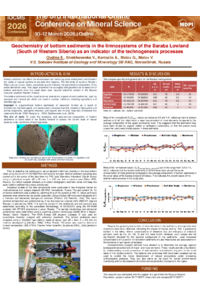
Human activities that affect the environment are becoming more widespread and threaten the ability of natural systems to maintain their balance. The flat lands of southern Western Siberia act as natural plates, accumulating and reflecting the geochemical composition of the entire demolition area. This paper examines the ecogeochemical composition of bottom sediments from five small lakes near regional industrial centers in the Baraba Lowland, southern Western Siberia. The results will help us understand future processes and predict possible scenarios for natural ecosystem development in the present, in the context of the powerful geological force of technogenesis. In the components of lake ecosystems (sediments, water, soil, rocks, and biota), there is a simultaneous distribution of elements related to sidero-, chalco-, litho-, atmo-, and biophilic elements (Si, Ca, Mg, K, Na, Fe, Mn, Sb, Sr, Cd, Zn, Pb, Hg, P, etc.), as a reflection of biosphere evolution under conditions of human influence. For the first time, an assessment of the average background concentration of major and trace elements in the bottom sediment of small lakes in the Baraba Lowland was conducted. The study of the chemical composition of lake system components was carried out using a range of modern analytical techniques, including atomic absorption analysis (AAA), inductively coupled plasma atomic emission spectroscopy (ICP-AES), X-ray fluorescence analysis (XFA), X-ray powder diffractometry (XRD), and scanning electron microscopy (SEM). In total, more than 6,000 determinations of individual measured elements were made, ensuring the statistical significance of the obtained data. GIS mapping of the catchment areas of lake systems has been conducted to identify the sources of potential pollutants. Abnormal concentrations of major and trace elements have been identified based on the data collected.
Keywords
limnosystem
bottom sediments
geochemistry
distribution of elements
potential pollutants
technogenesis
GIS
Baraba lowland
Western Siberia
Poster
OvdinaEA_poster.pdf
MINERALOGICAL AND GEOCHEMICAL ANALYSIS OF HEAVY PLACER DERIVED FROM CHALIYAR RIVER, KERALA, INDIA
Optimization of Brown Seaweed (Sargassum crassifolium) and Glycerine Solution for Dust Suppression on Limestone Mine Haulage Roads