Event submissions
Published
This submission belongs to the session S1. Mineral Geochemistry: Environmental Applications and Recent Advances of the event The 3rd International Online Conference on Mineral Science
Published date
06 Mar, 2026
Academic Editor
'%3e%3cpath%20d='M12.6657%2010.9104C12.4185%2010.325%2012.0599%209.79327%2011.6097%209.34482C11.1609%208.89508%2010.6293%208.5365%2010.0442%208.28888C10.0389%208.28626%2010.0337%208.28495%2010.0285%208.28233C10.8446%207.69279%2011.3752%206.73249%2011.3752%205.64904C11.3752%203.8542%209.92103%202.39999%208.1262%202.39999C6.33136%202.39999%204.87715%203.8542%204.87715%205.64904C4.87715%206.73249%205.40774%207.69279%206.22393%208.28364C6.21869%208.28626%206.21345%208.28757%206.20821%208.29019C5.62129%208.5378%205.09463%208.89284%204.64265%209.34613C4.1929%209.79493%203.83432%2010.3266%203.58671%2010.9117C3.34345%2011.4845%203.21226%2012.0987%203.20023%2012.7209C3.19988%2012.7349%203.20233%2012.7488%203.20744%2012.7619C3.21255%2012.7749%203.22022%2012.7867%203.22998%2012.7968C3.23975%2012.8068%203.25142%2012.8147%203.26431%2012.8202C3.2772%2012.8256%203.29105%2012.8284%203.30504%2012.8284H4.09109C4.14874%2012.8284%204.19459%2012.7825%204.1959%2012.7262C4.2221%2011.7148%204.62823%2010.7676%205.34617%2010.0497C6.08899%209.30683%207.0755%208.89808%208.1262%208.89808C9.17689%208.89808%2010.1634%209.30683%2010.9062%2010.0497C11.6242%2010.7676%2012.0303%2011.7148%2012.0565%2012.7262C12.0578%2012.7838%2012.1037%2012.8284%2012.1613%2012.8284H12.9474C12.9613%2012.8284%2012.9752%2012.8256%2012.9881%2012.8202C13.001%2012.8147%2013.0126%2012.8068%2013.0224%2012.7968C13.0322%2012.7867%2013.0398%2012.7749%2013.0449%2012.7619C13.0501%2012.7488%2013.0525%2012.7349%2013.0522%2012.7209C13.0391%2012.0947%2012.9094%2011.4855%2012.6657%2010.9104ZM8.1262%207.9024C7.52486%207.9024%206.9589%207.6679%206.53312%207.24211C6.10733%206.81633%205.87283%206.25037%205.87283%205.64904C5.87283%205.0477%206.10733%204.48174%206.53312%204.05596C6.9589%203.63018%207.52486%203.39567%208.1262%203.39567C8.72753%203.39567%209.29349%203.63018%209.71927%204.05596C10.1451%204.48174%2010.3796%205.0477%2010.3796%205.64904C10.3796%206.25037%2010.1451%206.81633%209.71927%207.24211C9.29349%207.6679%208.72753%207.9024%208.1262%207.9024Z'%20fill='%235D1EE1'/%3e%3c/g%3e%3c/svg%3e) Urs Klötzli
Urs KlötzliCitation
John David Castromayor Eboña, John Patrick Galindo Mula, Nichole Anthony Dacallos Pacle, Alphonse Rey Macion, Yvonne Torralba Olayvar, Jillian Aira Gabo-Ratio, Carbon sequestration potential of the mafic rocks from the Mindanao Eastern Pacific Cordillera, southern Philippines, in Proceedings of The 3rd International Online Conference on Mineral Science, 10 March–12 March 2026, MDPI: Basel, Switzerland
Share
Email
Facebook
Twitter
LinkedIn
Carbon sequestration potential of the mafic rocks from the Mindanao Eastern Pacific Cordillera, southern Philippines
'%3e%3cpath%20d='M12.6647%2010.9104C12.4176%2010.325%2012.0589%209.7933%2011.6088%209.34485C11.16%208.89511%2010.6283%208.53653%2010.0432%208.28891C10.038%208.28629%2010.0327%208.28498%2010.0275%208.28236C10.8437%207.69282%2011.3743%206.73252%2011.3743%205.64907C11.3743%203.85423%209.92005%202.40002%208.12522%202.40002C6.33038%202.40002%204.87618%203.85423%204.87618%205.64907C4.87618%206.73252%205.40677%207.69282%206.22296%208.28367C6.21772%208.28629%206.21248%208.2876%206.20724%208.29022C5.62031%208.53783%205.09365%208.89287%204.64167%209.34616C4.19192%209.79496%203.83334%2010.3266%203.58573%2010.9117C3.34247%2011.4846%203.21128%2012.0987%203.19925%2012.721C3.1989%2012.735%203.20135%2012.7489%203.20646%2012.7619C3.21157%2012.7749%203.21924%2012.7868%203.22901%2012.7968C3.23877%2012.8068%203.25045%2012.8148%203.26334%2012.8202C3.27623%2012.8256%203.29007%2012.8284%203.30406%2012.8284H4.09012C4.14776%2012.8284%204.19362%2012.7825%204.19493%2012.7262C4.22113%2011.7148%204.62726%2010.7676%205.34519%2010.0497C6.08802%209.30686%207.07452%208.89811%208.12522%208.89811C9.17592%208.89811%2010.1624%209.30686%2010.9052%2010.0497C11.6232%2010.7676%2012.0293%2011.7148%2012.0555%2012.7262C12.0568%2012.7839%2012.1027%2012.8284%2012.1603%2012.8284H12.9464C12.9604%2012.8284%2012.9742%2012.8256%2012.9871%2012.8202C13%2012.8148%2013.0117%2012.8068%2013.0214%2012.7968C13.0312%2012.7868%2013.0389%2012.7749%2013.044%2012.7619C13.0491%2012.7489%2013.0515%2012.735%2013.0512%2012.721C13.0381%2012.0947%2012.9084%2011.4856%2012.6647%2010.9104ZM8.12522%207.90243C7.52388%207.90243%206.95792%207.66793%206.53214%207.24215C6.10636%206.81636%205.87185%206.2504%205.87185%205.64907C5.87185%205.04773%206.10636%204.48177%206.53214%204.05599C6.95792%203.63021%207.52388%203.3957%208.12522%203.3957C8.72655%203.3957%209.29252%203.63021%209.7183%204.05599C10.1441%204.48177%2010.3786%205.04773%2010.3786%205.64907C10.3786%206.2504%2010.1441%206.81636%209.7183%207.24215C9.29252%207.66793%208.72655%207.90243%208.12522%207.90243Z'%20fill='%235D1EE1'/%3e%3c/g%3e%3c/svg%3e)
John David Castromayor Eboña 1
John Patrick Galindo Mula 1
Nichole Anthony Dacallos Pacle 1
Alphonse Rey Macion 1
Yvonne Torralba Olayvar 1
Jillian Aira Gabo-Ratio 2
1. Department of Geology, Caraga State University, Butuan City 8600, Philippines
2. National Institute of Geological Sciences, University of the Philippines- Diliman, Quezon City 81101, Philippines
Abstract
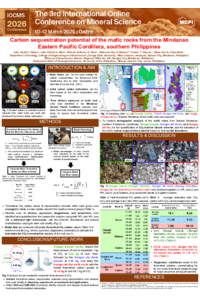
As human-induced carbon emissions continue to increase, the demand for effective strategies to achieve net-zero emissions also grows. One promising approach is carbon sequestration via enhanced rock weathering, specifically through carbon mineralization. This process entails the weathering of ultramafic to mafic minerals, leading to the formation of stable carbonate minerals that help regulate atmospheric CO₂ levels. This study employs petrographic analysis to evaluate the potential of mafic rocks in the Mindanao Eastern Pacific Cordillera, southern Philippines, for atmospheric CO₂ sequestration. Using point-counting techniques on prepared thin sections, the study quantifies the abundance of reactive minerals. The modal percentages of olivine, pyroxene, and plagioclase—key reactive minerals—are determined, and their corresponding CO₂ uptake capacities are used to calculate the total potential CO₂ sequestration. Results from petrographic analysis indicate that mafic rocks from the Dinagat Islands, characterized by high plagioclase, pyroxene, and olivine contents with minimal alteration, exhibit the greatest estimated CO₂ uptake at 16.11 wt% CO₂. Basalts from the Siargao Islands show a potential CO₂ uptake of 14.85 wt% CO₂, attributed to their abundance of plagioclase and pyroxene. Meanwhile, the Bacuag Formation’s porphyritic basalts in Surigao del Norte, containing significant plagioclase, moderate pyroxene, and lesser olivine, can sequester up to 12.69 wt% CO₂. In contrast, although reactive minerals are present in the Barcelona Formation mafic rocks in Surigao del Sur, their potential CO₂ uptake is reduced to 8.92 wt% CO₂ due to the transformation of these minerals into clay minerals, zeolites, and chlorites during weathering. Variations in CO₂ uptake among the studied formations highlights the importance of mineralogical composition and degree of alteration in assessing a rock’s suitability for carbon mineralization. Overall, these results underscore the viability of utilizing select mafic rock formations in the southern Philippines as natural carbon sinks to support regional and global net-zero initiatives.
Keywords
Carbon Sequestration
Geochemistry
Petrography
Mafic rocks
Mindanao Pacific Cordillera
Poster
IOCMS- 158411.pdf
Investigating Redox Geochemistry and Peat Soil Characteristic of the Caimpugan Peatland, Agusan Marsh Wildlife Sanctuary, Mindanao, Philippines: Implications for Carbon Sequestration
SCALABLE AMMONIUM RECOVERY FROM LIVESTOCK AND MUNICIPAL DIGESTATES WITH ZEOLITIC-RICH TUFFS