Event submissions
Published
This submission belongs to the session S3. Nanominerals and Clays: Emerging Applications in Materials Science of the event The 3rd International Online Conference on Mineral Science
Published date
06 Mar, 2026
Academic Editor
'%3e%3cpath%20d='M12.6657%2010.9104C12.4185%2010.325%2012.0599%209.79327%2011.6097%209.34482C11.1609%208.89508%2010.6293%208.5365%2010.0442%208.28888C10.0389%208.28626%2010.0337%208.28495%2010.0285%208.28233C10.8446%207.69279%2011.3752%206.73249%2011.3752%205.64904C11.3752%203.8542%209.92103%202.39999%208.1262%202.39999C6.33136%202.39999%204.87715%203.8542%204.87715%205.64904C4.87715%206.73249%205.40774%207.69279%206.22393%208.28364C6.21869%208.28626%206.21345%208.28757%206.20821%208.29019C5.62129%208.5378%205.09463%208.89284%204.64265%209.34613C4.1929%209.79493%203.83432%2010.3266%203.58671%2010.9117C3.34345%2011.4845%203.21226%2012.0987%203.20023%2012.7209C3.19988%2012.7349%203.20233%2012.7488%203.20744%2012.7619C3.21255%2012.7749%203.22022%2012.7867%203.22998%2012.7968C3.23975%2012.8068%203.25142%2012.8147%203.26431%2012.8202C3.2772%2012.8256%203.29105%2012.8284%203.30504%2012.8284H4.09109C4.14874%2012.8284%204.19459%2012.7825%204.1959%2012.7262C4.2221%2011.7148%204.62823%2010.7676%205.34617%2010.0497C6.08899%209.30683%207.0755%208.89808%208.1262%208.89808C9.17689%208.89808%2010.1634%209.30683%2010.9062%2010.0497C11.6242%2010.7676%2012.0303%2011.7148%2012.0565%2012.7262C12.0578%2012.7838%2012.1037%2012.8284%2012.1613%2012.8284H12.9474C12.9613%2012.8284%2012.9752%2012.8256%2012.9881%2012.8202C13.001%2012.8147%2013.0126%2012.8068%2013.0224%2012.7968C13.0322%2012.7867%2013.0398%2012.7749%2013.0449%2012.7619C13.0501%2012.7488%2013.0525%2012.7349%2013.0522%2012.7209C13.0391%2012.0947%2012.9094%2011.4855%2012.6657%2010.9104ZM8.1262%207.9024C7.52486%207.9024%206.9589%207.6679%206.53312%207.24211C6.10733%206.81633%205.87283%206.25037%205.87283%205.64904C5.87283%205.0477%206.10733%204.48174%206.53312%204.05596C6.9589%203.63018%207.52486%203.39567%208.1262%203.39567C8.72753%203.39567%209.29349%203.63018%209.71927%204.05596C10.1451%204.48174%2010.3796%205.0477%2010.3796%205.64904C10.3796%206.25037%2010.1451%206.81633%209.71927%207.24211C9.29349%207.6679%208.72753%207.9024%208.1262%207.9024Z'%20fill='%235D1EE1'/%3e%3c/g%3e%3c/svg%3e) Andrey Kalinichev
Andrey KalinichevCitation
Ivyleen Constantino Bernardo-Arugay, Leslie Joy L Diaz, Effect of the Specific combination of the Applied Voltage and substrate gap of Electrophoretic deposition on the yield and purity of Montmorillonite , in Proceedings of The 3rd International Online Conference on Mineral Science, 10 March–12 March 2026, MDPI: Basel, Switzerland
Share
Email
Facebook
Twitter
LinkedIn
Effect of the Specific combination of the Applied Voltage and substrate gap of Electrophoretic deposition on the yield and purity of Montmorillonite

Ivyleen Constantino Bernardo-Arugay 1
'%3e%3cpath%20d='M12.6647%2010.9104C12.4176%2010.325%2012.0589%209.7933%2011.6088%209.34485C11.16%208.89511%2010.6283%208.53653%2010.0432%208.28891C10.038%208.28629%2010.0327%208.28498%2010.0275%208.28236C10.8437%207.69282%2011.3743%206.73252%2011.3743%205.64907C11.3743%203.85423%209.92005%202.40002%208.12522%202.40002C6.33038%202.40002%204.87618%203.85423%204.87618%205.64907C4.87618%206.73252%205.40677%207.69282%206.22296%208.28367C6.21772%208.28629%206.21248%208.2876%206.20724%208.29022C5.62031%208.53783%205.09365%208.89287%204.64167%209.34616C4.19192%209.79496%203.83334%2010.3266%203.58573%2010.9117C3.34247%2011.4846%203.21128%2012.0987%203.19925%2012.721C3.1989%2012.735%203.20135%2012.7489%203.20646%2012.7619C3.21157%2012.7749%203.21924%2012.7868%203.22901%2012.7968C3.23877%2012.8068%203.25045%2012.8148%203.26334%2012.8202C3.27623%2012.8256%203.29007%2012.8284%203.30406%2012.8284H4.09012C4.14776%2012.8284%204.19362%2012.7825%204.19493%2012.7262C4.22113%2011.7148%204.62726%2010.7676%205.34519%2010.0497C6.08802%209.30686%207.07452%208.89811%208.12522%208.89811C9.17592%208.89811%2010.1624%209.30686%2010.9052%2010.0497C11.6232%2010.7676%2012.0293%2011.7148%2012.0555%2012.7262C12.0568%2012.7839%2012.1027%2012.8284%2012.1603%2012.8284H12.9464C12.9604%2012.8284%2012.9742%2012.8256%2012.9871%2012.8202C13%2012.8148%2013.0117%2012.8068%2013.0214%2012.7968C13.0312%2012.7868%2013.0389%2012.7749%2013.044%2012.7619C13.0491%2012.7489%2013.0515%2012.735%2013.0512%2012.721C13.0381%2012.0947%2012.9084%2011.4856%2012.6647%2010.9104ZM8.12522%207.90243C7.52388%207.90243%206.95792%207.66793%206.53214%207.24215C6.10636%206.81636%205.87185%206.2504%205.87185%205.64907C5.87185%205.04773%206.10636%204.48177%206.53214%204.05599C6.95792%203.63021%207.52388%203.3957%208.12522%203.3957C8.72655%203.3957%209.29252%203.63021%209.7183%204.05599C10.1441%204.48177%2010.3786%205.04773%2010.3786%205.64907C10.3786%206.2504%2010.1441%206.81636%209.7183%207.24215C9.29252%207.66793%208.72655%207.90243%208.12522%207.90243Z'%20fill='%235D1EE1'/%3e%3c/g%3e%3c/svg%3e)
Leslie Joy L Diaz 2
1. Department of Materials and Resources Engineering and Technology/ College of Engineering, Mindanao State University-Iligan Institute of Technology, Iligan City 9200, Philippines
2. Department of Mining, Metallurgical and Materials Engineering/ College of Engineering, University of the Philippines, Diliman, Quezon City 1101, Philippines
Abstract
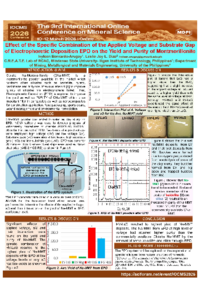
The Cloisite Na-Montmorillonite (CNa-MMT) available in the market contains other silicates, such as beidellite, quartz, cristobalite and tridymite. This study explores the potential of electrophoretic deposition (EPD) to improve the purity of CNa-MMT as an important nanoclay filler of nanocomposites, at least for construction materials, food containers, environmental remediation, wound management and sports gear applications. A program of procedures was developed using AUTOLAB p/g for the conduct of EPD. Stainless steel strips were used as electrodes during EPD. XRD of EPD deposits was performed using a Shimadzu XRD-700 with a copper target. Two levels of applied potential were used: high potential “HP”, low potential “LP”, and electrode gap; high electrode gap “HeG” and low electrode gap “LeG”, were investigated for their effects on the yield and purity of CNa-MMT deposits. Analysis of Variance for the two-factor fixed effect model was performed to determine the effects of the factors and their interaction on the yield of CNa-MMT EPD deposits at a 95% confidence level. Results showed significant effects of applied potential, electrode gaps and their interaction on the yield and purity of CNa-MMT. The specific combination of HP-LeG resulted in the highest yield of Na-MMT deposits, while low potential levels (LP) at any electrode gap had a low yield. Interaction plots also showed that low gap (LeG) has a higher slope than high gap (HeG), suggesting that a slight increase in applied potential at a low electrode gap (LeG) will result in a higher increase in the dry Na-MMT EPD deposit than with the same level of potential at a high electrode gap (HeG). Results further showed that even though HP-HeG and LP-LeG experienced the same effect of the electric field, HP-HeG resulted in a higher yield than LP-LeG. Furthermore, XRD showed that the dry Na-MMT EPD deposits swelled and attained higher purity than the commercially available Cloisite Na-MMT.
Keywords
electrophoretic deposition of clays
purification of clays
Montmorillonite
beidellite
quartz
silica
cristobalite
tridymite
electrophoresis
Poster
IOCMS2026 poster 157489 arugay.pdf
Computational Insights into the Hydrolysis and Aqueous Stability of Thorianite (ThO₂) and its Environmental Implications for Groundwater Systems.
Development of Accurate, Non-Concentration-Restricted Models for Predicting Solution Properties and Solid–Liquid Equilibrium in Binary Nitrate Systems from Low to Very High Concentrations (up to ≈ 30 mol.kg-1) at 25oC