Event submissions
Published
This submission belongs to the session S3. Nanominerals and Clays: Emerging Applications in Materials Science of the event The 3rd International Online Conference on Mineral Science
Published date
06 Mar, 2026
Academic Editor
'%3e%3cpath%20d='M12.6657%2010.9104C12.4185%2010.325%2012.0599%209.79327%2011.6097%209.34482C11.1609%208.89508%2010.6293%208.5365%2010.0442%208.28888C10.0389%208.28626%2010.0337%208.28495%2010.0285%208.28233C10.8446%207.69279%2011.3752%206.73249%2011.3752%205.64904C11.3752%203.8542%209.92103%202.39999%208.1262%202.39999C6.33136%202.39999%204.87715%203.8542%204.87715%205.64904C4.87715%206.73249%205.40774%207.69279%206.22393%208.28364C6.21869%208.28626%206.21345%208.28757%206.20821%208.29019C5.62129%208.5378%205.09463%208.89284%204.64265%209.34613C4.1929%209.79493%203.83432%2010.3266%203.58671%2010.9117C3.34345%2011.4845%203.21226%2012.0987%203.20023%2012.7209C3.19988%2012.7349%203.20233%2012.7488%203.20744%2012.7619C3.21255%2012.7749%203.22022%2012.7867%203.22998%2012.7968C3.23975%2012.8068%203.25142%2012.8147%203.26431%2012.8202C3.2772%2012.8256%203.29105%2012.8284%203.30504%2012.8284H4.09109C4.14874%2012.8284%204.19459%2012.7825%204.1959%2012.7262C4.2221%2011.7148%204.62823%2010.7676%205.34617%2010.0497C6.08899%209.30683%207.0755%208.89808%208.1262%208.89808C9.17689%208.89808%2010.1634%209.30683%2010.9062%2010.0497C11.6242%2010.7676%2012.0303%2011.7148%2012.0565%2012.7262C12.0578%2012.7838%2012.1037%2012.8284%2012.1613%2012.8284H12.9474C12.9613%2012.8284%2012.9752%2012.8256%2012.9881%2012.8202C13.001%2012.8147%2013.0126%2012.8068%2013.0224%2012.7968C13.0322%2012.7867%2013.0398%2012.7749%2013.0449%2012.7619C13.0501%2012.7488%2013.0525%2012.7349%2013.0522%2012.7209C13.0391%2012.0947%2012.9094%2011.4855%2012.6657%2010.9104ZM8.1262%207.9024C7.52486%207.9024%206.9589%207.6679%206.53312%207.24211C6.10733%206.81633%205.87283%206.25037%205.87283%205.64904C5.87283%205.0477%206.10733%204.48174%206.53312%204.05596C6.9589%203.63018%207.52486%203.39567%208.1262%203.39567C8.72753%203.39567%209.29349%203.63018%209.71927%204.05596C10.1451%204.48174%2010.3796%205.0477%2010.3796%205.64904C10.3796%206.25037%2010.1451%206.81633%209.71927%207.24211C9.29349%207.6679%208.72753%207.9024%208.1262%207.9024Z'%20fill='%235D1EE1'/%3e%3c/g%3e%3c/svg%3e) Andrey Kalinichev
Andrey KalinichevCitation
Vilma Snapkauskienė, Regina Kalpokaitė-Dičkuvienė, Arūnas Baltušnikas, Mindaugas Aikas, Reactivity and structural characteristics of plasma-derived wind turbine blade slag in geopolymer systems, in Proceedings of The 3rd International Online Conference on Mineral Science, 10 March–12 March 2026, MDPI: Basel, Switzerland
Share
Email
Facebook
Twitter
LinkedIn
Reactivity and structural characteristics of plasma-derived wind turbine blade slag in geopolymer systems
'%3e%3cpath%20d='M12.6647%2010.9104C12.4176%2010.325%2012.0589%209.7933%2011.6088%209.34485C11.16%208.89511%2010.6283%208.53653%2010.0432%208.28891C10.038%208.28629%2010.0327%208.28498%2010.0275%208.28236C10.8437%207.69282%2011.3743%206.73252%2011.3743%205.64907C11.3743%203.85423%209.92005%202.40002%208.12522%202.40002C6.33038%202.40002%204.87618%203.85423%204.87618%205.64907C4.87618%206.73252%205.40677%207.69282%206.22296%208.28367C6.21772%208.28629%206.21248%208.2876%206.20724%208.29022C5.62031%208.53783%205.09365%208.89287%204.64167%209.34616C4.19192%209.79496%203.83334%2010.3266%203.58573%2010.9117C3.34247%2011.4846%203.21128%2012.0987%203.19925%2012.721C3.1989%2012.735%203.20135%2012.7489%203.20646%2012.7619C3.21157%2012.7749%203.21924%2012.7868%203.22901%2012.7968C3.23877%2012.8068%203.25045%2012.8148%203.26334%2012.8202C3.27623%2012.8256%203.29007%2012.8284%203.30406%2012.8284H4.09012C4.14776%2012.8284%204.19362%2012.7825%204.19493%2012.7262C4.22113%2011.7148%204.62726%2010.7676%205.34519%2010.0497C6.08802%209.30686%207.07452%208.89811%208.12522%208.89811C9.17592%208.89811%2010.1624%209.30686%2010.9052%2010.0497C11.6232%2010.7676%2012.0293%2011.7148%2012.0555%2012.7262C12.0568%2012.7839%2012.1027%2012.8284%2012.1603%2012.8284H12.9464C12.9604%2012.8284%2012.9742%2012.8256%2012.9871%2012.8202C13%2012.8148%2013.0117%2012.8068%2013.0214%2012.7968C13.0312%2012.7868%2013.0389%2012.7749%2013.044%2012.7619C13.0491%2012.7489%2013.0515%2012.735%2013.0512%2012.721C13.0381%2012.0947%2012.9084%2011.4856%2012.6647%2010.9104ZM8.12522%207.90243C7.52388%207.90243%206.95792%207.66793%206.53214%207.24215C6.10636%206.81636%205.87185%206.2504%205.87185%205.64907C5.87185%205.04773%206.10636%204.48177%206.53214%204.05599C6.95792%203.63021%207.52388%203.3957%208.12522%203.3957C8.72655%203.3957%209.29252%203.63021%209.7183%204.05599C10.1441%204.48177%2010.3786%205.04773%2010.3786%205.64907C10.3786%206.2504%2010.1441%206.81636%209.7183%207.24215C9.29252%207.66793%208.72655%207.90243%208.12522%207.90243Z'%20fill='%235D1EE1'/%3e%3c/g%3e%3c/svg%3e)
Vilma Snapkauskienė 1

Regina Kalpokaitė-Dičkuvienė 2
Arūnas Baltušnikas 2
Mindaugas Aikas 1
1. Plasma Processing Laboratory, Lithuanian Energy Institute, Breslaujos 3, LT-3035 Kaunas, Lithuania
2. Laboratory of Materials Research and Testing, Lithuanian Energy Institute, Breslaujos 3, LT-3035 Kaunas, Lithuania
Abstract
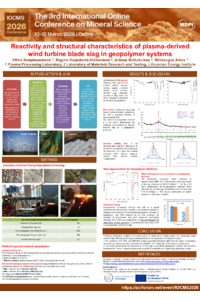
The waste management of wind turbine components is challenging, as they are composed of glass or carbon fibers embedded in highly durable polymer matrices. A potential method for recycling wind turbine blades involves their conversion into melted or vitrified slag using thermal plasma-based systems. However, the suitability of melted slag as the geopolymer binding material remains underexplored. Therefore, this study focused on the resistance of slag obtained after wind turbine blade vitrification to alkaline and acidic activation solutions, subsequently assessing the effectiveness of adding such specific waste for the synthesis of geopolymers.
The composition and microstructure of the slag and geopolymer were analyzed using X-ray diffraction, FTIR, and SEM-EDS analytical tools. The results revealed that the vitrified slag contains both amorphous and crystalline anorthite phases, with the content of the amorphous phase decreasing as the distance from the plasma reactor increases.
According to SEM-EDS and FTIR analysis, the leaching of calcium was observed in slag exposed to an acidic environment, although dissolution was also observed in an alkaline solution. The impact of as-derived vitrified slag on the microstructure and mechanical strength of geopolymer was investigated to evaluate its potential application in geopolymer materials.
The study demonstrates that plasma vitrification of wind turbine blade waste produces a partially amorphous slag with potential for geopolymer applications. The reactivity and microstructure of the resulting materials suggest that this slag can serve as a supplementary precursor in sustainable binder systems.
Acknowledgment: This research was carried out with the financial support of European Union Structural Funds for the project “Testing an R&D idea - The Potential of Waste in the Synthesis of Climate-Neutral Geopolymers (ANGeoS)”.
Keywords
wind turbine blade waste
plasma vitrification
melted slag
geopolymer reactivity
microstructure.
Poster
IOCMS 2026 Conference_Snapkauskienė Vilma.pdf
The environmental distribution and sources of strontium in the case of natural anomaly within the river floodplains
Local Diatomaceous Earth from Kapatagan, Northern Mindanao, Philippines: A Micro/Nanoporous Siliceous Additive for Ceramic Wall Tile Production