Event submissions
Published
This submission belongs to the session S2. Mineral Systems and Ore Deposits: From Formation to Exploration of the event The 3rd International Online Conference on Mineral Science
Published date
06 Mar, 2026
Academic Editor
'%3e%3cpath%20d='M12.6657%2010.9104C12.4185%2010.325%2012.0599%209.79327%2011.6097%209.34482C11.1609%208.89508%2010.6293%208.5365%2010.0442%208.28888C10.0389%208.28626%2010.0337%208.28495%2010.0285%208.28233C10.8446%207.69279%2011.3752%206.73249%2011.3752%205.64904C11.3752%203.8542%209.92103%202.39999%208.1262%202.39999C6.33136%202.39999%204.87715%203.8542%204.87715%205.64904C4.87715%206.73249%205.40774%207.69279%206.22393%208.28364C6.21869%208.28626%206.21345%208.28757%206.20821%208.29019C5.62129%208.5378%205.09463%208.89284%204.64265%209.34613C4.1929%209.79493%203.83432%2010.3266%203.58671%2010.9117C3.34345%2011.4845%203.21226%2012.0987%203.20023%2012.7209C3.19988%2012.7349%203.20233%2012.7488%203.20744%2012.7619C3.21255%2012.7749%203.22022%2012.7867%203.22998%2012.7968C3.23975%2012.8068%203.25142%2012.8147%203.26431%2012.8202C3.2772%2012.8256%203.29105%2012.8284%203.30504%2012.8284H4.09109C4.14874%2012.8284%204.19459%2012.7825%204.1959%2012.7262C4.2221%2011.7148%204.62823%2010.7676%205.34617%2010.0497C6.08899%209.30683%207.0755%208.89808%208.1262%208.89808C9.17689%208.89808%2010.1634%209.30683%2010.9062%2010.0497C11.6242%2010.7676%2012.0303%2011.7148%2012.0565%2012.7262C12.0578%2012.7838%2012.1037%2012.8284%2012.1613%2012.8284H12.9474C12.9613%2012.8284%2012.9752%2012.8256%2012.9881%2012.8202C13.001%2012.8147%2013.0126%2012.8068%2013.0224%2012.7968C13.0322%2012.7867%2013.0398%2012.7749%2013.0449%2012.7619C13.0501%2012.7488%2013.0525%2012.7349%2013.0522%2012.7209C13.0391%2012.0947%2012.9094%2011.4855%2012.6657%2010.9104ZM8.1262%207.9024C7.52486%207.9024%206.9589%207.6679%206.53312%207.24211C6.10733%206.81633%205.87283%206.25037%205.87283%205.64904C5.87283%205.0477%206.10733%204.48174%206.53312%204.05596C6.9589%203.63018%207.52486%203.39567%208.1262%203.39567C8.72753%203.39567%209.29349%203.63018%209.71927%204.05596C10.1451%204.48174%2010.3796%205.0477%2010.3796%205.64904C10.3796%206.25037%2010.1451%206.81633%209.71927%207.24211C9.29349%207.6679%208.72753%207.9024%208.1262%207.9024Z'%20fill='%235D1EE1'/%3e%3c/g%3e%3c/svg%3e) Theodore Bornhorst
Theodore BornhorstCitation
Kaide Cheng, Di Zhang, Kuidong Zhao, In situ U-Pb dating of 1.75 Ga garnet from the Mary Kathleen Domain, Mount Isa Inlier, Australia, in Proceedings of The 3rd International Online Conference on Mineral Science, 10 March–12 March 2026, MDPI: Basel, Switzerland
Share
Email
Facebook
Twitter
LinkedIn
In situ U-Pb dating of 1.75 Ga garnet from the Mary Kathleen Domain, Mount Isa Inlier, Australia
'%3e%3cpath%20d='M12.6647%2010.9104C12.4176%2010.325%2012.0589%209.7933%2011.6088%209.34485C11.16%208.89511%2010.6283%208.53653%2010.0432%208.28891C10.038%208.28629%2010.0327%208.28498%2010.0275%208.28236C10.8437%207.69282%2011.3743%206.73252%2011.3743%205.64907C11.3743%203.85423%209.92005%202.40002%208.12522%202.40002C6.33038%202.40002%204.87618%203.85423%204.87618%205.64907C4.87618%206.73252%205.40677%207.69282%206.22296%208.28367C6.21772%208.28629%206.21248%208.2876%206.20724%208.29022C5.62031%208.53783%205.09365%208.89287%204.64167%209.34616C4.19192%209.79496%203.83334%2010.3266%203.58573%2010.9117C3.34247%2011.4846%203.21128%2012.0987%203.19925%2012.721C3.1989%2012.735%203.20135%2012.7489%203.20646%2012.7619C3.21157%2012.7749%203.21924%2012.7868%203.22901%2012.7968C3.23877%2012.8068%203.25045%2012.8148%203.26334%2012.8202C3.27623%2012.8256%203.29007%2012.8284%203.30406%2012.8284H4.09012C4.14776%2012.8284%204.19362%2012.7825%204.19493%2012.7262C4.22113%2011.7148%204.62726%2010.7676%205.34519%2010.0497C6.08802%209.30686%207.07452%208.89811%208.12522%208.89811C9.17592%208.89811%2010.1624%209.30686%2010.9052%2010.0497C11.6232%2010.7676%2012.0293%2011.7148%2012.0555%2012.7262C12.0568%2012.7839%2012.1027%2012.8284%2012.1603%2012.8284H12.9464C12.9604%2012.8284%2012.9742%2012.8256%2012.9871%2012.8202C13%2012.8148%2013.0117%2012.8068%2013.0214%2012.7968C13.0312%2012.7868%2013.0389%2012.7749%2013.044%2012.7619C13.0491%2012.7489%2013.0515%2012.735%2013.0512%2012.721C13.0381%2012.0947%2012.9084%2011.4856%2012.6647%2010.9104ZM8.12522%207.90243C7.52388%207.90243%206.95792%207.66793%206.53214%207.24215C6.10636%206.81636%205.87185%206.2504%205.87185%205.64907C5.87185%205.04773%206.10636%204.48177%206.53214%204.05599C6.95792%203.63021%207.52388%203.3957%208.12522%203.3957C8.72655%203.3957%209.29252%203.63021%209.7183%204.05599C10.1441%204.48177%2010.3786%205.04773%2010.3786%205.64907C10.3786%206.2504%2010.1441%206.81636%209.7183%207.24215C9.29252%207.66793%208.72655%207.90243%208.12522%207.90243Z'%20fill='%235D1EE1'/%3e%3c/g%3e%3c/svg%3e)
Kaide Cheng 1
Di Zhang 1
Kuidong Zhao 1
1. State Key Laboratory of Geological Processes and Mineral Resources, Collaborative Innovation Center for Exploration of Strategic Mineral Resources, School of Earth Resources, China University of Geosciences, Wuhan, Wuhan 430074, China
Abstract
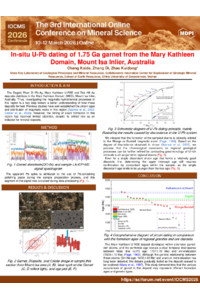
The Dugald River Zn-Pb-Ag, Mary Kathleen U-REE, and Tick Hill Au deposits are distributed in the Mary Kathleen Domain (MKD), Mount Isa Inlier, Australia. Investigating the magmatic-hydrothermal processes in this region is a key step toward a better understanding of how these deposits formed. Previous studies have established the zircon ages and distribution of magmatic rocks in this region (Spence et al., 2022; Cocker et al., 2025). However, the timing of skarn formation has received limited attention, despite its critical role as an indicator for mineral deposits.
Most of the intrusions in MKD have been grouped into several igneous provinces, which include the Kalkadoon–Leichhardt (ca. 1870-1850 Ma), Argylla (ca. 1780-1775 Ma), Wonga (ca. 1760-1730 Ma), Burstall (ca. 1750-1710 Ma), and Williams (ca. 1550-1500 Ma). We collected skarn samples of the Burstall and Wonga granites (19°45'35" S, 147°08'46" E). The garnet crystals within the calcite matrix commonly exhibit distinct diopside rims in these skarns. QC-04 garnet was used as the primary reference material (130 Ma; Deng et al., 2017), and data reduction was performed on the Isoclock software (Liu et al., 2023) to calculate the garnet U-Pb age. The garnet dating (n = 14) yielded a weighted mean age of 1754.2 ± 13.9 Ma (MSWD = 1.2) and a concordant age of 1758.2±13.5 Ma (MSWD = 0.39). Therefore, we interpret that the formation of the sampled skarns is primarily related to the Wonga or Burstall magmatic event (Page, 1983). Based on the degree of discordance observed in zircon (Spence et al., 2022), we propose that the chronological constraints on regional geological processes can be further refined by conducting geochronology of U-rich minerals such as garnet in regional skarns.
Keywords
The Mary Kathleen Domain
Garnet
U-Pb age
Poster
Poster-1.pdf
Iron stable isotope analysis to decipher hematite ore formation in the Lake Vermilion-Soudan Underground Mine State Park, Minnesota, USA
Comparison of Surface Properties and Flotation Performance of Products of SAG + Ball Mill and HPGR + Tower Mill