Event submissions
Published
This submission belongs to the session S2. Mineral Systems and Ore Deposits: From Formation to Exploration of the event The 3rd International Online Conference on Mineral Science
Published date
06 Mar, 2026
Academic Editor
'%3e%3cpath%20d='M12.6657%2010.9104C12.4185%2010.325%2012.0599%209.79327%2011.6097%209.34482C11.1609%208.89508%2010.6293%208.5365%2010.0442%208.28888C10.0389%208.28626%2010.0337%208.28495%2010.0285%208.28233C10.8446%207.69279%2011.3752%206.73249%2011.3752%205.64904C11.3752%203.8542%209.92103%202.39999%208.1262%202.39999C6.33136%202.39999%204.87715%203.8542%204.87715%205.64904C4.87715%206.73249%205.40774%207.69279%206.22393%208.28364C6.21869%208.28626%206.21345%208.28757%206.20821%208.29019C5.62129%208.5378%205.09463%208.89284%204.64265%209.34613C4.1929%209.79493%203.83432%2010.3266%203.58671%2010.9117C3.34345%2011.4845%203.21226%2012.0987%203.20023%2012.7209C3.19988%2012.7349%203.20233%2012.7488%203.20744%2012.7619C3.21255%2012.7749%203.22022%2012.7867%203.22998%2012.7968C3.23975%2012.8068%203.25142%2012.8147%203.26431%2012.8202C3.2772%2012.8256%203.29105%2012.8284%203.30504%2012.8284H4.09109C4.14874%2012.8284%204.19459%2012.7825%204.1959%2012.7262C4.2221%2011.7148%204.62823%2010.7676%205.34617%2010.0497C6.08899%209.30683%207.0755%208.89808%208.1262%208.89808C9.17689%208.89808%2010.1634%209.30683%2010.9062%2010.0497C11.6242%2010.7676%2012.0303%2011.7148%2012.0565%2012.7262C12.0578%2012.7838%2012.1037%2012.8284%2012.1613%2012.8284H12.9474C12.9613%2012.8284%2012.9752%2012.8256%2012.9881%2012.8202C13.001%2012.8147%2013.0126%2012.8068%2013.0224%2012.7968C13.0322%2012.7867%2013.0398%2012.7749%2013.0449%2012.7619C13.0501%2012.7488%2013.0525%2012.7349%2013.0522%2012.7209C13.0391%2012.0947%2012.9094%2011.4855%2012.6657%2010.9104ZM8.1262%207.9024C7.52486%207.9024%206.9589%207.6679%206.53312%207.24211C6.10733%206.81633%205.87283%206.25037%205.87283%205.64904C5.87283%205.0477%206.10733%204.48174%206.53312%204.05596C6.9589%203.63018%207.52486%203.39567%208.1262%203.39567C8.72753%203.39567%209.29349%203.63018%209.71927%204.05596C10.1451%204.48174%2010.3796%205.0477%2010.3796%205.64904C10.3796%206.25037%2010.1451%206.81633%209.71927%207.24211C9.29349%207.6679%208.72753%207.9024%208.1262%207.9024Z'%20fill='%235D1EE1'/%3e%3c/g%3e%3c/svg%3e) Theodore Bornhorst
Theodore BornhorstCitation
Amal EL ARBAOUI, Hydrothermal Fluid Evolution and Polymetallic Mineralization of the Roc Blanc Pb-Zn-Ag-Au Vein Deposit, Jebilet Massif, Variscan Belt, Morocco, in Proceedings of The 3rd International Online Conference on Mineral Science, 10 March–12 March 2026, MDPI: Basel, Switzerland
Share
Email
Facebook
Twitter
LinkedIn
Hydrothermal Fluid Evolution and Polymetallic Mineralization of the Roc Blanc Pb-Zn-Ag-Au Vein Deposit, Jebilet Massif, Variscan Belt, Morocco
'%3e%3cpath%20d='M12.6647%2010.9104C12.4176%2010.325%2012.0589%209.7933%2011.6088%209.34485C11.16%208.89511%2010.6283%208.53653%2010.0432%208.28891C10.038%208.28629%2010.0327%208.28498%2010.0275%208.28236C10.8437%207.69282%2011.3743%206.73252%2011.3743%205.64907C11.3743%203.85423%209.92005%202.40002%208.12522%202.40002C6.33038%202.40002%204.87618%203.85423%204.87618%205.64907C4.87618%206.73252%205.40677%207.69282%206.22296%208.28367C6.21772%208.28629%206.21248%208.2876%206.20724%208.29022C5.62031%208.53783%205.09365%208.89287%204.64167%209.34616C4.19192%209.79496%203.83334%2010.3266%203.58573%2010.9117C3.34247%2011.4846%203.21128%2012.0987%203.19925%2012.721C3.1989%2012.735%203.20135%2012.7489%203.20646%2012.7619C3.21157%2012.7749%203.21924%2012.7868%203.22901%2012.7968C3.23877%2012.8068%203.25045%2012.8148%203.26334%2012.8202C3.27623%2012.8256%203.29007%2012.8284%203.30406%2012.8284H4.09012C4.14776%2012.8284%204.19362%2012.7825%204.19493%2012.7262C4.22113%2011.7148%204.62726%2010.7676%205.34519%2010.0497C6.08802%209.30686%207.07452%208.89811%208.12522%208.89811C9.17592%208.89811%2010.1624%209.30686%2010.9052%2010.0497C11.6232%2010.7676%2012.0293%2011.7148%2012.0555%2012.7262C12.0568%2012.7839%2012.1027%2012.8284%2012.1603%2012.8284H12.9464C12.9604%2012.8284%2012.9742%2012.8256%2012.9871%2012.8202C13%2012.8148%2013.0117%2012.8068%2013.0214%2012.7968C13.0312%2012.7868%2013.0389%2012.7749%2013.044%2012.7619C13.0491%2012.7489%2013.0515%2012.735%2013.0512%2012.721C13.0381%2012.0947%2012.9084%2011.4856%2012.6647%2010.9104ZM8.12522%207.90243C7.52388%207.90243%206.95792%207.66793%206.53214%207.24215C6.10636%206.81636%205.87185%206.2504%205.87185%205.64907C5.87185%205.04773%206.10636%204.48177%206.53214%204.05599C6.95792%203.63021%207.52388%203.3957%208.12522%203.3957C8.72655%203.3957%209.29252%203.63021%209.7183%204.05599C10.1441%204.48177%2010.3786%205.04773%2010.3786%205.64907C10.3786%206.2504%2010.1441%206.81636%209.7183%207.24215C9.29252%207.66793%208.72655%207.90243%208.12522%207.90243Z'%20fill='%235D1EE1'/%3e%3c/g%3e%3c/svg%3e)
Amal EL ARBAOUI 1
1. Laboratory of Geosciences, Environment and Associated Resources, Department of Geology, Faculty of Sciences Dhar El Mehraz, Sidi Mohammed Ben Abdellah University, Fez 30000, Morocco
Abstract
The Roc Blanc polymetallic vein deposit is located in the NW of Marrakech, in the Variscan Central Jebilet massif, and is closely associated with the contact metamorphic aureoles produced by S- and I-type calc-alkaline granitic intrusions (ca. 330–295 Ma) along the Marrakech Shear Zone. The mineralized veins are hosted by Carboniferous black shales and metavolcaniclastic formations metamorphosed from greenschist to amphibolite facies. Ore assemblages are dominated by Pb-Zn-Ag sulfides and sulfosalts, with late gold occurring as electrum intimately intergrown with multiple sulfide generations. Hydrothermal alteration is characterized by silicification, sericitization, chloritization, and carbonatization. Chlorite and arsenopyrite geothermometry yield temperatures of ~350-364 °C, consistent with a metamorphic origin of the mineralizing fluids. Oxygen, lead, and strontium isotopic signatures further indicate that ore-forming metals and sulfur were largely sourced from the enclosing metamorphic host rocks during granite emplacement and devolatilization of carbonaceous sediments.
Two major stages of ore deposition are distinguished. The pre-ore stage (Stage I) includes two quartz-rich vein generations carrying Fe-As-Zn-Cu sulfides. The main ore stage (Stage II) is enriched in Ag-Au-Pb-Zn-Cu-Sb and is hosted within carbonaceous veins and late quartz generations. Fluid-inclusion studies identify three fluid types: (i) liquid-rich H2O-N2-CH4±CO2, (ii) vapor-rich H2O-CO2-CH4-N2, and (iii) aqueous H2O-salt inclusions. These data reflect the mixing of deep metamorphic fluids with surface to subsurface aqueous fluids, locally trapped under boiling conditions. Stage I mineralization formed at 350 ± 20 °C with salinity around 13.7 wt% NaCl eq., whereas the economically significant argentiferous stage precipitated at ~150 °C with salinity of 12.1 wt% NaCl eq. All ore deposition occurred at relatively low pressure (<1–1.1 kbar). Overall, cooling and dilution of the hybrid fluid system represent the key mechanisms driving Ag-rich polymetallic mineralization at Roc Blanc.
Keywords
Variscan belt
Roc Blanc Pb-Zn-Ag-Au deposit
Polymetallic veins
Fluid inclusions
Geothermometry
isotopes (O-Pb-Sr)
Ore deposition stages
Boiling
Cooling and dilution mechanisms.
Poster
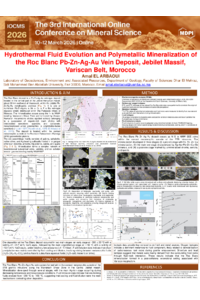
My poster IOCMS 2026_EL ARBAOUI.pdf
COMMINUTION STUDIES OF DIFFICULT GRINDABLE IRON ORES OF SOUTH INDIA—A case study on low-grade iron ores of Sandur, Karnataka, India.
Critical-Metal Potential and Mineral Systems of the NE Estonian Basement: Insights from Geochemistry, Geostatistics, and Geophysics