Event submissions
Published
This submission belongs to the session S2. Mineral Systems and Ore Deposits: From Formation to Exploration of the event The 3rd International Online Conference on Mineral Science
Published date
06 Mar, 2026
Academic Editor
'%3e%3cpath%20d='M12.6657%2010.9104C12.4185%2010.325%2012.0599%209.79327%2011.6097%209.34482C11.1609%208.89508%2010.6293%208.5365%2010.0442%208.28888C10.0389%208.28626%2010.0337%208.28495%2010.0285%208.28233C10.8446%207.69279%2011.3752%206.73249%2011.3752%205.64904C11.3752%203.8542%209.92103%202.39999%208.1262%202.39999C6.33136%202.39999%204.87715%203.8542%204.87715%205.64904C4.87715%206.73249%205.40774%207.69279%206.22393%208.28364C6.21869%208.28626%206.21345%208.28757%206.20821%208.29019C5.62129%208.5378%205.09463%208.89284%204.64265%209.34613C4.1929%209.79493%203.83432%2010.3266%203.58671%2010.9117C3.34345%2011.4845%203.21226%2012.0987%203.20023%2012.7209C3.19988%2012.7349%203.20233%2012.7488%203.20744%2012.7619C3.21255%2012.7749%203.22022%2012.7867%203.22998%2012.7968C3.23975%2012.8068%203.25142%2012.8147%203.26431%2012.8202C3.2772%2012.8256%203.29105%2012.8284%203.30504%2012.8284H4.09109C4.14874%2012.8284%204.19459%2012.7825%204.1959%2012.7262C4.2221%2011.7148%204.62823%2010.7676%205.34617%2010.0497C6.08899%209.30683%207.0755%208.89808%208.1262%208.89808C9.17689%208.89808%2010.1634%209.30683%2010.9062%2010.0497C11.6242%2010.7676%2012.0303%2011.7148%2012.0565%2012.7262C12.0578%2012.7838%2012.1037%2012.8284%2012.1613%2012.8284H12.9474C12.9613%2012.8284%2012.9752%2012.8256%2012.9881%2012.8202C13.001%2012.8147%2013.0126%2012.8068%2013.0224%2012.7968C13.0322%2012.7867%2013.0398%2012.7749%2013.0449%2012.7619C13.0501%2012.7488%2013.0525%2012.7349%2013.0522%2012.7209C13.0391%2012.0947%2012.9094%2011.4855%2012.6657%2010.9104ZM8.1262%207.9024C7.52486%207.9024%206.9589%207.6679%206.53312%207.24211C6.10733%206.81633%205.87283%206.25037%205.87283%205.64904C5.87283%205.0477%206.10733%204.48174%206.53312%204.05596C6.9589%203.63018%207.52486%203.39567%208.1262%203.39567C8.72753%203.39567%209.29349%203.63018%209.71927%204.05596C10.1451%204.48174%2010.3796%205.0477%2010.3796%205.64904C10.3796%206.25037%2010.1451%206.81633%209.71927%207.24211C9.29349%207.6679%208.72753%207.9024%208.1262%207.9024Z'%20fill='%235D1EE1'/%3e%3c/g%3e%3c/svg%3e) Theodore Bornhorst
Theodore BornhorstCitation
Ahmad Alvandi, Elham Zare, Hazel Deniz Toktay, High-Resolution Mapping of Magnetic Source Boundaries Using a Skewed-Sigmoid Approach: A Case Study of the Shavaz Deposit in Iran, in Proceedings of The 3rd International Online Conference on Mineral Science, 10 March–12 March 2026, MDPI: Basel, Switzerland
Share
Email
Facebook
Twitter
LinkedIn
High-Resolution Mapping of Magnetic Source Boundaries Using a Skewed-Sigmoid Approach: A Case Study of the Shavaz Deposit in Iran

Ahmad Alvandi 1
'%3e%3cpath%20d='M12.6647%2010.9104C12.4176%2010.325%2012.0589%209.7933%2011.6088%209.34485C11.16%208.89511%2010.6283%208.53653%2010.0432%208.28891C10.038%208.28629%2010.0327%208.28498%2010.0275%208.28236C10.8437%207.69282%2011.3743%206.73252%2011.3743%205.64907C11.3743%203.85423%209.92005%202.40002%208.12522%202.40002C6.33038%202.40002%204.87618%203.85423%204.87618%205.64907C4.87618%206.73252%205.40677%207.69282%206.22296%208.28367C6.21772%208.28629%206.21248%208.2876%206.20724%208.29022C5.62031%208.53783%205.09365%208.89287%204.64167%209.34616C4.19192%209.79496%203.83334%2010.3266%203.58573%2010.9117C3.34247%2011.4846%203.21128%2012.0987%203.19925%2012.721C3.1989%2012.735%203.20135%2012.7489%203.20646%2012.7619C3.21157%2012.7749%203.21924%2012.7868%203.22901%2012.7968C3.23877%2012.8068%203.25045%2012.8148%203.26334%2012.8202C3.27623%2012.8256%203.29007%2012.8284%203.30406%2012.8284H4.09012C4.14776%2012.8284%204.19362%2012.7825%204.19493%2012.7262C4.22113%2011.7148%204.62726%2010.7676%205.34519%2010.0497C6.08802%209.30686%207.07452%208.89811%208.12522%208.89811C9.17592%208.89811%2010.1624%209.30686%2010.9052%2010.0497C11.6232%2010.7676%2012.0293%2011.7148%2012.0555%2012.7262C12.0568%2012.7839%2012.1027%2012.8284%2012.1603%2012.8284H12.9464C12.9604%2012.8284%2012.9742%2012.8256%2012.9871%2012.8202C13%2012.8148%2013.0117%2012.8068%2013.0214%2012.7968C13.0312%2012.7868%2013.0389%2012.7749%2013.044%2012.7619C13.0491%2012.7489%2013.0515%2012.735%2013.0512%2012.721C13.0381%2012.0947%2012.9084%2011.4856%2012.6647%2010.9104ZM8.12522%207.90243C7.52388%207.90243%206.95792%207.66793%206.53214%207.24215C6.10636%206.81636%205.87185%206.2504%205.87185%205.64907C5.87185%205.04773%206.10636%204.48177%206.53214%204.05599C6.95792%203.63021%207.52388%203.3957%208.12522%203.3957C8.72655%203.3957%209.29252%203.63021%209.7183%204.05599C10.1441%204.48177%2010.3786%205.04773%2010.3786%205.64907C10.3786%206.2504%2010.1441%206.81636%209.7183%207.24215C9.29252%207.66793%208.72655%207.90243%208.12522%207.90243Z'%20fill='%235D1EE1'/%3e%3c/g%3e%3c/svg%3e)
Elham Zare 2
Hazel Deniz Toktay 3
1. Centre of Hamedan, University of Applied Science and Technology, Tehran, Iran
2. Institute of Geophysics, University of Tehran, Tehran, Iran
3. Department of Geophysical Engineering, Istanbul University—Cerrahpasa, Istanbul, Türkiye
Abstract
Abstract
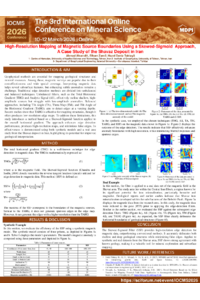
Determining the horizontal position of magnetic anomalies is essential for interpreting subsurface geological structures in geophysical exploration. Although numerous edge-detection techniques exist for outlining anomaly boundaries, many still struggle with issues such as false edge generation, poor resolution, and high noise sensitivity. This study introduces a new high-resolution approach that combines the Skewed-Sigmoid (Skewed-Sig) function with the Total Horizontal Gradient (THG) to overcome these limitations. The Skewed-Sig function resembles the commonly used arctangent operator found in many edge-detection filters, while the THG is a standard technique that often lacks sufficient edge-resolution when used alone. By integrating these two components, we develop a hybrid filter—referred to as SSF—that enhances the detection of mineralized targets. To evaluate the performance of the proposed SSF filter, we compare it with widely used methods, including the analytical signal (AS), THG, tilt angle (TA), theta map (TM), and total horizontal gradient of the tilt angle (TAHG), using a synthetic magnetic model with a complex subsurface structure. To create synthetic conditions that were close to the real world, noise was added to the model data, and the quality of the output maps was checked. The filter was then applied to magnetic data from the Shavaz iron deposit in Yazd Province, Iran. The study area lies within the Central Iran Block, a region that is known for its significant potential for iron mineralization, particularly hematite and magnetite. Our results demonstrate that SSF delineates the mine location with greater accuracy than traditional methods and shows strong agreement with existing geological information and previous investigations in the Shavaz region. Consequently, the SSF technique offers a reliable tool for detecting mineral deposits and other subsurface magnetic sources.
Keywords
Magnetic data
total horizontal gradient
skewed - sigmoid function
Shavaz Mine.
Poster
SSF-MDPI-poster.pdf
Optimization of Ultrafine Grinding Parameters Guided by Process Mineralogy to Improve Iron Separation Efficiency of titano-magnetite in Magnetic Separation
Comparison of Applicability of Comminution Methods for Complex Rare-Earth Ores: Product Characteristics, Grinding Energy Consumption and Magnetic Separation Performance