Event submissions
Published
This submission belongs to the session S4. Minerals in Extreme Environments: From Earth's Depths to Space of the event The 3rd International Online Conference on Mineral Science
Published date
06 Mar, 2026
Academic Editor
'%3e%3cpath%20d='M12.6657%2010.9104C12.4185%2010.325%2012.0599%209.79327%2011.6097%209.34482C11.1609%208.89508%2010.6293%208.5365%2010.0442%208.28888C10.0389%208.28626%2010.0337%208.28495%2010.0285%208.28233C10.8446%207.69279%2011.3752%206.73249%2011.3752%205.64904C11.3752%203.8542%209.92103%202.39999%208.1262%202.39999C6.33136%202.39999%204.87715%203.8542%204.87715%205.64904C4.87715%206.73249%205.40774%207.69279%206.22393%208.28364C6.21869%208.28626%206.21345%208.28757%206.20821%208.29019C5.62129%208.5378%205.09463%208.89284%204.64265%209.34613C4.1929%209.79493%203.83432%2010.3266%203.58671%2010.9117C3.34345%2011.4845%203.21226%2012.0987%203.20023%2012.7209C3.19988%2012.7349%203.20233%2012.7488%203.20744%2012.7619C3.21255%2012.7749%203.22022%2012.7867%203.22998%2012.7968C3.23975%2012.8068%203.25142%2012.8147%203.26431%2012.8202C3.2772%2012.8256%203.29105%2012.8284%203.30504%2012.8284H4.09109C4.14874%2012.8284%204.19459%2012.7825%204.1959%2012.7262C4.2221%2011.7148%204.62823%2010.7676%205.34617%2010.0497C6.08899%209.30683%207.0755%208.89808%208.1262%208.89808C9.17689%208.89808%2010.1634%209.30683%2010.9062%2010.0497C11.6242%2010.7676%2012.0303%2011.7148%2012.0565%2012.7262C12.0578%2012.7838%2012.1037%2012.8284%2012.1613%2012.8284H12.9474C12.9613%2012.8284%2012.9752%2012.8256%2012.9881%2012.8202C13.001%2012.8147%2013.0126%2012.8068%2013.0224%2012.7968C13.0322%2012.7867%2013.0398%2012.7749%2013.0449%2012.7619C13.0501%2012.7488%2013.0525%2012.7349%2013.0522%2012.7209C13.0391%2012.0947%2012.9094%2011.4855%2012.6657%2010.9104ZM8.1262%207.9024C7.52486%207.9024%206.9589%207.6679%206.53312%207.24211C6.10733%206.81633%205.87283%206.25037%205.87283%205.64904C5.87283%205.0477%206.10733%204.48174%206.53312%204.05596C6.9589%203.63018%207.52486%203.39567%208.1262%203.39567C8.72753%203.39567%209.29349%203.63018%209.71927%204.05596C10.1451%204.48174%2010.3796%205.0477%2010.3796%205.64904C10.3796%206.25037%2010.1451%206.81633%209.71927%207.24211C9.29349%207.6679%208.72753%207.9024%208.1262%207.9024Z'%20fill='%235D1EE1'/%3e%3c/g%3e%3c/svg%3e) Leonid Dubrovinsky
Leonid DubrovinskyCitation
Marina Corrêa Freitas, Astrobiomineralogy: A Systematic Review of Mineral–Microbe Interactions and Biosignatures in Extreme and Extraterrestrial Environments, in Proceedings of The 3rd International Online Conference on Mineral Science, 10 March–12 March 2026, MDPI: Basel, Switzerland
Share
Email
Facebook
Twitter
LinkedIn
Astrobiomineralogy: A Systematic Review of Mineral–Microbe Interactions and Biosignatures in Extreme and Extraterrestrial Environments
Astrobiomineralogy: A Systematic Review of Mineral–Microbe Interactions and Biosignatures in Extreme and Extraterrestrial Environments

Marina Corrêa Freitas 1
1. ICBS – International Center for Biomedical & Space Sciences, LIASTRA International Astronomy League, Rio de Janeiro, Brazil
Abstract
Introduction
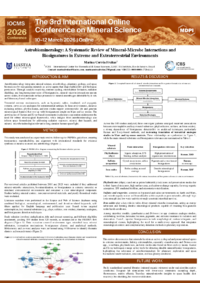
The study of mineral–microbe interactions under extreme conditions has become a cornerstone in understanding both the origins of life and its potential beyond Earth. Minerals play a crucial role as catalytic surfaces, nutrient sources, and preservers of biosignatures. The emerging field of astrobiomineralogy integrates geochemistry, microbiology, and space sciences to explore how such processes operate from Earth’s deepest biosphere to Martian and icy moon environments.
Methods
Following PRISMA guidelines, this systematic review analyzed 180 peer-reviewed studies (2010-2025) retrieved from Scopus and Web of Science. Studies focusing on microbial colonization, biomineralization, and mineral biosignatures in extreme or simulated extraterrestrial conditions were included. Bibliometric and co-word analyses were conducted using VOSviewer.
Results
Results reveal convergent patterns between terrestrial extremophiles (e.g., cyanobacteria, Deinococcus spp.) and their mineral substrates, particularly sulfates, phyllosilicates, and iron oxides, mirroring assemblages detected on Mars and Europa. Laboratory simulations demonstrate that microbial films induce mineralogical transformations that can persist as biosignatures detectable by Raman and X-ray spectroscopy.
Conclusions
Astrobiomineralogy bridges the gap between mineral sciences and space biomedicine, elucidating how life-mineral systems respond to radiation, desiccation, and low gravity. The synthesis highlights new frontiers for planetary exploration, life detection strategies, and potential biotechnological applications of extremophilic mineral interactions in human spaceflight contexts.
Keywords
Astrobiomineralogy
Biosignatures
Mineral-Microbe Interactions
Extreme Environments
Planetary Habitability
Poster
IOCMS2026_Poster_sciforum-157497_ICBS_LIASTRA.pdf
Transmission Electron Microscopy Highlighted the Importance of Clay Minerals in the Dolomitization of Ca-Mg Carbonates in a Hypersaline Soda Lake
A Hybrid Dimensionality Reduction and Spectral Classification Workflow for Mineral Mapping in Polar Terrains