Event submissions
Published
This submission belongs to the session S5. Virus-Host Interactions of the event Viruses 2026 – New Horizons in Virology
Published date
09 Mar, 2026
Academic Editor
'%3e%3cpath%20d='M12.6657%2010.9104C12.4185%2010.325%2012.0599%209.79327%2011.6097%209.34482C11.1609%208.89508%2010.6293%208.5365%2010.0442%208.28888C10.0389%208.28626%2010.0337%208.28495%2010.0285%208.28233C10.8446%207.69279%2011.3752%206.73249%2011.3752%205.64904C11.3752%203.8542%209.92103%202.39999%208.1262%202.39999C6.33136%202.39999%204.87715%203.8542%204.87715%205.64904C4.87715%206.73249%205.40774%207.69279%206.22393%208.28364C6.21869%208.28626%206.21345%208.28757%206.20821%208.29019C5.62129%208.5378%205.09463%208.89284%204.64265%209.34613C4.1929%209.79493%203.83432%2010.3266%203.58671%2010.9117C3.34345%2011.4845%203.21226%2012.0987%203.20023%2012.7209C3.19988%2012.7349%203.20233%2012.7488%203.20744%2012.7619C3.21255%2012.7749%203.22022%2012.7867%203.22998%2012.7968C3.23975%2012.8068%203.25142%2012.8147%203.26431%2012.8202C3.2772%2012.8256%203.29105%2012.8284%203.30504%2012.8284H4.09109C4.14874%2012.8284%204.19459%2012.7825%204.1959%2012.7262C4.2221%2011.7148%204.62823%2010.7676%205.34617%2010.0497C6.08899%209.30683%207.0755%208.89808%208.1262%208.89808C9.17689%208.89808%2010.1634%209.30683%2010.9062%2010.0497C11.6242%2010.7676%2012.0303%2011.7148%2012.0565%2012.7262C12.0578%2012.7838%2012.1037%2012.8284%2012.1613%2012.8284H12.9474C12.9613%2012.8284%2012.9752%2012.8256%2012.9881%2012.8202C13.001%2012.8147%2013.0126%2012.8068%2013.0224%2012.7968C13.0322%2012.7867%2013.0398%2012.7749%2013.0449%2012.7619C13.0501%2012.7488%2013.0525%2012.7349%2013.0522%2012.7209C13.0391%2012.0947%2012.9094%2011.4855%2012.6657%2010.9104ZM8.1262%207.9024C7.52486%207.9024%206.9589%207.6679%206.53312%207.24211C6.10733%206.81633%205.87283%206.25037%205.87283%205.64904C5.87283%205.0477%206.10733%204.48174%206.53312%204.05596C6.9589%203.63018%207.52486%203.39567%208.1262%203.39567C8.72753%203.39567%209.29349%203.63018%209.71927%204.05596C10.1451%204.48174%2010.3796%205.0477%2010.3796%205.64904C10.3796%206.25037%2010.1451%206.81633%209.71927%207.24211C9.29349%207.6679%208.72753%207.9024%208.1262%207.9024Z'%20fill='%235D1EE1'/%3e%3c/g%3e%3c/svg%3e) Eric Freed
Eric FreedCitation
Francesca Palma, Carla Zannella, Rosa Giugliano, Anna Riccio, Simone La Frazia, Valentina Svicher, Anna De Filippis, Massimiliano Galdiero, The phleboviruses Sandfly Fever Naples virus and Toscana virus uncouple the RNase and kinase activity of IRE-1, in Proceedings of Viruses 2026 – New Horizons in Virology, Barcelona, 11 March–13 March 2026, MDPI: Basel, Switzerland
Share
Email
Facebook
Twitter
LinkedIn
The phleboviruses Sandfly Fever Naples virus and Toscana virus uncouple the RNase and kinase activity of IRE-1

Francesca Palma 1
'%3e%3cpath%20d='M12.6647%2010.9104C12.4176%2010.325%2012.0589%209.7933%2011.6088%209.34485C11.16%208.89511%2010.6283%208.53653%2010.0432%208.28891C10.038%208.28629%2010.0327%208.28498%2010.0275%208.28236C10.8437%207.69282%2011.3743%206.73252%2011.3743%205.64907C11.3743%203.85423%209.92005%202.40002%208.12522%202.40002C6.33038%202.40002%204.87618%203.85423%204.87618%205.64907C4.87618%206.73252%205.40677%207.69282%206.22296%208.28367C6.21772%208.28629%206.21248%208.2876%206.20724%208.29022C5.62031%208.53783%205.09365%208.89287%204.64167%209.34616C4.19192%209.79496%203.83334%2010.3266%203.58573%2010.9117C3.34247%2011.4846%203.21128%2012.0987%203.19925%2012.721C3.1989%2012.735%203.20135%2012.7489%203.20646%2012.7619C3.21157%2012.7749%203.21924%2012.7868%203.22901%2012.7968C3.23877%2012.8068%203.25045%2012.8148%203.26334%2012.8202C3.27623%2012.8256%203.29007%2012.8284%203.30406%2012.8284H4.09012C4.14776%2012.8284%204.19362%2012.7825%204.19493%2012.7262C4.22113%2011.7148%204.62726%2010.7676%205.34519%2010.0497C6.08802%209.30686%207.07452%208.89811%208.12522%208.89811C9.17592%208.89811%2010.1624%209.30686%2010.9052%2010.0497C11.6232%2010.7676%2012.0293%2011.7148%2012.0555%2012.7262C12.0568%2012.7839%2012.1027%2012.8284%2012.1603%2012.8284H12.9464C12.9604%2012.8284%2012.9742%2012.8256%2012.9871%2012.8202C13%2012.8148%2013.0117%2012.8068%2013.0214%2012.7968C13.0312%2012.7868%2013.0389%2012.7749%2013.044%2012.7619C13.0491%2012.7489%2013.0515%2012.735%2013.0512%2012.721C13.0381%2012.0947%2012.9084%2011.4856%2012.6647%2010.9104ZM8.12522%207.90243C7.52388%207.90243%206.95792%207.66793%206.53214%207.24215C6.10636%206.81636%205.87185%206.2504%205.87185%205.64907C5.87185%205.04773%206.10636%204.48177%206.53214%204.05599C6.95792%203.63021%207.52388%203.3957%208.12522%203.3957C8.72655%203.3957%209.29252%203.63021%209.7183%204.05599C10.1441%204.48177%2010.3786%205.04773%2010.3786%205.64907C10.3786%206.2504%2010.1441%206.81636%209.7183%207.24215C9.29252%207.66793%208.72655%207.90243%208.12522%207.90243Z'%20fill='%235D1EE1'/%3e%3c/g%3e%3c/svg%3e)
Carla Zannella 1

Rosa Giugliano 1
Anna Riccio 2

Simone La Frazia 2
Valentina Svicher 2

Anna De Filippis 1

Massimiliano Galdiero 1,3
1. Department of Experimental Medicine, University of Campania ''Luigi Vanvitelli'', 80138, Naples, Italy
2. Department of Biology, University of Rome Tor Vergata, 00133, Rome, Italy
3. UOC of Virology and Microbiology, University Hospital of Campania “Luigi Vanvitelli”, 80138 Naples, Italy
Abstract
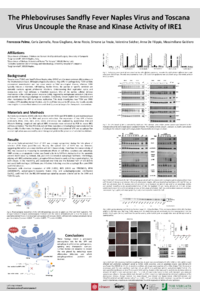
Background: Toscana virus (TOSV) and Sandfly Fever Naples virus (SFNV) are the most common phleboviruses in the Mediterranean Basin. Although antigenically related, they differ in pathogenicity: TOSV exhibits pronounced neurotropism and can cause severe or fatal neurological disease, whereas SFNV typically induces a transient, self-limiting, flu-like illness. No vaccine or specific antivirals are currently available against phleboviral infections. Understanding their replication cycles and interactions with host defenses is, therefore, essential. One of the earliest cellular defense mechanisms is the unfolded protein response (UPR), triggered by endoplasmic reticulum stress, which is capable of inducing autophagy or apoptosis. Conversely, viruses exploit host translation and often manipulate the UPR to enhance replication. This study investigates how TOSV and SFNV modulate UPR signaling during infection, providing insight into virus–host interactions and identifying potential targets for therapeutic intervention. Methodology: Human lung carcinoma (A549) cells were infected with TOSV and SFNV and monitored over a 16-hour time course for RNA and protein extraction. The expression of key UPR effectors (BIP, PERK, ATF6, IRE1, ATF4, CHOP, and eIF2α) was analyzed by quantitative PCR and Western Blotting. Unspliced and spliced XBP1 transcripts were detected by PCR to assess IRE1 pathway activation. Furthermore, the impact of pharmacological modulation of the UPR on viral replication was evaluated by determining viral yields in the presence of UPR modulators. Results and Conclusions: The active form of IRE1 was strongly upregulated during the late phase of infection (9-16 hours post-infection). Notably, the spliced form of XBP1 was not detected, suggesting that the virus may interfere with IRE1 RNase activity. Therefore, the kinase activity of IRE1 was assessed through its downstream targets JNK, BCL1, and BCL2 to evaluate the impact on autophagy. These findings reveal the previously unrecognized role of UPR and autophagy in phlebovirus pathogenesis, opening new therapeutic perspectives.
Keywords
phlebovirus
TOSV
SFNV
UPR
IRE1
autophagy
Poster
Poster_Viruses2026_FP.pdf
Single spike mutation differentiating XBB.1 and XBB.1.5 enhances SARS-CoV-2 cell-to-cell transmission and facilitates serum-mediated enhancement
Heat shock factor 2 as a dual regulator of gamma-herpesvirus life cycle