Event submissions
Published
This submission belongs to the session S4. Structure and Mechanisms of Virus Replication of the event Viruses 2026 – New Horizons in Virology
Published date
09 Mar, 2026
Academic Editor
'%3e%3cpath%20d='M12.6657%2010.9104C12.4185%2010.325%2012.0599%209.79327%2011.6097%209.34482C11.1609%208.89508%2010.6293%208.5365%2010.0442%208.28888C10.0389%208.28626%2010.0337%208.28495%2010.0285%208.28233C10.8446%207.69279%2011.3752%206.73249%2011.3752%205.64904C11.3752%203.8542%209.92103%202.39999%208.1262%202.39999C6.33136%202.39999%204.87715%203.8542%204.87715%205.64904C4.87715%206.73249%205.40774%207.69279%206.22393%208.28364C6.21869%208.28626%206.21345%208.28757%206.20821%208.29019C5.62129%208.5378%205.09463%208.89284%204.64265%209.34613C4.1929%209.79493%203.83432%2010.3266%203.58671%2010.9117C3.34345%2011.4845%203.21226%2012.0987%203.20023%2012.7209C3.19988%2012.7349%203.20233%2012.7488%203.20744%2012.7619C3.21255%2012.7749%203.22022%2012.7867%203.22998%2012.7968C3.23975%2012.8068%203.25142%2012.8147%203.26431%2012.8202C3.2772%2012.8256%203.29105%2012.8284%203.30504%2012.8284H4.09109C4.14874%2012.8284%204.19459%2012.7825%204.1959%2012.7262C4.2221%2011.7148%204.62823%2010.7676%205.34617%2010.0497C6.08899%209.30683%207.0755%208.89808%208.1262%208.89808C9.17689%208.89808%2010.1634%209.30683%2010.9062%2010.0497C11.6242%2010.7676%2012.0303%2011.7148%2012.0565%2012.7262C12.0578%2012.7838%2012.1037%2012.8284%2012.1613%2012.8284H12.9474C12.9613%2012.8284%2012.9752%2012.8256%2012.9881%2012.8202C13.001%2012.8147%2013.0126%2012.8068%2013.0224%2012.7968C13.0322%2012.7867%2013.0398%2012.7749%2013.0449%2012.7619C13.0501%2012.7488%2013.0525%2012.7349%2013.0522%2012.7209C13.0391%2012.0947%2012.9094%2011.4855%2012.6657%2010.9104ZM8.1262%207.9024C7.52486%207.9024%206.9589%207.6679%206.53312%207.24211C6.10733%206.81633%205.87283%206.25037%205.87283%205.64904C5.87283%205.0477%206.10733%204.48174%206.53312%204.05596C6.9589%203.63018%207.52486%203.39567%208.1262%203.39567C8.72753%203.39567%209.29349%203.63018%209.71927%204.05596C10.1451%204.48174%2010.3796%205.0477%2010.3796%205.64904C10.3796%206.25037%2010.1451%206.81633%209.71927%207.24211C9.29349%207.6679%208.72753%207.9024%208.1262%207.9024Z'%20fill='%235D1EE1'/%3e%3c/g%3e%3c/svg%3e) Eric Freed
Eric FreedCitation
Paola Nicole Loperena Gonzalez, Taanishi Gulati, Hannah Tsui, Bryan Perez Soto, Nicholas Chesarino, Jesse J Kwiek, The role of host fatty acid synthase in Mayaro virus replication, in Proceedings of Viruses 2026 – New Horizons in Virology, Barcelona, 11 March–13 March 2026, MDPI: Basel, Switzerland
Share
Email
Facebook
Twitter
LinkedIn
The role of host fatty acid synthase in Mayaro virus replication
'%3e%3cpath%20d='M12.6647%2010.9104C12.4176%2010.325%2012.0589%209.7933%2011.6088%209.34485C11.16%208.89511%2010.6283%208.53653%2010.0432%208.28891C10.038%208.28629%2010.0327%208.28498%2010.0275%208.28236C10.8437%207.69282%2011.3743%206.73252%2011.3743%205.64907C11.3743%203.85423%209.92005%202.40002%208.12522%202.40002C6.33038%202.40002%204.87618%203.85423%204.87618%205.64907C4.87618%206.73252%205.40677%207.69282%206.22296%208.28367C6.21772%208.28629%206.21248%208.2876%206.20724%208.29022C5.62031%208.53783%205.09365%208.89287%204.64167%209.34616C4.19192%209.79496%203.83334%2010.3266%203.58573%2010.9117C3.34247%2011.4846%203.21128%2012.0987%203.19925%2012.721C3.1989%2012.735%203.20135%2012.7489%203.20646%2012.7619C3.21157%2012.7749%203.21924%2012.7868%203.22901%2012.7968C3.23877%2012.8068%203.25045%2012.8148%203.26334%2012.8202C3.27623%2012.8256%203.29007%2012.8284%203.30406%2012.8284H4.09012C4.14776%2012.8284%204.19362%2012.7825%204.19493%2012.7262C4.22113%2011.7148%204.62726%2010.7676%205.34519%2010.0497C6.08802%209.30686%207.07452%208.89811%208.12522%208.89811C9.17592%208.89811%2010.1624%209.30686%2010.9052%2010.0497C11.6232%2010.7676%2012.0293%2011.7148%2012.0555%2012.7262C12.0568%2012.7839%2012.1027%2012.8284%2012.1603%2012.8284H12.9464C12.9604%2012.8284%2012.9742%2012.8256%2012.9871%2012.8202C13%2012.8148%2013.0117%2012.8068%2013.0214%2012.7968C13.0312%2012.7868%2013.0389%2012.7749%2013.044%2012.7619C13.0491%2012.7489%2013.0515%2012.735%2013.0512%2012.721C13.0381%2012.0947%2012.9084%2011.4856%2012.6647%2010.9104ZM8.12522%207.90243C7.52388%207.90243%206.95792%207.66793%206.53214%207.24215C6.10636%206.81636%205.87185%206.2504%205.87185%205.64907C5.87185%205.04773%206.10636%204.48177%206.53214%204.05599C6.95792%203.63021%207.52388%203.3957%208.12522%203.3957C8.72655%203.3957%209.29252%203.63021%209.7183%204.05599C10.1441%204.48177%2010.3786%205.04773%2010.3786%205.64907C10.3786%206.2504%2010.1441%206.81636%209.7183%207.24215C9.29252%207.66793%208.72655%207.90243%208.12522%207.90243Z'%20fill='%235D1EE1'/%3e%3c/g%3e%3c/svg%3e)
Paola Nicole Loperena Gonzalez 1,2
Taanishi Gulati 1
Hannah Tsui 1
Bryan Perez Soto 3
Nicholas Chesarino 1,4
Jesse J Kwiek 1,2
1. Department of Microbiology, The Ohio State University, Columbus, Ohio, USA
2. Cellular, Molecular, and Biochemical Sciences Program, The Ohio State University, Columbus, Ohio, USA
3. Molecular, Cellular, and Developmental Sciences Program, The Ohio State University, Columbus, Ohio, USA
4. Department of Biology, University of Akron, Akron, Ohio, USA
Abstract
To date, more than twenty viruses require host-catalyzed de novo fatty acid biosynthesis for replication. In mammals, this pathway is driven by the enzyme fatty acid synthase (FASN), which condenses acetyl-CoA and malonyl-CoA to catalyze the production of the fatty acid palmitate. Palmitate serves as a precursor for various metabolic fates during viral infection, including lipid droplet formation for viral assembly, beta-oxidation for ATP generation, and/or post-translational modification of viral proteins. It was unknown if Mayaro virus (MAYV), an emerging mosquito-borne alphavirus that causes debilitating arthritogenic disease, requires FASN for replication. We found that pharmacological FASN inhibition with Fasnall, TVB-2640, and C75 significantly reduced MAYV infection in vitro. To determine the metabolic fate of palmitate, we pharmacologically inhibited the three pathways downstream of FASN and found that 2-bromopalmitate (2-BP), a protein palmitoylation inhibitor, led to a ~90% reduction in MAYV infection. Protein palmitoylation, or S-palmitoylation, is a post-translational modification in which palmitate is attached to sulfur atoms in cysteines residues. In Chikungunya virus , a related alphavirus, FASN-dependent palmitoylation of nonstructural protein 1 (nsP1) is essential for membrane association and formation of replication complexes. Based on this, we hypothesized that MAYV nsP1 is palmitoylated in a FASN-dependent manner. Protein labeling by click-chemistry confirmed that MAYV nsP1 is palmitoylated at conserved cysteine residues C417–C419. Using an alkyne acetate analog metabolized by FASN into alkyne palmitate, we observed specific labeling of wild-type nsP1 but not a cysteine-to-alanine mutant. Furthermore, treatment with FASN inhibitors or 2-BP abrogated alkyne acetate labeling of wild-type nsP1, reinforcing that MAYV protein palmitoylation is a FASN-dependent process. Our findings reveal a conserved mechanism of FASN-dependent protein palmitoylation in alphaviruses and highlight FASN as a potential therapeutic target for MAYV and related viruses.
Keywords
Mayaro virus
fatty acid synthase
protein palmitoylation
click chemistry
Poster
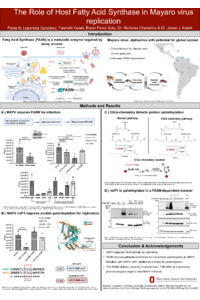
Paola Loperena Poster Viruses 2026 conference final version.pdf
Hamsters with long Covid exhibit a neurodegenerative signature in the brainstem
The interferon-induced protein 27 (IFI27) is a positive regulator of PACT-dependent PKR activation