Event submissions
Published
This submission belongs to the session S1. General Topics in Virology of the event Viruses 2026 – New Horizons in Virology
Published date
09 Mar, 2026
Academic Editor
'%3e%3cpath%20d='M12.6657%2010.9104C12.4185%2010.325%2012.0599%209.79327%2011.6097%209.34482C11.1609%208.89508%2010.6293%208.5365%2010.0442%208.28888C10.0389%208.28626%2010.0337%208.28495%2010.0285%208.28233C10.8446%207.69279%2011.3752%206.73249%2011.3752%205.64904C11.3752%203.8542%209.92103%202.39999%208.1262%202.39999C6.33136%202.39999%204.87715%203.8542%204.87715%205.64904C4.87715%206.73249%205.40774%207.69279%206.22393%208.28364C6.21869%208.28626%206.21345%208.28757%206.20821%208.29019C5.62129%208.5378%205.09463%208.89284%204.64265%209.34613C4.1929%209.79493%203.83432%2010.3266%203.58671%2010.9117C3.34345%2011.4845%203.21226%2012.0987%203.20023%2012.7209C3.19988%2012.7349%203.20233%2012.7488%203.20744%2012.7619C3.21255%2012.7749%203.22022%2012.7867%203.22998%2012.7968C3.23975%2012.8068%203.25142%2012.8147%203.26431%2012.8202C3.2772%2012.8256%203.29105%2012.8284%203.30504%2012.8284H4.09109C4.14874%2012.8284%204.19459%2012.7825%204.1959%2012.7262C4.2221%2011.7148%204.62823%2010.7676%205.34617%2010.0497C6.08899%209.30683%207.0755%208.89808%208.1262%208.89808C9.17689%208.89808%2010.1634%209.30683%2010.9062%2010.0497C11.6242%2010.7676%2012.0303%2011.7148%2012.0565%2012.7262C12.0578%2012.7838%2012.1037%2012.8284%2012.1613%2012.8284H12.9474C12.9613%2012.8284%2012.9752%2012.8256%2012.9881%2012.8202C13.001%2012.8147%2013.0126%2012.8068%2013.0224%2012.7968C13.0322%2012.7867%2013.0398%2012.7749%2013.0449%2012.7619C13.0501%2012.7488%2013.0525%2012.7349%2013.0522%2012.7209C13.0391%2012.0947%2012.9094%2011.4855%2012.6657%2010.9104ZM8.1262%207.9024C7.52486%207.9024%206.9589%207.6679%206.53312%207.24211C6.10733%206.81633%205.87283%206.25037%205.87283%205.64904C5.87283%205.0477%206.10733%204.48174%206.53312%204.05596C6.9589%203.63018%207.52486%203.39567%208.1262%203.39567C8.72753%203.39567%209.29349%203.63018%209.71927%204.05596C10.1451%204.48174%2010.3796%205.0477%2010.3796%205.64904C10.3796%206.25037%2010.1451%206.81633%209.71927%207.24211C9.29349%207.6679%208.72753%207.9024%208.1262%207.9024Z'%20fill='%235D1EE1'/%3e%3c/g%3e%3c/svg%3e) Eric Freed
Eric FreedCitation
Alessandra Rossetto, Alberto Reale, Michele Gottardi, Arianna Calistri, Monocyte-Based Transport of HSV-1 Oncolytic Viruses for Enhanced Acute Myeloid Leukemia Targeting, in Proceedings of Viruses 2026 – New Horizons in Virology, Barcelona, 11 March–13 March 2026, MDPI: Basel, Switzerland
Share
Email
Facebook
Twitter
LinkedIn
Monocyte-Based Transport of HSV-1 Oncolytic Viruses for Enhanced Acute Myeloid Leukemia Targeting
'%3e%3cpath%20d='M12.6647%2010.9104C12.4176%2010.325%2012.0589%209.7933%2011.6088%209.34485C11.16%208.89511%2010.6283%208.53653%2010.0432%208.28891C10.038%208.28629%2010.0327%208.28498%2010.0275%208.28236C10.8437%207.69282%2011.3743%206.73252%2011.3743%205.64907C11.3743%203.85423%209.92005%202.40002%208.12522%202.40002C6.33038%202.40002%204.87618%203.85423%204.87618%205.64907C4.87618%206.73252%205.40677%207.69282%206.22296%208.28367C6.21772%208.28629%206.21248%208.2876%206.20724%208.29022C5.62031%208.53783%205.09365%208.89287%204.64167%209.34616C4.19192%209.79496%203.83334%2010.3266%203.58573%2010.9117C3.34247%2011.4846%203.21128%2012.0987%203.19925%2012.721C3.1989%2012.735%203.20135%2012.7489%203.20646%2012.7619C3.21157%2012.7749%203.21924%2012.7868%203.22901%2012.7968C3.23877%2012.8068%203.25045%2012.8148%203.26334%2012.8202C3.27623%2012.8256%203.29007%2012.8284%203.30406%2012.8284H4.09012C4.14776%2012.8284%204.19362%2012.7825%204.19493%2012.7262C4.22113%2011.7148%204.62726%2010.7676%205.34519%2010.0497C6.08802%209.30686%207.07452%208.89811%208.12522%208.89811C9.17592%208.89811%2010.1624%209.30686%2010.9052%2010.0497C11.6232%2010.7676%2012.0293%2011.7148%2012.0555%2012.7262C12.0568%2012.7839%2012.1027%2012.8284%2012.1603%2012.8284H12.9464C12.9604%2012.8284%2012.9742%2012.8256%2012.9871%2012.8202C13%2012.8148%2013.0117%2012.8068%2013.0214%2012.7968C13.0312%2012.7868%2013.0389%2012.7749%2013.044%2012.7619C13.0491%2012.7489%2013.0515%2012.735%2013.0512%2012.721C13.0381%2012.0947%2012.9084%2011.4856%2012.6647%2010.9104ZM8.12522%207.90243C7.52388%207.90243%206.95792%207.66793%206.53214%207.24215C6.10636%206.81636%205.87185%206.2504%205.87185%205.64907C5.87185%205.04773%206.10636%204.48177%206.53214%204.05599C6.95792%203.63021%207.52388%203.3957%208.12522%203.3957C8.72655%203.3957%209.29252%203.63021%209.7183%204.05599C10.1441%204.48177%2010.3786%205.04773%2010.3786%205.64907C10.3786%206.2504%2010.1441%206.81636%209.7183%207.24215C9.29252%207.66793%208.72655%207.90243%208.12522%207.90243Z'%20fill='%235D1EE1'/%3e%3c/g%3e%3c/svg%3e)
Alessandra Rossetto 1
Alberto Reale 1
Michele Gottardi 2
Arianna Calistri 1
1. Department of Molecular Medicine; University of Padua
2. IOV - Istituto Oncologico Veneto
Abstract
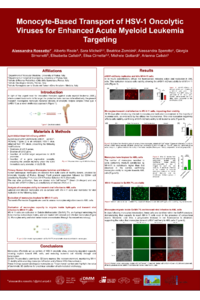
Acute myeloid leukemia (AML) is the most common leukemia in adults. It is a malignant disease of myeloid hematopoietic stem/progenitor cells, characterized by a high rate of recurrence and mortality. Therefore, more effective therapies are urgently needed. Among the emerging treatment options, oncolytic viruses (OVs)—viruses that selectively replicate in cancer cells and stimulate the patient’s immune system—have recently gained attention. We developed an OV based on Herpes Simplex Virus type I (oHSV-1 mCherry) due to its large genome capacity for genetic insertion, broad tropism, and previously demonstrated antitumor effects in solid tumors. This virus was tested in two human AML cell lines (OCI-AML3 and MV-4-11), demonstrating its ability to infect leukemia cells and effectively induce their death.
However, delivering the desired OV to the bone marrow, the primary site of leukemia proliferation, remains a significant challenge. To overcome this, we propose using human monocytes as carrier cells for oHSV-1, leveraging their natural tropism for cancer cells, ease of isolation, and ability to home to multiple body compartments. We assessed the capacity of human monocytes to deliver oHSV-1 mCherry to AML cells and found that they significantly reduced leukemia cell viability. Moreover, through the use of a migration assay, we confirmed the natural tropism of primary human monocytes for leukemia cells.
Our data suggest that HSV-1-based oncolytic viruses represent a promising therapeutic approach for acute myeloid leukemia (AML), and that human monocytes can efficiently serve as carrier cells, enabling the viruses to reach the tumor microenvironment.
Keywords
Oncolytic Viruses
Acute Myeloid Leukemia
Monocytes
Poster
Poster Viruses 2026_Rossetto Alessandra.pdf
OAS1 and OAS3 enhance inflammatory responses to SARS-CoV-2
The small genome viruses and big genome viruses: Interaction and their competitive nature