Event submissions
Published
This submission belongs to the session 4. Animal Genetics and Genomics of the event The 4th International Online Conference on Animals
Published date
12 Mar, 2026
Academic Editor
'%3e%3cpath%20d='M12.6657%2010.9104C12.4185%2010.325%2012.0599%209.79327%2011.6097%209.34482C11.1609%208.89508%2010.6293%208.5365%2010.0442%208.28888C10.0389%208.28626%2010.0337%208.28495%2010.0285%208.28233C10.8446%207.69279%2011.3752%206.73249%2011.3752%205.64904C11.3752%203.8542%209.92103%202.39999%208.1262%202.39999C6.33136%202.39999%204.87715%203.8542%204.87715%205.64904C4.87715%206.73249%205.40774%207.69279%206.22393%208.28364C6.21869%208.28626%206.21345%208.28757%206.20821%208.29019C5.62129%208.5378%205.09463%208.89284%204.64265%209.34613C4.1929%209.79493%203.83432%2010.3266%203.58671%2010.9117C3.34345%2011.4845%203.21226%2012.0987%203.20023%2012.7209C3.19988%2012.7349%203.20233%2012.7488%203.20744%2012.7619C3.21255%2012.7749%203.22022%2012.7867%203.22998%2012.7968C3.23975%2012.8068%203.25142%2012.8147%203.26431%2012.8202C3.2772%2012.8256%203.29105%2012.8284%203.30504%2012.8284H4.09109C4.14874%2012.8284%204.19459%2012.7825%204.1959%2012.7262C4.2221%2011.7148%204.62823%2010.7676%205.34617%2010.0497C6.08899%209.30683%207.0755%208.89808%208.1262%208.89808C9.17689%208.89808%2010.1634%209.30683%2010.9062%2010.0497C11.6242%2010.7676%2012.0303%2011.7148%2012.0565%2012.7262C12.0578%2012.7838%2012.1037%2012.8284%2012.1613%2012.8284H12.9474C12.9613%2012.8284%2012.9752%2012.8256%2012.9881%2012.8202C13.001%2012.8147%2013.0126%2012.8068%2013.0224%2012.7968C13.0322%2012.7867%2013.0398%2012.7749%2013.0449%2012.7619C13.0501%2012.7488%2013.0525%2012.7349%2013.0522%2012.7209C13.0391%2012.0947%2012.9094%2011.4855%2012.6657%2010.9104ZM8.1262%207.9024C7.52486%207.9024%206.9589%207.6679%206.53312%207.24211C6.10733%206.81633%205.87283%206.25037%205.87283%205.64904C5.87283%205.0477%206.10733%204.48174%206.53312%204.05596C6.9589%203.63018%207.52486%203.39567%208.1262%203.39567C8.72753%203.39567%209.29349%203.63018%209.71927%204.05596C10.1451%204.48174%2010.3796%205.0477%2010.3796%205.64904C10.3796%206.25037%2010.1451%206.81633%209.71927%207.24211C9.29349%207.6679%208.72753%207.9024%208.1262%207.9024Z'%20fill='%235D1EE1'/%3e%3c/g%3e%3c/svg%3e) Michael Hässig
Michael HässigCitation
Osamede Henry Osaiyuwu, Ifeoluwa Mojirade Egunjobi, Lydia Ojonugwa Igbatigbi, Genetic Polymorphism in the exon 5 of the prolactin gene on two duck breeds adapted to Nigeria., in Proceedings of The 4th International Online Conference on Animals, 17 March–19 March 2026, MDPI: Basel, Switzerland
Share
Email
Facebook
Twitter
LinkedIn
Genetic Polymorphism in the exon 5 of the prolactin gene on two duck breeds adapted to Nigeria.
'%3e%3cpath%20d='M12.6647%2010.9104C12.4176%2010.325%2012.0589%209.7933%2011.6088%209.34485C11.16%208.89511%2010.6283%208.53653%2010.0432%208.28891C10.038%208.28629%2010.0327%208.28498%2010.0275%208.28236C10.8437%207.69282%2011.3743%206.73252%2011.3743%205.64907C11.3743%203.85423%209.92005%202.40002%208.12522%202.40002C6.33038%202.40002%204.87618%203.85423%204.87618%205.64907C4.87618%206.73252%205.40677%207.69282%206.22296%208.28367C6.21772%208.28629%206.21248%208.2876%206.20724%208.29022C5.62031%208.53783%205.09365%208.89287%204.64167%209.34616C4.19192%209.79496%203.83334%2010.3266%203.58573%2010.9117C3.34247%2011.4846%203.21128%2012.0987%203.19925%2012.721C3.1989%2012.735%203.20135%2012.7489%203.20646%2012.7619C3.21157%2012.7749%203.21924%2012.7868%203.22901%2012.7968C3.23877%2012.8068%203.25045%2012.8148%203.26334%2012.8202C3.27623%2012.8256%203.29007%2012.8284%203.30406%2012.8284H4.09012C4.14776%2012.8284%204.19362%2012.7825%204.19493%2012.7262C4.22113%2011.7148%204.62726%2010.7676%205.34519%2010.0497C6.08802%209.30686%207.07452%208.89811%208.12522%208.89811C9.17592%208.89811%2010.1624%209.30686%2010.9052%2010.0497C11.6232%2010.7676%2012.0293%2011.7148%2012.0555%2012.7262C12.0568%2012.7839%2012.1027%2012.8284%2012.1603%2012.8284H12.9464C12.9604%2012.8284%2012.9742%2012.8256%2012.9871%2012.8202C13%2012.8148%2013.0117%2012.8068%2013.0214%2012.7968C13.0312%2012.7868%2013.0389%2012.7749%2013.044%2012.7619C13.0491%2012.7489%2013.0515%2012.735%2013.0512%2012.721C13.0381%2012.0947%2012.9084%2011.4856%2012.6647%2010.9104ZM8.12522%207.90243C7.52388%207.90243%206.95792%207.66793%206.53214%207.24215C6.10636%206.81636%205.87185%206.2504%205.87185%205.64907C5.87185%205.04773%206.10636%204.48177%206.53214%204.05599C6.95792%203.63021%207.52388%203.3957%208.12522%203.3957C8.72655%203.3957%209.29252%203.63021%209.7183%204.05599C10.1441%204.48177%2010.3786%205.04773%2010.3786%205.64907C10.3786%206.2504%2010.1441%206.81636%209.7183%207.24215C9.29252%207.66793%208.72655%207.90243%208.12522%207.90243Z'%20fill='%235D1EE1'/%3e%3c/g%3e%3c/svg%3e)
Osamede Henry Osaiyuwu 1
Ifeoluwa Mojirade Egunjobi 1
Lydia Ojonugwa Igbatigbi 2
1. Department of Animal Science, Breeding and Genetics Unit, University of Ibadan, Ibadan, Nigeria
2. Department of Zoology, Federal University Lokoja, Lokoja, Nigeria
Abstract
Purpose:
This study aimed at determining genetic variants of prolactin gene in the Muscovy and Mallard ducks in Nigeria, and to evaluate the genetic relatedness or diversity of the duck species at the exon 5 of Prolactin (PRL) gene loci in the two selected Duck breeds, by determining the genetic polymorphisms, genetic parameters and genetic variation in the duck breeds. 80 adult ducks sourced from Lagos, Ogun and Oyo states of Nigeria, were used for this study.
Method:
Blood samples (2ml) collected by jugular venipuncture from the ducks, using sterile needles and syringes, were stored in ethylene diamine tetra acetic acid (EDTA) bottles, to prevent coagulation and preserve the integrity of the samples, were transported in ice packs, to the laboratory for analysis. Genomic DNA was extracted from whole blood samples, amplified using PCR were digested using HinfI Restriction Enzyme. The data were analyzed using POPGENE 1.32 software.
Results:
Two alleles with frequencies A (0.1034, 0.2188), B (0.8966, 0.7812), and three genotypes with frequencies AA (0.0000, 1.0000), AB (6.0000, 5.0000) and BB (23.000, 10.0000) were identified at the Exon 5 of of PRL gene in Mallard and Muscovy ducks respectively. Indicating that prolactin gene was polymorphic in both populations. The Chi-square test (0.367, 0.2381) suggests that the populations conforms to Hardy-Weinberg equilibrium. Also, noted were observed heterozygosity (0.2069, 0.3125) and expected heterozygosity (0.1887, 0.3528).
Conclusion:
The sampled populations were polymorphic for PRL gene at exon 5, and are also in Hardy–Weinberg equilibrium, based on the observed parameters and statistical analysis. The values of observed heterozygosity and expected heterozygosity, indicates higher genetic variation within the Mallard breed population, compared to the Muscovy population, which can be attributed to inbreeding. This indicates the need for Genetic intervention to prevent this indigenous breed of ducks from extinction.
Keywords
Keywords: Alleles
Genotype
Polymorphic
Population
Poster
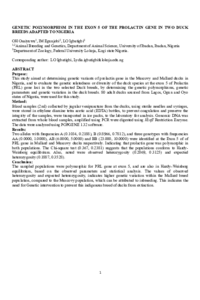
PROLACTIN ARTICLE.docx_095355.pdf
Carbonic Anhydrase Polymorphism Reveals Striking Genetic Diversity and Strong Selection Signatures in Nigerian Indigenous Cattle Breeds
Genomic evaluation of productive, health, and economic traits in Ecuadorian Jersey dairy cattle