Event submissions
Published
This submission belongs to the session 4. Animal Genetics and Genomics of the event The 4th International Online Conference on Animals
Published date
12 Mar, 2026
Academic Editor
'%3e%3cpath%20d='M12.6657%2010.9104C12.4185%2010.325%2012.0599%209.79327%2011.6097%209.34482C11.1609%208.89508%2010.6293%208.5365%2010.0442%208.28888C10.0389%208.28626%2010.0337%208.28495%2010.0285%208.28233C10.8446%207.69279%2011.3752%206.73249%2011.3752%205.64904C11.3752%203.8542%209.92103%202.39999%208.1262%202.39999C6.33136%202.39999%204.87715%203.8542%204.87715%205.64904C4.87715%206.73249%205.40774%207.69279%206.22393%208.28364C6.21869%208.28626%206.21345%208.28757%206.20821%208.29019C5.62129%208.5378%205.09463%208.89284%204.64265%209.34613C4.1929%209.79493%203.83432%2010.3266%203.58671%2010.9117C3.34345%2011.4845%203.21226%2012.0987%203.20023%2012.7209C3.19988%2012.7349%203.20233%2012.7488%203.20744%2012.7619C3.21255%2012.7749%203.22022%2012.7867%203.22998%2012.7968C3.23975%2012.8068%203.25142%2012.8147%203.26431%2012.8202C3.2772%2012.8256%203.29105%2012.8284%203.30504%2012.8284H4.09109C4.14874%2012.8284%204.19459%2012.7825%204.1959%2012.7262C4.2221%2011.7148%204.62823%2010.7676%205.34617%2010.0497C6.08899%209.30683%207.0755%208.89808%208.1262%208.89808C9.17689%208.89808%2010.1634%209.30683%2010.9062%2010.0497C11.6242%2010.7676%2012.0303%2011.7148%2012.0565%2012.7262C12.0578%2012.7838%2012.1037%2012.8284%2012.1613%2012.8284H12.9474C12.9613%2012.8284%2012.9752%2012.8256%2012.9881%2012.8202C13.001%2012.8147%2013.0126%2012.8068%2013.0224%2012.7968C13.0322%2012.7867%2013.0398%2012.7749%2013.0449%2012.7619C13.0501%2012.7488%2013.0525%2012.7349%2013.0522%2012.7209C13.0391%2012.0947%2012.9094%2011.4855%2012.6657%2010.9104ZM8.1262%207.9024C7.52486%207.9024%206.9589%207.6679%206.53312%207.24211C6.10733%206.81633%205.87283%206.25037%205.87283%205.64904C5.87283%205.0477%206.10733%204.48174%206.53312%204.05596C6.9589%203.63018%207.52486%203.39567%208.1262%203.39567C8.72753%203.39567%209.29349%203.63018%209.71927%204.05596C10.1451%204.48174%2010.3796%205.0477%2010.3796%205.64904C10.3796%206.25037%2010.1451%206.81633%209.71927%207.24211C9.29349%207.6679%208.72753%207.9024%208.1262%207.9024Z'%20fill='%235D1EE1'/%3e%3c/g%3e%3c/svg%3e) Michael Hässig
Michael HässigCitation
Simara Larissa Fanalli, Richard Crooijmans, Izally Carvalho Gervásio, Bárbara Silva Vignato, Vivian Almeida, Aline S. M. Cesar, Omega-6-associated gene modules reveal novel regulatory mechanisms in porcine liver, in Proceedings of The 4th International Online Conference on Animals, 17 March–19 March 2026, MDPI: Basel, Switzerland
Share
Email
Facebook
Twitter
LinkedIn
Omega-6-associated gene modules reveal novel regulatory mechanisms in porcine liver
'%3e%3cpath%20d='M12.6647%2010.9104C12.4176%2010.325%2012.0589%209.7933%2011.6088%209.34485C11.16%208.89511%2010.6283%208.53653%2010.0432%208.28891C10.038%208.28629%2010.0327%208.28498%2010.0275%208.28236C10.8437%207.69282%2011.3743%206.73252%2011.3743%205.64907C11.3743%203.85423%209.92005%202.40002%208.12522%202.40002C6.33038%202.40002%204.87618%203.85423%204.87618%205.64907C4.87618%206.73252%205.40677%207.69282%206.22296%208.28367C6.21772%208.28629%206.21248%208.2876%206.20724%208.29022C5.62031%208.53783%205.09365%208.89287%204.64167%209.34616C4.19192%209.79496%203.83334%2010.3266%203.58573%2010.9117C3.34247%2011.4846%203.21128%2012.0987%203.19925%2012.721C3.1989%2012.735%203.20135%2012.7489%203.20646%2012.7619C3.21157%2012.7749%203.21924%2012.7868%203.22901%2012.7968C3.23877%2012.8068%203.25045%2012.8148%203.26334%2012.8202C3.27623%2012.8256%203.29007%2012.8284%203.30406%2012.8284H4.09012C4.14776%2012.8284%204.19362%2012.7825%204.19493%2012.7262C4.22113%2011.7148%204.62726%2010.7676%205.34519%2010.0497C6.08802%209.30686%207.07452%208.89811%208.12522%208.89811C9.17592%208.89811%2010.1624%209.30686%2010.9052%2010.0497C11.6232%2010.7676%2012.0293%2011.7148%2012.0555%2012.7262C12.0568%2012.7839%2012.1027%2012.8284%2012.1603%2012.8284H12.9464C12.9604%2012.8284%2012.9742%2012.8256%2012.9871%2012.8202C13%2012.8148%2013.0117%2012.8068%2013.0214%2012.7968C13.0312%2012.7868%2013.0389%2012.7749%2013.044%2012.7619C13.0491%2012.7489%2013.0515%2012.735%2013.0512%2012.721C13.0381%2012.0947%2012.9084%2011.4856%2012.6647%2010.9104ZM8.12522%207.90243C7.52388%207.90243%206.95792%207.66793%206.53214%207.24215C6.10636%206.81636%205.87185%206.2504%205.87185%205.64907C5.87185%205.04773%206.10636%204.48177%206.53214%204.05599C6.95792%203.63021%207.52388%203.3957%208.12522%203.3957C8.72655%203.3957%209.29252%203.63021%209.7183%204.05599C10.1441%204.48177%2010.3786%205.04773%2010.3786%205.64907C10.3786%206.2504%2010.1441%206.81636%209.7183%207.24215C9.29252%207.66793%208.72655%207.90243%208.12522%207.90243Z'%20fill='%235D1EE1'/%3e%3c/g%3e%3c/svg%3e)
Simara Larissa Fanalli 1
Richard Crooijmans 2
Izally Carvalho Gervásio 3

Bárbara Silva Vignato 3
Vivian Almeida 4
Aline S. M. Cesar 1
1. School of Animal Science and Food Engineering, University of São Paulo, Pirassununga, 13635-900, Brazil
2. Animal Breeding and Genomics, Wageningen University & Research, Wageningen, 6700 AH, The Netherlands
3. Department of Food Science and Technology, Luiz de Queiroz College of Agriculture, University of São Paulo, Piracicaba, 13418-900, Brazil
4. Department of Animal Science, Federal University of Goiás, Goiânia, 74691-835, Brazil
Abstract
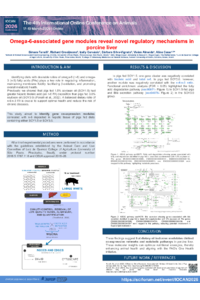
Identifying diets with desirable ratios of omega-6 (n-6) and omega-3 (n-3) fatty acids (FAs) plays a key role in regulating inflammation, maintaining membrane fluidity, facilitating β-oxidation, and promoting overall metabolic health. Previously, we showed that pigs fed 1.5% soybean oil (SOY1.5) had greater hepatic linoleic acid (an n-6 FA) deposition than pigs fed 3.0% soybean oil (SOY3.0). A balanced dietary ratio of n-6:n-3 FA is crucial to support optimal health and reduce the risk of chronic diseases. Thus, this study aimed to identify gene co-expression modules correlated with n-6 deposited in hepatic tissue of pigs fed diets containing either SOY 1.5 or SOY3.0. mRNA-seq data from 35 immunocastrated Large White pigs (CEUA2018-28) were analyzed using standard bioinformatics pipelines. Co-expression modules were identified with WGCNA, followed by functional enrichment using DAVID. Strong co-expression patterns related to n-6 were observed in both diets, but they involved distinct modules and pathways. In pigs fed SOY1.5, one gene cluster was negatively correlated with linoleic acid and total n-6. In pigs fed SOY3.0, however, another module was negatively correlated with the n-6:n-3 ratio. Functional enrichment analysis (FDR < 0.05) highlighted the fatty acid degradation pathway (ssc00071) in SOY1.5-fed pigs and Bile secretion pathway (ssc04976) in the SOY3.0 group. These findings suggest that dietary oil inclusion modulates distinct co-expression networks and metabolic pathways in porcine liver. These molecular insights can optimize nutritional strategies, thereby enhancing animal health and aligning with the FAO’s One Health initiative.
Keywords
animal model
fatty acids
co-expression
Poster
fanalliiocan2026.pdf
Genomic evaluation of productive, health, and economic traits in Ecuadorian Jersey dairy cattle
In Silico Prediction of DNA-RNA Triplex Formation Sites Reveals Novel Regulatory Links Between Key Fertility Genes and lncRNAs in Retinta Beef Cattle