Event submissions
Published
This submission belongs to the session 4. Animal Genetics and Genomics of the event The 4th International Online Conference on Animals
Published date
12 Mar, 2026
Academic Editor
'%3e%3cpath%20d='M12.6657%2010.9104C12.4185%2010.325%2012.0599%209.79327%2011.6097%209.34482C11.1609%208.89508%2010.6293%208.5365%2010.0442%208.28888C10.0389%208.28626%2010.0337%208.28495%2010.0285%208.28233C10.8446%207.69279%2011.3752%206.73249%2011.3752%205.64904C11.3752%203.8542%209.92103%202.39999%208.1262%202.39999C6.33136%202.39999%204.87715%203.8542%204.87715%205.64904C4.87715%206.73249%205.40774%207.69279%206.22393%208.28364C6.21869%208.28626%206.21345%208.28757%206.20821%208.29019C5.62129%208.5378%205.09463%208.89284%204.64265%209.34613C4.1929%209.79493%203.83432%2010.3266%203.58671%2010.9117C3.34345%2011.4845%203.21226%2012.0987%203.20023%2012.7209C3.19988%2012.7349%203.20233%2012.7488%203.20744%2012.7619C3.21255%2012.7749%203.22022%2012.7867%203.22998%2012.7968C3.23975%2012.8068%203.25142%2012.8147%203.26431%2012.8202C3.2772%2012.8256%203.29105%2012.8284%203.30504%2012.8284H4.09109C4.14874%2012.8284%204.19459%2012.7825%204.1959%2012.7262C4.2221%2011.7148%204.62823%2010.7676%205.34617%2010.0497C6.08899%209.30683%207.0755%208.89808%208.1262%208.89808C9.17689%208.89808%2010.1634%209.30683%2010.9062%2010.0497C11.6242%2010.7676%2012.0303%2011.7148%2012.0565%2012.7262C12.0578%2012.7838%2012.1037%2012.8284%2012.1613%2012.8284H12.9474C12.9613%2012.8284%2012.9752%2012.8256%2012.9881%2012.8202C13.001%2012.8147%2013.0126%2012.8068%2013.0224%2012.7968C13.0322%2012.7867%2013.0398%2012.7749%2013.0449%2012.7619C13.0501%2012.7488%2013.0525%2012.7349%2013.0522%2012.7209C13.0391%2012.0947%2012.9094%2011.4855%2012.6657%2010.9104ZM8.1262%207.9024C7.52486%207.9024%206.9589%207.6679%206.53312%207.24211C6.10733%206.81633%205.87283%206.25037%205.87283%205.64904C5.87283%205.0477%206.10733%204.48174%206.53312%204.05596C6.9589%203.63018%207.52486%203.39567%208.1262%203.39567C8.72753%203.39567%209.29349%203.63018%209.71927%204.05596C10.1451%204.48174%2010.3796%205.0477%2010.3796%205.64904C10.3796%206.25037%2010.1451%206.81633%209.71927%207.24211C9.29349%207.6679%208.72753%207.9024%208.1262%207.9024Z'%20fill='%235D1EE1'/%3e%3c/g%3e%3c/svg%3e) Michael Davis
Michael DavisCitation
Iris A.L. Silva, Morgana Angelo, Inês Freitas, Florbela Soares, Rui Sousa, Silvia Gregório, Bárbara Requeijo, Pedro Pousão-Ferreira, Diogo Medina, Carolina Castro, Cátia Lourenço-Marques, Integrative Genomic Approaches to Improve Disease Resistance in Senegalese Sole: Insights from the BETTERFLAT Project, in Proceedings of The 4th International Online Conference on Animals, 17 March–19 March 2026, MDPI: Basel, Switzerland
Share
Email
Facebook
Twitter
LinkedIn
Integrative Genomic Approaches to Improve Disease Resistance in Senegalese Sole: Insights from the BETTERFLAT Project
'%3e%3cpath%20d='M12.6647%2010.9104C12.4176%2010.325%2012.0589%209.7933%2011.6088%209.34485C11.16%208.89511%2010.6283%208.53653%2010.0432%208.28891C10.038%208.28629%2010.0327%208.28498%2010.0275%208.28236C10.8437%207.69282%2011.3743%206.73252%2011.3743%205.64907C11.3743%203.85423%209.92005%202.40002%208.12522%202.40002C6.33038%202.40002%204.87618%203.85423%204.87618%205.64907C4.87618%206.73252%205.40677%207.69282%206.22296%208.28367C6.21772%208.28629%206.21248%208.2876%206.20724%208.29022C5.62031%208.53783%205.09365%208.89287%204.64167%209.34616C4.19192%209.79496%203.83334%2010.3266%203.58573%2010.9117C3.34247%2011.4846%203.21128%2012.0987%203.19925%2012.721C3.1989%2012.735%203.20135%2012.7489%203.20646%2012.7619C3.21157%2012.7749%203.21924%2012.7868%203.22901%2012.7968C3.23877%2012.8068%203.25045%2012.8148%203.26334%2012.8202C3.27623%2012.8256%203.29007%2012.8284%203.30406%2012.8284H4.09012C4.14776%2012.8284%204.19362%2012.7825%204.19493%2012.7262C4.22113%2011.7148%204.62726%2010.7676%205.34519%2010.0497C6.08802%209.30686%207.07452%208.89811%208.12522%208.89811C9.17592%208.89811%2010.1624%209.30686%2010.9052%2010.0497C11.6232%2010.7676%2012.0293%2011.7148%2012.0555%2012.7262C12.0568%2012.7839%2012.1027%2012.8284%2012.1603%2012.8284H12.9464C12.9604%2012.8284%2012.9742%2012.8256%2012.9871%2012.8202C13%2012.8148%2013.0117%2012.8068%2013.0214%2012.7968C13.0312%2012.7868%2013.0389%2012.7749%2013.044%2012.7619C13.0491%2012.7489%2013.0515%2012.735%2013.0512%2012.721C13.0381%2012.0947%2012.9084%2011.4856%2012.6647%2010.9104ZM8.12522%207.90243C7.52388%207.90243%206.95792%207.66793%206.53214%207.24215C6.10636%206.81636%205.87185%206.2504%205.87185%205.64907C5.87185%205.04773%206.10636%204.48177%206.53214%204.05599C6.95792%203.63021%207.52388%203.3957%208.12522%203.3957C8.72655%203.3957%209.29252%203.63021%209.7183%204.05599C10.1441%204.48177%2010.3786%205.04773%2010.3786%205.64907C10.3786%206.2504%2010.1441%206.81636%209.7183%207.24215C9.29252%207.66793%208.72655%207.90243%208.12522%207.90243Z'%20fill='%235D1EE1'/%3e%3c/g%3e%3c/svg%3e)
Iris A.L. Silva 1
Morgana Angelo 1
Inês Freitas 1
Florbela Soares 1,2
Rui Sousa 1
Silvia Gregório 1
Bárbara Requeijo 1
Pedro Pousão-Ferreira 1,2
Diogo Medina 3
Carolina Castro 3
Cátia Lourenço-Marques 1,2
1. S2AQUAcoLAB, Olhão, 8700-194, Portugal
2. IPMA/EPPO, Olhão, 8700-194, Portugal
3. FLATLANTIC Lta, Mira, 3070-732, Portugal
Abstract
Introduction
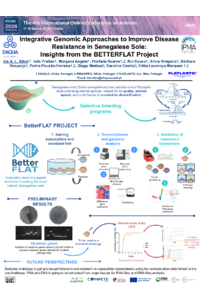
The increasing global demand for seafood underscores the urgency of developing sustainable and resilient aquaculture systems. The Senegalese sole (Solea senegalensis), a species of high commercial value, plays a pivotal role in enhancing diversification and competitiveness within European aquaculture. However, its benthic nature heightens susceptibility to sediment-associated pathogens, making disease management a persistent production constraint. In alignment with the EU Aquaculture Strategy 2030, which prioritizes environmentally responsible disease mitigation, the BetterFLAT project aims to establish genomic resources to enable the selective breeding of disease-resistant Senegalese sole.
Materials and Methods
The BetterFLAT project employs an integrative multi-omics approach—combining functional genomics, transcriptomics, and molecular marker discovery—to identify genetic determinants associated with resistance to key bacterial pathogens. The consortium, comprising FLATLANTIC, IPMA, and S2AQUA, brings together expertise in aquaculture, pathology, and molecular biology to advance genetic improvement strategies for this species.
Results
An initial pre-test phase optimized pathogen challenge conditions by determining the median (LD₅₀) and 75% (LD₇₅) lethal doses for selected bacterial isolates. Experimental fish were subjected to a range of bacterial concentrations, and cumulative mortality was recorded to assess isolate virulence. Molecular characterization, including species confirmation and virulence gene profiling, validated the selection of the most pathogenic and genetically defined strain for subsequent infection trials.
Discussion and Conclusion
Through the integration of multi-omics datasets with pathogen-challenge experiments, the BetterFLAT project lays the groundwork for the development of disease-resilient Senegalese sole broodstock. These advances are expected to enhance juvenile robustness, reduce production losses, and promote more sustainable and economically viable aquaculture practices.
Acknowledgments
The operation BetterFLAT was developed with funding from Programmes COMPETE2030, Algarve2030, Portugal2030, and the European Union; the Interface Mission cofinanced by PRR - Plano de Recuperação e Resiliência by the European Union (operation code 01/C05-i02/2022.P148); and SAUDE&AQUA II (MAR-021.1.3-FEAMPA-00018).
Keywords
sole
selective breeding
genomics
disease resistance
Poster
Silva et al Animals 2026 BetterFLAT_Poster2.pdf
Adaptive Genomics and Conservation Objectives: Balancing Hybrid Vigor and Climate Resilience in Pakistan’s Yak Population
Genomic Approaches for Enhancing Disease Resistance and Climate Adaptation in Livestock