Event submissions
Published
This submission belongs to the session 4. Animal Genetics and Genomics of the event The 4th International Online Conference on Animals
Published date
12 Mar, 2026
Academic Editor
'%3e%3cpath%20d='M12.6657%2010.9104C12.4185%2010.325%2012.0599%209.79327%2011.6097%209.34482C11.1609%208.89508%2010.6293%208.5365%2010.0442%208.28888C10.0389%208.28626%2010.0337%208.28495%2010.0285%208.28233C10.8446%207.69279%2011.3752%206.73249%2011.3752%205.64904C11.3752%203.8542%209.92103%202.39999%208.1262%202.39999C6.33136%202.39999%204.87715%203.8542%204.87715%205.64904C4.87715%206.73249%205.40774%207.69279%206.22393%208.28364C6.21869%208.28626%206.21345%208.28757%206.20821%208.29019C5.62129%208.5378%205.09463%208.89284%204.64265%209.34613C4.1929%209.79493%203.83432%2010.3266%203.58671%2010.9117C3.34345%2011.4845%203.21226%2012.0987%203.20023%2012.7209C3.19988%2012.7349%203.20233%2012.7488%203.20744%2012.7619C3.21255%2012.7749%203.22022%2012.7867%203.22998%2012.7968C3.23975%2012.8068%203.25142%2012.8147%203.26431%2012.8202C3.2772%2012.8256%203.29105%2012.8284%203.30504%2012.8284H4.09109C4.14874%2012.8284%204.19459%2012.7825%204.1959%2012.7262C4.2221%2011.7148%204.62823%2010.7676%205.34617%2010.0497C6.08899%209.30683%207.0755%208.89808%208.1262%208.89808C9.17689%208.89808%2010.1634%209.30683%2010.9062%2010.0497C11.6242%2010.7676%2012.0303%2011.7148%2012.0565%2012.7262C12.0578%2012.7838%2012.1037%2012.8284%2012.1613%2012.8284H12.9474C12.9613%2012.8284%2012.9752%2012.8256%2012.9881%2012.8202C13.001%2012.8147%2013.0126%2012.8068%2013.0224%2012.7968C13.0322%2012.7867%2013.0398%2012.7749%2013.0449%2012.7619C13.0501%2012.7488%2013.0525%2012.7349%2013.0522%2012.7209C13.0391%2012.0947%2012.9094%2011.4855%2012.6657%2010.9104ZM8.1262%207.9024C7.52486%207.9024%206.9589%207.6679%206.53312%207.24211C6.10733%206.81633%205.87283%206.25037%205.87283%205.64904C5.87283%205.0477%206.10733%204.48174%206.53312%204.05596C6.9589%203.63018%207.52486%203.39567%208.1262%203.39567C8.72753%203.39567%209.29349%203.63018%209.71927%204.05596C10.1451%204.48174%2010.3796%205.0477%2010.3796%205.64904C10.3796%206.25037%2010.1451%206.81633%209.71927%207.24211C9.29349%207.6679%208.72753%207.9024%208.1262%207.9024Z'%20fill='%235D1EE1'/%3e%3c/g%3e%3c/svg%3e) Michael Hässig
Michael HässigCitation
Carlos Eduardo de Carvalho Silva Oliveira, Raissa Pereira de Oliveira, Pedro Henrique Gonçalves de Carvalho, Genomic Approaches for Enhancing Disease Resistance and Climate Adaptation in Livestock, in Proceedings of The 4th International Online Conference on Animals, 17 March–19 March 2026, MDPI: Basel, Switzerland
Share
Email
Facebook
Twitter
LinkedIn
Genomic Approaches for Enhancing Disease Resistance and Climate Adaptation in Livestock
'%3e%3cpath%20d='M12.6647%2010.9104C12.4176%2010.325%2012.0589%209.7933%2011.6088%209.34485C11.16%208.89511%2010.6283%208.53653%2010.0432%208.28891C10.038%208.28629%2010.0327%208.28498%2010.0275%208.28236C10.8437%207.69282%2011.3743%206.73252%2011.3743%205.64907C11.3743%203.85423%209.92005%202.40002%208.12522%202.40002C6.33038%202.40002%204.87618%203.85423%204.87618%205.64907C4.87618%206.73252%205.40677%207.69282%206.22296%208.28367C6.21772%208.28629%206.21248%208.2876%206.20724%208.29022C5.62031%208.53783%205.09365%208.89287%204.64167%209.34616C4.19192%209.79496%203.83334%2010.3266%203.58573%2010.9117C3.34247%2011.4846%203.21128%2012.0987%203.19925%2012.721C3.1989%2012.735%203.20135%2012.7489%203.20646%2012.7619C3.21157%2012.7749%203.21924%2012.7868%203.22901%2012.7968C3.23877%2012.8068%203.25045%2012.8148%203.26334%2012.8202C3.27623%2012.8256%203.29007%2012.8284%203.30406%2012.8284H4.09012C4.14776%2012.8284%204.19362%2012.7825%204.19493%2012.7262C4.22113%2011.7148%204.62726%2010.7676%205.34519%2010.0497C6.08802%209.30686%207.07452%208.89811%208.12522%208.89811C9.17592%208.89811%2010.1624%209.30686%2010.9052%2010.0497C11.6232%2010.7676%2012.0293%2011.7148%2012.0555%2012.7262C12.0568%2012.7839%2012.1027%2012.8284%2012.1603%2012.8284H12.9464C12.9604%2012.8284%2012.9742%2012.8256%2012.9871%2012.8202C13%2012.8148%2013.0117%2012.8068%2013.0214%2012.7968C13.0312%2012.7868%2013.0389%2012.7749%2013.044%2012.7619C13.0491%2012.7489%2013.0515%2012.735%2013.0512%2012.721C13.0381%2012.0947%2012.9084%2011.4856%2012.6647%2010.9104ZM8.12522%207.90243C7.52388%207.90243%206.95792%207.66793%206.53214%207.24215C6.10636%206.81636%205.87185%206.2504%205.87185%205.64907C5.87185%205.04773%206.10636%204.48177%206.53214%204.05599C6.95792%203.63021%207.52388%203.3957%208.12522%203.3957C8.72655%203.3957%209.29252%203.63021%209.7183%204.05599C10.1441%204.48177%2010.3786%205.04773%2010.3786%205.64907C10.3786%206.2504%2010.1441%206.81636%209.7183%207.24215C9.29252%207.66793%208.72655%207.90243%208.12522%207.90243Z'%20fill='%235D1EE1'/%3e%3c/g%3e%3c/svg%3e)
Carlos Eduardo de Carvalho Silva Oliveira 1
Raissa Pereira de Oliveira 1
Pedro Henrique Gonçalves de Carvalho 1
1. Department of Clinical and Veterinary Surgery, School of Veterinary Medicine, Federal University of Minas Gerais (UFMG), Belo Horizonte, Minas Gerais, Brazil
Abstract
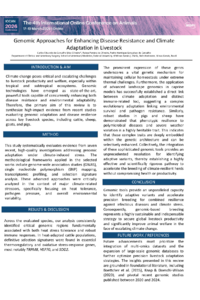
Climate change poses increasing challenges to livestock productivity and health, particularly in tropical and subtropical regions. Genomic technologies have emerged as powerful tools to enhance both disease resistance and environmental adaptability in animals. Several studies have demonstrated that integrating genomic selection, genome-wide association studies (GWAS), and functional genomics can accelerate breeding for resilience traits (Boettcher et al., 2015; Knap & Doeschl-Wilson, 2020). This review synthesizes evidence from seven recent studies addressing genomic adaptation and disease resistance in livestock species, including cattle, sheep, goats, and pigs. The selected works applied methodologies such as GWAS, SNP mapping, transcriptomic profiling, and selection signature analysis (Boettcher et al., 2015; Genomic Responses to Climatic Challenges in Beef Cattle, 2024; BMC Genomics, 2024; Genome Biol. Evol., 2020). These approaches were evaluated in the context of climate-related stressors such as heat tolerance, pathogen pressure, and environmental variability. Across species, genomic regions associated with heat stress tolerance and immune response have been consistently identified. For instance, heat-adapted cattle populations show selection signatures in genes such as TRPM8, HSP70, and SOD2 (Genomic Responses to Climatic Challenges in Beef Cattle, 2024). In goats, climate adaptation was linked to immune-related loci detected through landscape genomics (BMC Genomics, 2024). Likewise, studies in pigs and sheep revealed that resilience to polymicrobial diseases and weather variation is heritable and can be enhanced through genomic selection (Knap & Doeschl-Wilson, 2020; BMC Genom. Data, 2020). Collectively, these findings emphasize that genomic tools can identify adaptive variants and accelerate breeding for combined resilience to disease and climate stress. Genomic-based breeding therefore represents a sustainable strategy to improve livestock productivity and welfare under global climate change. Future directions should include the integration of multi-omics datasets and large-scale genomic databases to strengthen precision livestock adaptation strategies.
Keywords
Climate adaptation
Disease resistance
Genetic selection
Genomics
Livestock
Resilience
Poster
sciforum-157744 Carlos Eduardo de Carvalho Silva Oliveira.pdf
Integrative Genomic Approaches to Improve Disease Resistance in Senegalese Sole: Insights from the BETTERFLAT Project
Uncovering Growth Variability in Gilthead Seabream (Sparus aurata) through Muscle Transcriptomic Profiling