Event submissions
Published
This submission belongs to the session 3. Sustainable Animal Nutrition of the event The 4th International Online Conference on Animals
Published date
12 Mar, 2026
Academic Editor
'%3e%3cpath%20d='M12.6657%2010.9104C12.4185%2010.325%2012.0599%209.79327%2011.6097%209.34482C11.1609%208.89508%2010.6293%208.5365%2010.0442%208.28888C10.0389%208.28626%2010.0337%208.28495%2010.0285%208.28233C10.8446%207.69279%2011.3752%206.73249%2011.3752%205.64904C11.3752%203.8542%209.92103%202.39999%208.1262%202.39999C6.33136%202.39999%204.87715%203.8542%204.87715%205.64904C4.87715%206.73249%205.40774%207.69279%206.22393%208.28364C6.21869%208.28626%206.21345%208.28757%206.20821%208.29019C5.62129%208.5378%205.09463%208.89284%204.64265%209.34613C4.1929%209.79493%203.83432%2010.3266%203.58671%2010.9117C3.34345%2011.4845%203.21226%2012.0987%203.20023%2012.7209C3.19988%2012.7349%203.20233%2012.7488%203.20744%2012.7619C3.21255%2012.7749%203.22022%2012.7867%203.22998%2012.7968C3.23975%2012.8068%203.25142%2012.8147%203.26431%2012.8202C3.2772%2012.8256%203.29105%2012.8284%203.30504%2012.8284H4.09109C4.14874%2012.8284%204.19459%2012.7825%204.1959%2012.7262C4.2221%2011.7148%204.62823%2010.7676%205.34617%2010.0497C6.08899%209.30683%207.0755%208.89808%208.1262%208.89808C9.17689%208.89808%2010.1634%209.30683%2010.9062%2010.0497C11.6242%2010.7676%2012.0303%2011.7148%2012.0565%2012.7262C12.0578%2012.7838%2012.1037%2012.8284%2012.1613%2012.8284H12.9474C12.9613%2012.8284%2012.9752%2012.8256%2012.9881%2012.8202C13.001%2012.8147%2013.0126%2012.8068%2013.0224%2012.7968C13.0322%2012.7867%2013.0398%2012.7749%2013.0449%2012.7619C13.0501%2012.7488%2013.0525%2012.7349%2013.0522%2012.7209C13.0391%2012.0947%2012.9094%2011.4855%2012.6657%2010.9104ZM8.1262%207.9024C7.52486%207.9024%206.9589%207.6679%206.53312%207.24211C6.10733%206.81633%205.87283%206.25037%205.87283%205.64904C5.87283%205.0477%206.10733%204.48174%206.53312%204.05596C6.9589%203.63018%207.52486%203.39567%208.1262%203.39567C8.72753%203.39567%209.29349%203.63018%209.71927%204.05596C10.1451%204.48174%2010.3796%205.0477%2010.3796%205.64904C10.3796%206.25037%2010.1451%206.81633%209.71927%207.24211C9.29349%207.6679%208.72753%207.9024%208.1262%207.9024Z'%20fill='%235D1EE1'/%3e%3c/g%3e%3c/svg%3e) Elisabete Matos
Elisabete MatosCitation
María Eugenia Munilla, Juan Sebastián Vittone, Metabolic biomarkers in heifers fed with r-zeta® additive in their diets, in Proceedings of The 4th International Online Conference on Animals, 17 March–19 March 2026, MDPI: Basel, Switzerland
Share
Email
Facebook
Twitter
LinkedIn
Metabolic biomarkers in heifers fed with r-zeta® additive in their diets
'%3e%3cpath%20d='M12.6647%2010.9104C12.4176%2010.325%2012.0589%209.7933%2011.6088%209.34485C11.16%208.89511%2010.6283%208.53653%2010.0432%208.28891C10.038%208.28629%2010.0327%208.28498%2010.0275%208.28236C10.8437%207.69282%2011.3743%206.73252%2011.3743%205.64907C11.3743%203.85423%209.92005%202.40002%208.12522%202.40002C6.33038%202.40002%204.87618%203.85423%204.87618%205.64907C4.87618%206.73252%205.40677%207.69282%206.22296%208.28367C6.21772%208.28629%206.21248%208.2876%206.20724%208.29022C5.62031%208.53783%205.09365%208.89287%204.64167%209.34616C4.19192%209.79496%203.83334%2010.3266%203.58573%2010.9117C3.34247%2011.4846%203.21128%2012.0987%203.19925%2012.721C3.1989%2012.735%203.20135%2012.7489%203.20646%2012.7619C3.21157%2012.7749%203.21924%2012.7868%203.22901%2012.7968C3.23877%2012.8068%203.25045%2012.8148%203.26334%2012.8202C3.27623%2012.8256%203.29007%2012.8284%203.30406%2012.8284H4.09012C4.14776%2012.8284%204.19362%2012.7825%204.19493%2012.7262C4.22113%2011.7148%204.62726%2010.7676%205.34519%2010.0497C6.08802%209.30686%207.07452%208.89811%208.12522%208.89811C9.17592%208.89811%2010.1624%209.30686%2010.9052%2010.0497C11.6232%2010.7676%2012.0293%2011.7148%2012.0555%2012.7262C12.0568%2012.7839%2012.1027%2012.8284%2012.1603%2012.8284H12.9464C12.9604%2012.8284%2012.9742%2012.8256%2012.9871%2012.8202C13%2012.8148%2013.0117%2012.8068%2013.0214%2012.7968C13.0312%2012.7868%2013.0389%2012.7749%2013.044%2012.7619C13.0491%2012.7489%2013.0515%2012.735%2013.0512%2012.721C13.0381%2012.0947%2012.9084%2011.4856%2012.6647%2010.9104ZM8.12522%207.90243C7.52388%207.90243%206.95792%207.66793%206.53214%207.24215C6.10636%206.81636%205.87185%206.2504%205.87185%205.64907C5.87185%205.04773%206.10636%204.48177%206.53214%204.05599C6.95792%203.63021%207.52388%203.3957%208.12522%203.3957C8.72655%203.3957%209.29252%203.63021%209.7183%204.05599C10.1441%204.48177%2010.3786%205.04773%2010.3786%205.64907C10.3786%206.2504%2010.1441%206.81636%209.7183%207.24215C9.29252%207.66793%208.72655%207.90243%208.12522%207.90243Z'%20fill='%235D1EE1'/%3e%3c/g%3e%3c/svg%3e)
María Eugenia Munilla 1
Juan Sebastián Vittone 1
1. Department of Ruminants, Agricultural Experimental Station of Concepción del Uruguay, National Agricultural Technology Institute, Concepción del Uruguay, 3260, Argentina
Abstract
The aim of this work was to evaluate different rearing diet strategies with r-zeta® additive in heifers (192.6 ± 19.0 kg body weight, (BW)). The additive formulation includes flavorings that regulate intake, enzymes, microorganisms that modulate the gut microbiota, liver protectants, and anti-inflammatories. The treatments were HR+CS (hay roll (HR) and control supplementation at 1% BW—80% whole corn grain and 20% pelleted protein concentrate); HR+Sr-zeta® (HR and balanced pellet r-zeta® supplementation at 1% BW); HR+SFr-zeta® (HR and self-feeding balanced pellet r-zeta®) and SFr-zeta® (self-feeding balanced pellet r-zeta®). In treatments with the additive and self-feeding, food was offered ad libitum from the first day. Whole-blood samples were collected on days 0, 28, 56 and 83 to evaluate metabolic biomarkers (lactate dehydrogenase (LDH), uremia and glycemia). Continuous variables were analyzed using repeated measures (α = 0.05). All treatments showed similar values of LDH (1200 to 1400 mU/mL; p= 0.0713). The different feeding alternatives affected uremia (p= 0.0143). The animals fed SFr-zeta® had higher values on day 28 compared to supplemented groups. Furthermore, both self-feeding groups showed higher values on day 56 in comparison to the supplemented groups. In relation to the reference values (20 to 40 mg/dl), the supplemented animals showed even lower values, which could be considered an insufficient supply of nitrogen compounds in the diet. The self-feeding groups showed normal urea levels throughout the study (30 to 40 mg/dl). A lower value was observed in the blood glucose levels in HR+CS treatment on day 28 compared to the HR+SFr-zeta® group on day 56 (p= 0.0174). For the remaining sampling times, all groups showed similar means. Only the HR+CS group had the range established by other authors (60 to 80 mg/dL), while all groups fed with r-zeta® were above the reference values. The results demonstrate that there was no negative effect on the metabolic variables studied when the additive was included in self-feeding diets without adaptation protocols.
Keywords
beef
glycemia
replacement heifers
self-feeder
uremia
Poster
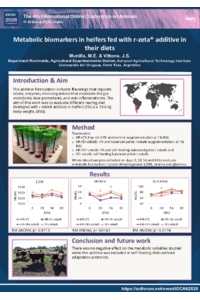
2026. Abstract IOCAN.pdf
Host genomic regulation of gut microbiota resilience under environmental stress in pigs
Seed Dispersal Coevolution with the Extinct Proboscidean Stegodon trigonocephalus Restricts Current Platymitra macrocarpa Distribution in Indonesia