Event submissions
Published
This submission belongs to the session 1. Sustainable Animal Welfare, Ethics and Human–Animal Interactions of the event The 4th International Online Conference on Animals
Published date
12 Mar, 2026
Academic Editor
'%3e%3cpath%20d='M12.6657%2010.9104C12.4185%2010.325%2012.0599%209.79327%2011.6097%209.34482C11.1609%208.89508%2010.6293%208.5365%2010.0442%208.28888C10.0389%208.28626%2010.0337%208.28495%2010.0285%208.28233C10.8446%207.69279%2011.3752%206.73249%2011.3752%205.64904C11.3752%203.8542%209.92103%202.39999%208.1262%202.39999C6.33136%202.39999%204.87715%203.8542%204.87715%205.64904C4.87715%206.73249%205.40774%207.69279%206.22393%208.28364C6.21869%208.28626%206.21345%208.28757%206.20821%208.29019C5.62129%208.5378%205.09463%208.89284%204.64265%209.34613C4.1929%209.79493%203.83432%2010.3266%203.58671%2010.9117C3.34345%2011.4845%203.21226%2012.0987%203.20023%2012.7209C3.19988%2012.7349%203.20233%2012.7488%203.20744%2012.7619C3.21255%2012.7749%203.22022%2012.7867%203.22998%2012.7968C3.23975%2012.8068%203.25142%2012.8147%203.26431%2012.8202C3.2772%2012.8256%203.29105%2012.8284%203.30504%2012.8284H4.09109C4.14874%2012.8284%204.19459%2012.7825%204.1959%2012.7262C4.2221%2011.7148%204.62823%2010.7676%205.34617%2010.0497C6.08899%209.30683%207.0755%208.89808%208.1262%208.89808C9.17689%208.89808%2010.1634%209.30683%2010.9062%2010.0497C11.6242%2010.7676%2012.0303%2011.7148%2012.0565%2012.7262C12.0578%2012.7838%2012.1037%2012.8284%2012.1613%2012.8284H12.9474C12.9613%2012.8284%2012.9752%2012.8256%2012.9881%2012.8202C13.001%2012.8147%2013.0126%2012.8068%2013.0224%2012.7968C13.0322%2012.7867%2013.0398%2012.7749%2013.0449%2012.7619C13.0501%2012.7488%2013.0525%2012.7349%2013.0522%2012.7209C13.0391%2012.0947%2012.9094%2011.4855%2012.6657%2010.9104ZM8.1262%207.9024C7.52486%207.9024%206.9589%207.6679%206.53312%207.24211C6.10733%206.81633%205.87283%206.25037%205.87283%205.64904C5.87283%205.0477%206.10733%204.48174%206.53312%204.05596C6.9589%203.63018%207.52486%203.39567%208.1262%203.39567C8.72753%203.39567%209.29349%203.63018%209.71927%204.05596C10.1451%204.48174%2010.3796%205.0477%2010.3796%205.64904C10.3796%206.25037%2010.1451%206.81633%209.71927%207.24211C9.29349%207.6679%208.72753%207.9024%208.1262%207.9024Z'%20fill='%235D1EE1'/%3e%3c/g%3e%3c/svg%3e) Colin Scanes
Colin ScanesCitation
Raiane Emy Aikawa, Hingryd Aparecida Olmo, Teresa Cristina Alves, Maria José Hötzel, Matheus Deniz, Karolini Tenffen De-Sousa, Gender effects in Brazilian livestock advisors’ management practice recommendations regarding dairy cattle welfare: a preliminary study, in Proceedings of The 4th International Online Conference on Animals, 17 March–19 March 2026, MDPI: Basel, Switzerland
Share
Email
Facebook
Twitter
LinkedIn
Gender effects in Brazilian livestock advisors’ management practice recommendations regarding dairy cattle welfare: a preliminary study
'%3e%3cpath%20d='M12.6647%2010.9104C12.4176%2010.325%2012.0589%209.7933%2011.6088%209.34485C11.16%208.89511%2010.6283%208.53653%2010.0432%208.28891C10.038%208.28629%2010.0327%208.28498%2010.0275%208.28236C10.8437%207.69282%2011.3743%206.73252%2011.3743%205.64907C11.3743%203.85423%209.92005%202.40002%208.12522%202.40002C6.33038%202.40002%204.87618%203.85423%204.87618%205.64907C4.87618%206.73252%205.40677%207.69282%206.22296%208.28367C6.21772%208.28629%206.21248%208.2876%206.20724%208.29022C5.62031%208.53783%205.09365%208.89287%204.64167%209.34616C4.19192%209.79496%203.83334%2010.3266%203.58573%2010.9117C3.34247%2011.4846%203.21128%2012.0987%203.19925%2012.721C3.1989%2012.735%203.20135%2012.7489%203.20646%2012.7619C3.21157%2012.7749%203.21924%2012.7868%203.22901%2012.7968C3.23877%2012.8068%203.25045%2012.8148%203.26334%2012.8202C3.27623%2012.8256%203.29007%2012.8284%203.30406%2012.8284H4.09012C4.14776%2012.8284%204.19362%2012.7825%204.19493%2012.7262C4.22113%2011.7148%204.62726%2010.7676%205.34519%2010.0497C6.08802%209.30686%207.07452%208.89811%208.12522%208.89811C9.17592%208.89811%2010.1624%209.30686%2010.9052%2010.0497C11.6232%2010.7676%2012.0293%2011.7148%2012.0555%2012.7262C12.0568%2012.7839%2012.1027%2012.8284%2012.1603%2012.8284H12.9464C12.9604%2012.8284%2012.9742%2012.8256%2012.9871%2012.8202C13%2012.8148%2013.0117%2012.8068%2013.0214%2012.7968C13.0312%2012.7868%2013.0389%2012.7749%2013.044%2012.7619C13.0491%2012.7489%2013.0515%2012.735%2013.0512%2012.721C13.0381%2012.0947%2012.9084%2011.4856%2012.6647%2010.9104ZM8.12522%207.90243C7.52388%207.90243%206.95792%207.66793%206.53214%207.24215C6.10636%206.81636%205.87185%206.2504%205.87185%205.64907C5.87185%205.04773%206.10636%204.48177%206.53214%204.05599C6.95792%203.63021%207.52388%203.3957%208.12522%203.3957C8.72655%203.3957%209.29252%203.63021%209.7183%204.05599C10.1441%204.48177%2010.3786%205.04773%2010.3786%205.64907C10.3786%206.2504%2010.1441%206.81636%209.7183%207.24215C9.29252%207.66793%208.72655%207.90243%208.12522%207.90243Z'%20fill='%235D1EE1'/%3e%3c/g%3e%3c/svg%3e)
Raiane Emy Aikawa 1

Hingryd Aparecida Olmo 2,3

Teresa Cristina Alves 4
Maria José Hötzel 5

Matheus Deniz 2

Karolini Tenffen De-Sousa 2,6
1. Faculdade de Medicina Veterinária e Zootecnia, Universidade de São Paulo, São Paulo, Brazil
2. Grupo de Estudos em Bovinos Leiteiros, Faculdade de Medicina Veterinária e Zootecnia, Universidade Estadual Paulista, Botucatu, São Paulo, Brazil
3. Programa de Pós-Graduação em Zootecnia, Faculdade de Medicina Veterinária e Zootecnia, Universidade Estadual Paulista, Botucatu, São Paulo, Brazil
4. Empresa Brasileira de Pesquisa Agropecuária, Embrapa Pecuária Sudeste, São Paulo, Brazil
5. Laboratório de Etologia Aplicada e Bem-Estar Animal, Universidade Federal de Santa Catarina, Florianópolis, Santa Catarina, Brazil.
6. Present Addredd: Institudo de Zootecnia, Sertãozinho, São Paulo, Brazil
Abstract
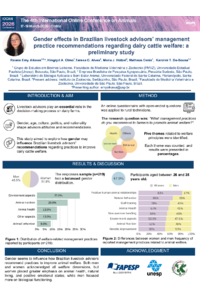
Livestock advisors play an essential role in the decision-making process on dairy farms. Yet, their attitudes and recommendations are shaped by factors such as gender, age, culture, politics, and nationality. We explored how gender may influence Brazilian livestock advisors' recommendations regarding practices to improve dairy cattle welfare. For this, we analysed the responses to one open-ended question from an online questionnaire: “What management practices do you recommend to farmers to promote animal welfare?” The responses were categorised into five themes related to welfare principles (nutrition, environment, animal health, behaviour, and other). The number of participants who mentioned each theme was counted, and the results were presented in percentages. The sample (n=219) had a balanced gender distribution (males=48% and females=51%), and participants were predominantly aged between 26 and 35 years old (47.9%). In general, reported management practices were mainly related to animal nutrition (20%) and environmental aspects (28%), including thermal comfort, hygiene, features of facilities, and animal stocking density. Animal health (13%), animal behaviour (9%), and other aspects (13%) were less mentioned. Women cited more frequent practices that promote natural behaviour (65%), followed by animal health (57%), environmental aspects (52%), and animal nutrition (51%). Also, 51% cited other welfare principles, like positive human–animal relationships (83%), staff training (59%), non-aversive handling (54%), and genetic improvement (50%). In contrast, men’s recommendations focused on animal nutrition (49%), environmental management (47%), animal health (43%), and natural behaviour (35%). Other welfare principles cited by men were genetic improvement (50%), non-aversive handling (46%), staff training (41%), and positive human–animal relationships (17%). In conclusion, gender seems to influence how livestock advisors recommend practices to improve animal welfare. Both women and men acknowledged all welfare dimensions, but women placed greater emphasis on animal health, natural living, and positive emotional states, while men focused more on biological functioning.
Keywords
sex
animal care
professionals.
Poster
Raiane Emy_ IOCAN._2026.pdf
Scratching behavior of dairy heifers in agrivoltaic systems with different configurations
Agrivoltaic systems as a tool to improve dairy farming sustainability—A case study