Event submissions
Published
This submission belongs to the session 1. Sustainable Animal Welfare, Ethics and Human–Animal Interactions of the event The 4th International Online Conference on Animals
Published date
12 Mar, 2026
Academic Editor
'%3e%3cpath%20d='M12.6657%2010.9104C12.4185%2010.325%2012.0599%209.79327%2011.6097%209.34482C11.1609%208.89508%2010.6293%208.5365%2010.0442%208.28888C10.0389%208.28626%2010.0337%208.28495%2010.0285%208.28233C10.8446%207.69279%2011.3752%206.73249%2011.3752%205.64904C11.3752%203.8542%209.92103%202.39999%208.1262%202.39999C6.33136%202.39999%204.87715%203.8542%204.87715%205.64904C4.87715%206.73249%205.40774%207.69279%206.22393%208.28364C6.21869%208.28626%206.21345%208.28757%206.20821%208.29019C5.62129%208.5378%205.09463%208.89284%204.64265%209.34613C4.1929%209.79493%203.83432%2010.3266%203.58671%2010.9117C3.34345%2011.4845%203.21226%2012.0987%203.20023%2012.7209C3.19988%2012.7349%203.20233%2012.7488%203.20744%2012.7619C3.21255%2012.7749%203.22022%2012.7867%203.22998%2012.7968C3.23975%2012.8068%203.25142%2012.8147%203.26431%2012.8202C3.2772%2012.8256%203.29105%2012.8284%203.30504%2012.8284H4.09109C4.14874%2012.8284%204.19459%2012.7825%204.1959%2012.7262C4.2221%2011.7148%204.62823%2010.7676%205.34617%2010.0497C6.08899%209.30683%207.0755%208.89808%208.1262%208.89808C9.17689%208.89808%2010.1634%209.30683%2010.9062%2010.0497C11.6242%2010.7676%2012.0303%2011.7148%2012.0565%2012.7262C12.0578%2012.7838%2012.1037%2012.8284%2012.1613%2012.8284H12.9474C12.9613%2012.8284%2012.9752%2012.8256%2012.9881%2012.8202C13.001%2012.8147%2013.0126%2012.8068%2013.0224%2012.7968C13.0322%2012.7867%2013.0398%2012.7749%2013.0449%2012.7619C13.0501%2012.7488%2013.0525%2012.7349%2013.0522%2012.7209C13.0391%2012.0947%2012.9094%2011.4855%2012.6657%2010.9104ZM8.1262%207.9024C7.52486%207.9024%206.9589%207.6679%206.53312%207.24211C6.10733%206.81633%205.87283%206.25037%205.87283%205.64904C5.87283%205.0477%206.10733%204.48174%206.53312%204.05596C6.9589%203.63018%207.52486%203.39567%208.1262%203.39567C8.72753%203.39567%209.29349%203.63018%209.71927%204.05596C10.1451%204.48174%2010.3796%205.0477%2010.3796%205.64904C10.3796%206.25037%2010.1451%206.81633%209.71927%207.24211C9.29349%207.6679%208.72753%207.9024%208.1262%207.9024Z'%20fill='%235D1EE1'/%3e%3c/g%3e%3c/svg%3e) Colin Scanes
Colin ScanesCitation
Matheus Deniz, Karolini Tenffen De-Sousa, Maria José Hötzel, Lenira El Faro, Ricardo Ruther, Agrivoltaic systems as a tool to improve dairy farming sustainability—A case study, in Proceedings of The 4th International Online Conference on Animals, 17 March–19 March 2026, MDPI: Basel, Switzerland
Share
Email
Facebook
Twitter
LinkedIn
Agrivoltaic systems as a tool to improve dairy farming sustainability—A case study

Matheus Deniz 1

Karolini Tenffen De-Sousa 1,2
'%3e%3cpath%20d='M12.6647%2010.9104C12.4176%2010.325%2012.0589%209.7933%2011.6088%209.34485C11.16%208.89511%2010.6283%208.53653%2010.0432%208.28891C10.038%208.28629%2010.0327%208.28498%2010.0275%208.28236C10.8437%207.69282%2011.3743%206.73252%2011.3743%205.64907C11.3743%203.85423%209.92005%202.40002%208.12522%202.40002C6.33038%202.40002%204.87618%203.85423%204.87618%205.64907C4.87618%206.73252%205.40677%207.69282%206.22296%208.28367C6.21772%208.28629%206.21248%208.2876%206.20724%208.29022C5.62031%208.53783%205.09365%208.89287%204.64167%209.34616C4.19192%209.79496%203.83334%2010.3266%203.58573%2010.9117C3.34247%2011.4846%203.21128%2012.0987%203.19925%2012.721C3.1989%2012.735%203.20135%2012.7489%203.20646%2012.7619C3.21157%2012.7749%203.21924%2012.7868%203.22901%2012.7968C3.23877%2012.8068%203.25045%2012.8148%203.26334%2012.8202C3.27623%2012.8256%203.29007%2012.8284%203.30406%2012.8284H4.09012C4.14776%2012.8284%204.19362%2012.7825%204.19493%2012.7262C4.22113%2011.7148%204.62726%2010.7676%205.34519%2010.0497C6.08802%209.30686%207.07452%208.89811%208.12522%208.89811C9.17592%208.89811%2010.1624%209.30686%2010.9052%2010.0497C11.6232%2010.7676%2012.0293%2011.7148%2012.0555%2012.7262C12.0568%2012.7839%2012.1027%2012.8284%2012.1603%2012.8284H12.9464C12.9604%2012.8284%2012.9742%2012.8256%2012.9871%2012.8202C13%2012.8148%2013.0117%2012.8068%2013.0214%2012.7968C13.0312%2012.7868%2013.0389%2012.7749%2013.044%2012.7619C13.0491%2012.7489%2013.0515%2012.735%2013.0512%2012.721C13.0381%2012.0947%2012.9084%2011.4856%2012.6647%2010.9104ZM8.12522%207.90243C7.52388%207.90243%206.95792%207.66793%206.53214%207.24215C6.10636%206.81636%205.87185%206.2504%205.87185%205.64907C5.87185%205.04773%206.10636%204.48177%206.53214%204.05599C6.95792%203.63021%207.52388%203.3957%208.12522%203.3957C8.72655%203.3957%209.29252%203.63021%209.7183%204.05599C10.1441%204.48177%2010.3786%205.04773%2010.3786%205.64907C10.3786%206.2504%2010.1441%206.81636%209.7183%207.24215C9.29252%207.66793%208.72655%207.90243%208.12522%207.90243Z'%20fill='%235D1EE1'/%3e%3c/g%3e%3c/svg%3e)
Maria José Hötzel 3
Lenira El Faro 2
Ricardo Ruther 3
1. Dairy Cattle Study Group, School of Veterinary Medicine and Animal Science, São Paulo State University, Botucatu, São Paulo, Brazil.
2. Institute of Animal Science, Sertãozinho, São Paulo, Brazil
3. Federal University of Santa Catarina, Florianópolis, Santa Catarina, Brazil
Abstract
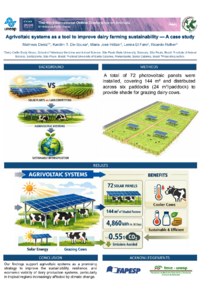
This case study aimed to discuss agrivoltaic systems, advocating that this approach can serve as a tool for the sustainable intensification of dairy farming. Solar power plants generally require extensive land areas and are positioned close to the ground surface, preventing the land from being used for other productive activities. In contrast, installing photovoltaic panels on rooftops or carports can be considered a zero-space-occupying strategy, as they optimize land use by fulfilling dual functions. This concept can be extended to agriculture, leading to increasing interest in agrivoltaic systems (AVSs). AVSs represent an innovative approach that integrates photovoltaic energy generation with crop and/or livestock production in the same area. In our system, a total of 72 photovoltaic panels were installed, covering 144 m² and distributed across six paddocks (24 m²/paddock) to provide shade for grazing dairy cows. In the first 30 days of operation (26th October - 26th November/2025), the AVS generated 4,860 kWh of energy, which corresponds to 0.55 t of CO₂ emissions avoided, directly contributing to lowering the carbon footprint of milk production. Agrivoltaic systems optimize land use, enhance sustainable intensification, and have broad social acceptance. In dairy farming, installing photovoltaic panels in pasture areas not only produces clean energy by intercepting part of the solar radiation but may also improve the thermal environment for cows, offering behavioral, productivity, and welfare benefits. These findings support agrivoltaic systems as a promising strategy to improve the sustainability, resilience, and economic viability of dairy production systems, particularly in tropical regions increasingly affected by climate change.
Keywords
dairy farming
photovoltaic panels
sustainability
Poster
Pôster_IOCAN_MD.pdf
Gender effects in Brazilian livestock advisors’ management practice recommendations regarding dairy cattle welfare: a preliminary study
Beef-on-dairy and Holstein Calves: should we mix or keep them separate? Behavioral impacts of Breed and Pair composition during the preweaning phase